
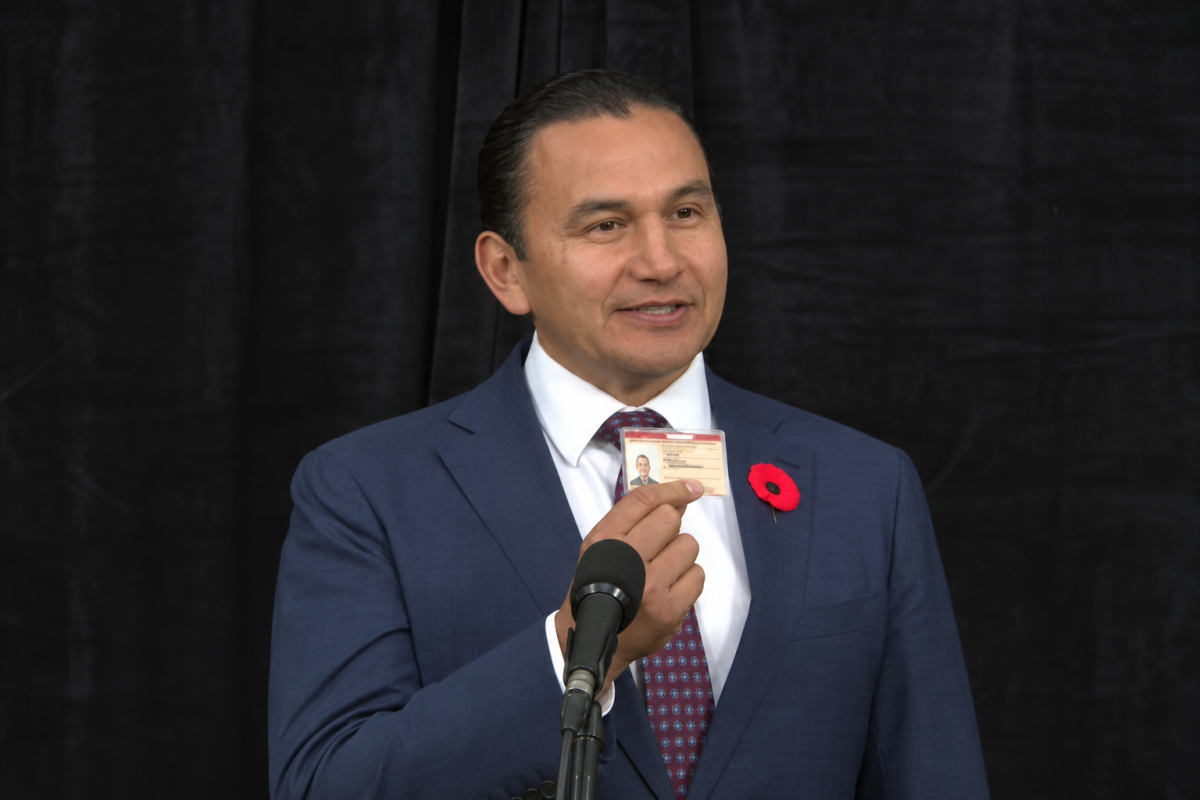
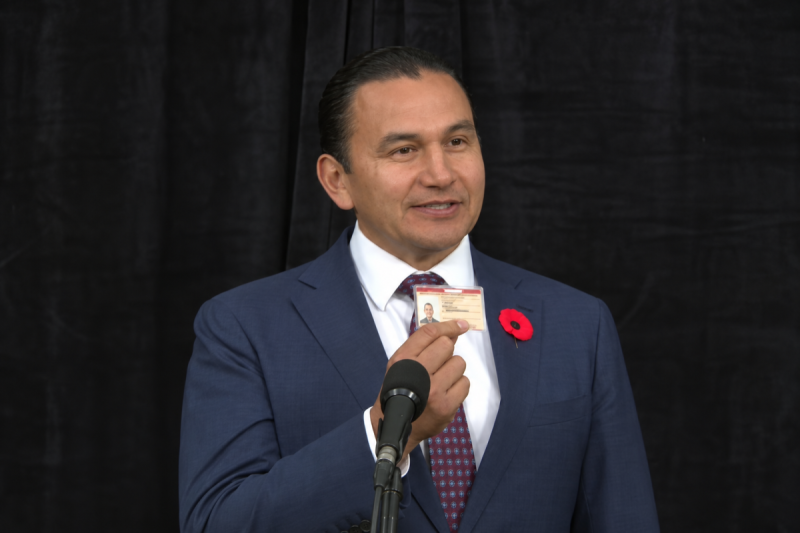
Manitoba Premier Wab Kinew holds up his First Nations status card during a press conference at the First Nations-First Ministers Meeting in Ottawa, October 26, 2026.
Of all the political leaders one would expect to revive Pierre Trudeau’s disastrous 1969 proposal to abolish the Indian Act, Manitoba Premier Wab Kinew is not one of them. There is something deeply troubling about a provincial premier calling for the repeal of the act, promising that First Nations have “nothing to lose but their chains”—a ham-fisted reference to Marx—by tearing up a law that, while colonial, outdated, and paternalistic recognizes the special status of First Nations and protects their reserve lands from the provinces.
At the recent First Nations-First Ministers meeting in Ottawa, Kinew held up his Indian status card, called it a “race-based” form of identification and said, “I think it’s time to abolish the Indian Act.” Just like that, his political grandstanding usurped the voices of the chiefs and redirected the national conversation away from the urgent issues facing First Nations communities. As a former broadcaster and journalist with extensive media experience, he should have known better. First Nations leaders have since pushed back, with Grand Chief Stewart Phillip describing Kinew’s comments as “highly inappropriate and completely disrespectful.”
One has to wonder whether this call to eliminate the Indian Act would have been so well received if the premier of Québec or Alberta had made it. While Kinew is an Anishinaabe member of Onigaming First Nation, he is not a chief, nor is he mandated to advance First Nations priorities. This proposition came from the premier of Manitoba, and we must assess it in the context of his government’s priorities—particularly its support for resource extraction.
Kinew has been a staunch proponent of mines and pipelines, even suggesting that not all laws regulating the mining industry are necessary. Manitoba’s economic agenda mirrors those of other jurisdictions that have recently moved to fast-track major energy projects and resource extraction. These efforts include Alberta’s Expedited 120-Day Approvals Act, Ontario’s Building Ontario Faster Act, British Columbia’s Infrastructure Projects Act, and the federal government’s highly controversial Building Canada Strong Act. First Nations have raised concerns that such legislation will not only circumvent important environmental protections but also permit breaches of their constitutionally protected Aboriginal, treaty, and land rights.
While Kinew has always advocated respect for First Nations rights, his call to abolish the Indian Act is set within the historical context of various federal governments making the same appeal when they wanted to speed up resource extraction.
Wab Kinew: “Let’s get rid of the Indian Act. You have nothing to lose but your chains.” https://t.co/q3LRXVLlMt
— Scott Robertson (@sarobertson_) October 26, 2026
Former Prime Minister Pierre Trudeau’s economic agenda included oil and gas exploration, pipeline construction, and resource extraction. His goal was to make Canada self-sufficient in petroleum—not unlike Carney’s current push for energy independence. First Nations, however, were viewed as an impediment to unfettered resource extraction on their territories. In 1969, Trudeau’s government released the White Paper on Indian Policy, which planned for the repeal of the Indian Act to eliminate the legal distinctions between First Nations people and other Canadians. It also called for ending treaties, transferring jurisdiction over First Nations to the provinces, and opening reserve lands for resource development to “bring Indians into a closer working relationship with the business community.”
Not surprisingly, the White Paper was resoundingly rejected by First Nations, who responded with their own policy papers—including the Red Paper and Wahbung—saying the treaties were staying, the Indian Act would not be repealed or amended without their consent, and legislative recognition of their special status under the act would ensure the federal government could not escape its constitutional and treaty obligations to First Nations.
Former Prime Minister Stephen Harper’s Conservative government not only made oil and gas extraction, pipeline construction, and mining central economic priorities but also made numerous legislative amendments to fast-track projects. In 2012, the Harper government repealed and replaced the Canadian Environmental Assessment Act to reduce the number of projects subject to federal assessment; narrowed habitat protection in the Fisheries Act; removed many lakes and rivers from federal approval systems; reduced species-at-risk protections; and repealed the Kyoto Protocol Implementation Act.
At the same time, the Conservatives also passed the Indian Act Amendment and Replacement Act to “unlock the economic development potential of First Nation communities.” The “abolish the Indian Act” refrain was hauled out yet again.
These calls have long served as a political distraction from more pressing First Nations priorities. Kinew himself once made this argument. Testifying before a parliamentary committee in 2013, he warned that “tinkering around the edges” of the act distracted from the more urgent work of honouring treaties and respecting Aboriginal title. He urged meaningful consultation with First Nations before any replacement legislation was introduced and recommended that the bill to repeal the act be withdrawn. As his committee testimony shows, Kinew understood the danger of allowing pleas to replace the Indian Act to overshadow First Nations’ priorities. What has changed?
Taken together with ongoing breaches of First Nations rights and environmental harms from resource development, Harper’s legislative acts helped spark the 2012-2013 Idle No More movement, one of the largest and longest Indigenous protest movements in Canada’s history. It should be no surprise, then, that after Idle No More, former Aboriginal Affairs Minister Bernard Valcourt told Parliament in 2014 that “rogue chiefs” were threatening the security of Canadians. The Harper government subsequently passed anti-terrorism legislation that expanded surveillance powers and restricted freedom of expression, which many experts feared would capture First Nations actions to protect their territories.
It’s clear that successive governments have used the call to abolish the Indian Act as an attempt to either distract the public from the real issues related to First Nations resistance to resource extraction or to remove First Nations politically from the equation.
During former Prime Minister Justin Trudeau’s term, the Liberal Party passed a resolution acknowledging that its introduction of the White Paper in 1969, which sought to abolish the Indian Act and end the nation-to-nation relationship, “was a serious mistake” and pledging not to repeat the mistakes of the past. The goal seemed to be respecting First Nations rights, renewing the nation-to-nation relationship, and ending the top-down approach. These goals were short-lived when First Nations land defenders and water protectors opposed the Trans Mountain pipeline. Trudeau bought the pipeline and claimed that the project was in the national interest. Then, as expected, Trudeau said: “We want to get past the Indian Act, which is a colonial relic.”
While Trudeau said moving past the Indian Act had to happen in step with First Nations, history has shown us that has never been the case.
None of this means First Nations like the Indian Act. It has been in place since 1876 and has resulted in government control over First Nations lives from birth to death. It replaced traditional governments with the chief and council system, made attendance at residential schools mandatory, designed a legal recognition system that treated First Nations as one race of people instead of respecting their sovereign status as nations, and removed thousands of First Nations women and children from their communities through decades of sex discrimination in Indian status. Most First Nations want discriminatory provisions, like the second-generation cut-off rule, removed, and other parts of the act amended to better suit First Nations objectives. Some First Nations want to negotiate their way out of the act through self-government agreements where they control the fate of their nations. Some already have.
What we do know is that, despite Kinew’s remarks, which may give the impression that abolishing the Indian Act is an easy or quick process, it cannot and will not be repealed anytime soon. Self-government agreements can take decades to negotiate and finalize. Many First Nations have enacted by-laws, codes, and other laws under the act that govern their communities. Some parcels of reserve lands are subject to 99-year lease agreements with businesses, and some have been allotted to individual First Nation members. First Nations businesses operate on reserves with certain protections afforded by the act, like tax exemptions and First Nation-specific laws. Some self-government agreements even retain certain Indian Act provisions. A whole suite of federal legislation is directly tied to the act and can’t be easily separated. That does not include some of the historic treaties that created reserves subsequently protected from provincial jurisdiction and private seizures.
Abolishing the Indian Act would not address breaches of First Nations’ Aboriginal, treaty, and land rights, such as Mi’kmaw fishing rights in the Maritimes; unresolved legal issues related to the Natural Resources Transfer Agreements in the Prairies; unfulfilled Treaty Land Entitlements and hundreds of outstanding land claims; or failures to respect First Nations’ right to free, prior, and informed consent before projects take place on their territories. Nor would it resolve questions of revenue sharing beyond natural resources, including tax revenues; climate change-induced crises such as wildfires, flooding, droughts, and shoreline erosion; or the need for rights- and needs-based funding for social programs. It would do nothing on its own to end the foster care crisis, the crisis of missing and murdered Indigenous women and girls, the overincarceration of First Nations people, unsafe drinking water on reserves, or systemic racism in health care, policing, and education.
First Nations leaders had significant and urgent issues to raise at the First Ministers meeting, none of which prioritized abolishing the Indian Act. You won’t even find abolishment on the Assembly of First Nations’ priority list. While Kinew’s comments were likely well-intentioned (none of us like the Indian Act), as premier he spoke for Manitoba and distracted the country’s attention from First Nations leaders’ urgent priorities.
Prime Minister Mark Carney, meanwhile, has a responsibility to engage directly and meaningfully with First Nations, rather than allowing provincial premiers to set the agenda. Perhaps Kinew’s intervention will pressure him to do just that. But any discussion of the Indian Act’s future must begin with First Nations themselves, their rights, and the issues their leaders have been raising all along.
Pam Palmater is a Mi’kmaw citizen and member of the Eel River Bar First Nation in northern New Brunswick. She is a longtime CD columnist, and has been a practicing lawyer for 27 years. Currently, Pam is a professor and the chair in Indigenous governance at Toronto Metropolitan University.
We Need Your Help
More than 75% of our operating budget comes to us in the form of donations from our readers. These donations help to pay our bills, and honorariums for some of our writers, photographers and graphic artists. Our supporters are part of everything we do.