
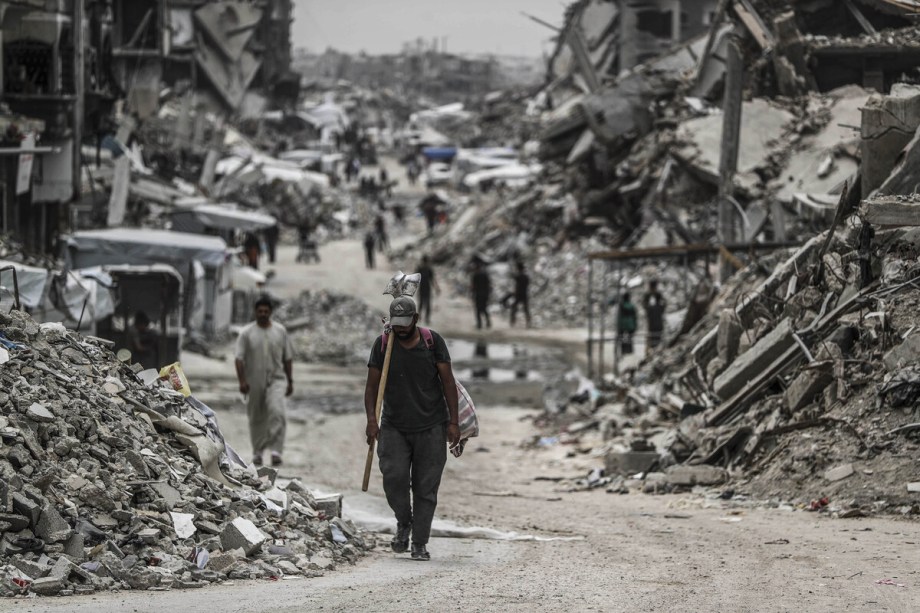
The latest war on the Gaza Strip has once again left the besieged enclave on the brink of collapse. Yet, beyond the familiar scenes of physical devastation, this round of conflict poses deeper, existential questions about Gaza’s trajectory and its place in the future of Palestinian politics and the wider Middle East. The destruction is not limited to neighbourhoods reduced to rubble or thousands of lives lost; it has also deepened a humanitarian crisis, complicated the Palestinian political landscape, and reshaped the regional debate.
The scale of the humanitarian disaster in Gaza defies description. Beyond the loss of life, the war has displaced hundreds of thousands of people, many of whom are living in temporary shelters with little to no access to clean water, electricity, or healthcare. Gaza’s already fragile healthcare system, long strained under the blockade, has reached a point of near collapse. Hospitals have been bombed, medical supplies are scarce, and doctors are forced to make impossible choices. Food insecurity has become a permanent condition, with the majority of Gazans now dependent on humanitarian relief. This situation is not merely a temporary crisis; it is an enduring reality.
The war has exacerbated the deep-seated divisions within Palestinian politics. The rivalry between Hamas and Fatah remains unresolved, and attempts at reconciliation have stalled. For Hamas, mere survival and continued control over Gaza are framed as victories. Meanwhile, the marginalisation of the Palestinian Authority in the post-war landscape has further eroded its legitimacy. Israel, for its part, appears determined to maintain a system of control that prevents any unified Palestinian leadership from emerging. Proposals for a “buffer zone,” tighter restrictions, and politically conditioned aid are all aimed at entrenching division and weakening Palestinian political cohesion. Without genuine reconciliation, Palestinians risk a post-war order where Gaza remains isolated while the West Bank drifts under expanding settlement activity.
READ: UN says 95% of recent displacements in Gaza are from Gaza City
The cycle of unfulfilled reconstruction promises is now painfully familiar. While international donors pledge billions, very little is delivered on the ground. The Israeli and Egyptian blockade hinders the import of essential construction materials, while donors often attach political conditions that delay or block aid. Reconstruction has been transformed from a humanitarian necessity into a political bargaining chip. Israel leverages its control over Gaza’s borders to dictate the pace and scope of rebuilding, while donors use aid commitments to pressure Hamas and the PA. This politicisation leaves ordinary Gazans in limbo, living among ruins while their future is negotiated in distant capitals. The danger is that Gaza may never be fully rebuilt, but rather kept in a state of “managed devastation,” repaired just enough to avoid total collapse, yet never restored to dignity and normalcy.
The war has once again highlighted Gaza’s centrality in regional politics. Egypt has positioned itself as the indispensable mediator, while Qatar continues to play a critical role through financial aid and communication with Hamas. Turkey and Iran view Gaza as a stage to project influence and challenge Israeli power. Western governments, particularly the US and EU, have repeated familiar talking points, yet the gap between rhetoric and reality is striking. Western pressure has not meaningfully altered Israel’s conduct or produced a credible pathway to addressing the root causes of the conflict. At the same time, global solidarity movements have grown stronger, challenging the impunity long enjoyed by Israel.
Gaza stands at a crossroads. One path leads to continued devastation: a partially rebuilt enclave, politically divided, and subjected to periodic military assaults. This is the trajectory Israel seems determined to maintain, supported by a global order unwilling to confront underlying injustices. The other path, however faint, offers the possibility of a different future. This would require lifting the blockade, supporting genuine Palestinian reconciliation, and prioritizing reconstruction without political conditions. It would also require the international community to move beyond crisis management toward addressing structural realities.
The resilience of Gaza’s people should not be underestimated. Time and again, they have rebuilt their lives and preserved their identity. But resilience alone cannot substitute for justice. Without political change, it risks becoming a euphemism for survival under endless siege.
In the end, what happens in Gaza will not stay in Gaza. The enclave’s fate will shape the Palestinian national movement, test the credibility of regional powers, and expose the limits of the international order. Whether Gaza’s ruins become the foundation of renewal or the symbol of a broken status quo depends on choices made today—not only in Gaza and Israel, but in capitals across the world.
OPINION: The evolving face of apartheid: How Israel’s policies institutionalise Palestinian displacement
The views expressed in this article belong to the author and do not necessarily reflect the editorial policy of Middle East Monitor.