
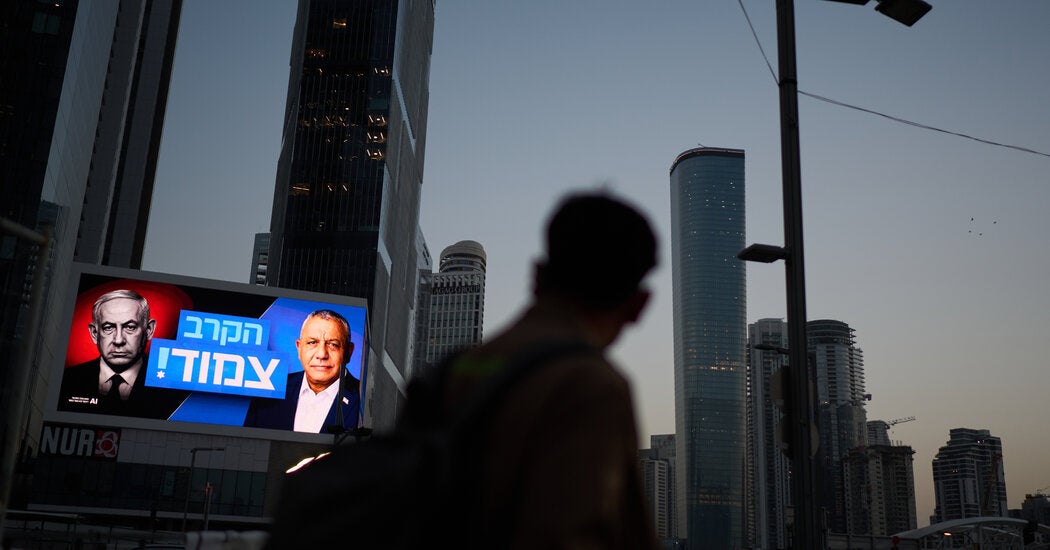
This week, Israeli party leaders will trickle into the residence of President Isaac Herzog to officially recommend their pick for Israel’s next prime minister following the inconclusive election last Tuesday.
In two days of livestreamed meetings set to begin on Wednesday, politicians from 11 parties, including those representing secular liberals, ultra-Orthodox Jews and Arab voters, will make their case to Mr. Herzog. He will then bestow the mandate to build a coalition on whichever candidate he deems the most viable, who will have up to six weeks to form a government.
Most party leaders are expected to back either Prime Minister Benjamin Netanyahu, the longtime right-wing leader, or his main rival, the center-right politician Gadi Eisenkot. Neither man’s party won a clear 61-seat majority in balloting for the 120-member Parliament, most likely meaning that weeks or months of negotiations among the parties and elected lawmakers lie ahead.
Behind the scenes, politicians are weighing the path forward and wrangling for the upper hand. With no one having emerged from the election with a decisive victory, Mr. Netanyahu, Mr. Eisenkot and the rest are left to cajole and squeeze opponents and would-be allies alike.
“It’s a game of chicken,” said Nevo Cohen, a political strategist who ran the 2022 election campaign for the far-right national security minister, Itamar Ben-Gvir.
Mr. Netanyahu has long exercised a tight grip over his bloc of conservative and religious parties. But some could always bolt — potentially, ultra-Orthodox or more moderate right-wingers in his own Likud faction — in exchange for influence in an Eisenkot-led government, political analysts said.
Mr. Eisenkot could also look to form a government by relying on Arab parties that have long sat on the sidelines of Israeli politics, or by partnering with Mr. Netanyahu to form a unity government. Either option would be tricky because some of his allies promised on the campaign trail never to work with Mr. Netanyahu, or with Arab lawmakers to form a government.
On Monday, Avigdor Liberman, a key figure in the opposition bloc, said he would recommend Mr. Eisenkot for prime minister. But he reiterated his longstanding vow not to share power with Mr. Netanyahu or serve in a minority government with Arab parties, further complicating matters for Mr. Eisenkot.
All the parties “are checking their internal situation to see how much room they have to maneuver,” said Lior Chorev, a political strategist who worked on former Prime Minister Naftali Bennett’s campaign, which picked up 12 seats in Parliament last week. “They want to know how far they can go.”
After the last election in 2022, Mr. Netanyahu swept to power with a 64-seat majority, allowing him to establish the most far-right government in Israel’s history. This time, the calculations are considerably more complex. Mr. Netanyahu and his allies’ majority dropped to 53 seats in Parliament, while Mr. Eisenkot’s opposition bloc garnered 48 seats.
Surging turnout among Israel’s Arab citizens also helped to deliver a historic result for the two main Arab-led parties — now potential kingmakers, with 19 seats between them — even as many Jewish Israelis reject the idea of a coalition government that includes them.
An Israeli opposition official, who spoke on the condition of anonymity to discuss private negotiations, said that party leaders were feeling out one another’s red lines. These leaders were also drawing up legislative plans for when Israel’s Parliament, the Knesset, is sworn in this week, the official said.
While the coalition talks lurch onward, the Israeli opposition could take over the Parliament by appointing a new speaker. Mr. Eisenkot and his allies could then threaten to begin passing laws antithetical to Mr. Netanyahu and his coalition, turning up the pressure in the talks.
The coalition talks will be extraordinarily sensitive because if no one can make a government, Israel will head to yet another round of elections, said Izhar Shay, a former centrist lawmaker.
“The parties are negotiating — but in reality, they’re still campaigning, because this might turn into an election campaign in just a few months,” said Mr. Shay. “So they’re being cautious about what they say, because it could hurt them in elections which might be in four months, rather than four years.”
Mr. Netanyahu could have the most to gain from rolling the dice in a new election. As it stands, he remains prime minister until a new government can be formed, meaning he would stay in power for months if a new election were called. And political analysts say he could have better odds in a second round of voting.
That heaps pressure on Mr. Eisenkot to form a coalition.
Some of Mr. Eisenkot’s voters say that, despite their loathing for Israel’s longest-serving prime minister, joining with Mr. Netanyahu might make the most sense, as it would keep the ultra-Orthodox and Arab parties out of power. Such an arrangement is not without risk: Mr. Netanyahu has walked away from political agreements before when they no longer served him.
In 2020, a unity government between Mr. Netanyahu and Benny Gantz, a centrist opposition leader, collapsed after less than a year of power sharing. Under their coalition agreement, Mr. Netanyahu was supposed to yield the prime minister’s seat to Mr. Gantz, but instead he dissolved the Knesset and called new elections.
“We thought we were doing the right thing, and in the end Netanyahu cheated us,” said Mr. Shay, a lawmaker in Mr. Gantz’s party at the time.
Mr. Eisenkot’s other route is to form a minority government with the Arab parties, particularly the pragmatic Raam party, which got eight seats. The Joint List, which netted 11 seats, is unlikely to join his governing coalition, but it could block a no-confidence vote against the coalition in the Knesset, allowing him to form a minority government with fewer than 61 seats.
Joining forces with Arab parties has become a more difficult proposition since the Oct. 7, 2023, Hamas-led attacks on Israel, which led to a rightward shift in the country’s politics. On Monday, Mr. Liberman — whose Yisrael Beiteinu party commands seven seats — declared that he would not join such a minority government, although he left the door open to other possibilities.
Further complicating matters, Mr. Netanyahu has accused Arab citizens of engaging in widespread electoral fraud and “stealing the election.” Israeli electoral officials have repeatedly said that there was no indication of systematic interference in the vote.
Analysts say Mr. Netanyahu’s racially charged campaign aims to further discredit any attempt by Mr. Eisenkot to engage Arab parties as partners.
“That’s the only scenario that Netanyahu is afraid of, so he’s trying to do things that will make a minority government impossible,” said Michael Koplow, an expert at the Israel Policy Forum, a research group.
An incident that surfaced Thursday gave Mr. Netanyahu an opening to cast doubt on the legitimacy of the high Arab vote.
Noam Sohlberg, the Supreme Court justice overseeing the country’s elections committee, said in a letter that he had seen intelligence indicating potential “improper influence through foreign funding” in the elections. He did not elaborate and said he “could not attest to the veracity of the suspicions.” He nevertheless sent a letter telling the head of Shin Bet, Israel’s domestic security agency, to investigate.
The Likud party quickly issued a statement saying that the Arab parties had “stolen the elections in Israel.” The party incorrectly cited Mr. Sohlberg’s letter to Shin Bet, falsely saying it had reported that “foreign officials have bribed voters on behalf of the Arab parties.”
Three days later, Mr. Sohlberg issued a clarification, saying that there was no reason to “call into question the votes cast by Arab citizens.” But the claim that Arab parties had tainted the elections had already become a right-wing talking point, with the Likud saying that a “black cloud” hung over the vote.
On Wednesday, the Israeli Central Elections Committee is expected to meet to certify the official results by a vote. The far-right Jewish Power party, which is part of Mr. Netanyahu’s coalition, has already said in a statement that it will refuse to do so, though it holds just two of the 34 votes in the committee’s general assembly.
Heedo Abu Laban contributed reporting from Modiin, Israel.