

The Democratic takeover gives opponents of the war greater influence over military spending, congressional investigations and legislation restricting presidential authority. Yet it also creates a nearly two-month period in which Trump can pursue military objectives before lawmakers assume their new positions on January 3.
The possibility that electoral defeat could encourage further military action emerged in assessments by foreign policy specialists and analysts interviewed by Iran International on Tuesday.
“We can expect Trump to carry out a major military operation, perhaps even more intense than what he would have undertaken had he retained control of Congress,” international relations analyst Fereshteh Pezeshk told Iran International.
Pezeshk argued that Trump could seek to demonstrate his authority and influence the media narrative following Republican losses. She said the incoming Congress might delay military funding or create other obstacles, but would have limited power to restrain the president, who would remain commander-in-chief after January 3.
Trump acknowledged the economic impact of the Iran war after the Republican defeat but rejected the suggestion that voters opposed the military campaign itself.
“I don’t think it’s the war. I think it’s a gasoline price. People agree with what I’m doing on Iran, but they really probably weren’t willing to do the short-term consequence of paying more for gasoline,” Trump told Fox News.
The president nevertheless defended his Iran policy.
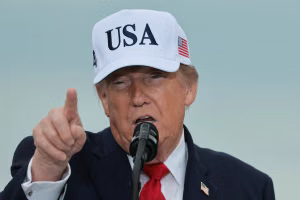 Trump says Iran war decision serves long-term US interests despite election setbacks
“I am totally convinced that my decision on Iran for the long term good of our country and even the world was absolutely the correct one and it continues to be,” Trump told Politico.
Could defeat encourage a bigger offensive?
The administration was preparing a major new offensive against Iran before the midterms, and the election result could strengthen Trump’s incentive to proceed during the transition period, Barbara Slavin, a distinguished fellow at the Stimson Center, wrote on November 2.
Slavin identified reopening the Strait of Hormuz and securing Iran’s stockpile of highly enriched uranium as possible objectives.
But she said that renewed attacks could expose American allies in the Persian Gulf to further Iranian retaliation, increase energy costs and cause extensive destruction without achieving Washington’s goals.
A military escalation could also offer Trump a way to seek a decisive outcome before Democrats acquire greater oversight powers.
Trump’s calculations differ from those of conventional presidents because he places considerable weight on his personal political achievements, journalist and political analyst Omid Memarian told Iran International.
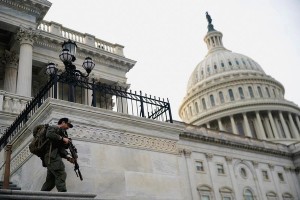
 A person walks near the US Capitol building during the US midterm elections, in Washington, DC, US, November 3, 2026.
“Trump is an unconventional president whose calculations of costs and benefits are very different from those of other politicians and former presidents,” Memarian said.
He argued that the president could use the period before January to launch a concentrated military operation, weaken Iran’s military or nuclear capabilities, declare victory and then seek negotiations or reduce American involvement.
“I think it may even have increased the likelihood of an attack,” Memarian said.
A Democratic Congress would make managing the war more difficult through investigations, committee hearings and scrutiny of military decisions, Memarian said. That could increase Trump’s incentive to seek a faster conclusion rather than simply abandon military options.
The possibility has a historical parallel. After Republicans lost the 2006 midterm elections, President George W. Bush increased US troop deployments to Iraq the following year despite mounting public opposition to the conflict.
That precedent does not establish what Trump will do, but it illustrates why an electoral defeat need not produce an immediate reduction in military operations.
How much power will Democrats have?
Control of Congress gives Democrats substantial legislative and budgetary authority, but the president remains commander-in-chief.
Congress can investigate the administration, restrict appropriations and pass legislation addressing military operations. Trump, however, can veto restrictive legislation, requiring two-thirds majorities in both chambers to override him.
 Trump’s Iran escalation fuels Senate clash over war powers
“Even if Democrats hold a majority in both houses, their influence will be limited to the legislative and political tools of Congress,” former national security adviser John Bolton told Deutsche Welle.
Democrats have already sought to use Congress’s financial authority against the war.
Senator Tim Kaine, who has repeatedly challenged Trump’s military operations without congressional authorization, pledged in August to continue efforts to cut off funding.
“I’m going to keep doing all that I can to cut off funding for what will go down in history as one of America’s most foolish foreign policy catastrophes of all time,” Kaine said in an official statement.
Other Democrats, including Senator Chris Coons, have distinguished between replenishing American military stockpiles and financing operations that would effectively extend the conflict.
Yet restricting funding may become politically harder if Trump orders a major offensive before January.
Democrats could inherit responsibility for decisions about supplying American troops already engaged in combat, political analyst Morad Veisi said. Opposing the war would not necessarily make lawmakers willing to withhold resources from deployed forces.
Could Trump pursue the Islamic Republic’s downfall?
The possible objectives of further military action remain a major point of disagreement among analysts interviewed by Iran International.
Trump could regard the remainder of his presidency as an opportunity to secure a historic legacy, potentially including military action contributing to the Islamic Republic’s downfall, Veisi said.
“I think Trump could leave behind a political legacy by helping bring about the downfall of the Islamic Republic. I’m not saying he will definitely do it, but it would be consistent with his character, and he has 60 days,” Veisi said.
Veisi linked that possibility to what he described as Israel’s increasingly explicit pursuit of the Islamic Republic’s removal. He argued that Trump might support a broader campaign if he believed it could deliver a defining political achievement.
The analyst also suggested that an expanded conflict launched before January could leave incoming Democrats confronting military commitments they would find difficult to reverse.
Pezeshk offered a different assessment, distinguishing between forcing the Islamic Republic to submit to American demands and deliberately seeking its overthrow.
“We still do not see evidence that Trump is taking steps that would lead us to conclude he intends to overthrow the Islamic Republic rather than force it to submit,” Pezeshk told Iran International.
 Democrats seize on Iran war costs to hit Trump ahead of midterms
She argued that Trump appeared more attracted to a Venezuela-style approach than an Iraq-style intervention involving prolonged American responsibility for political reconstruction.
She also questioned whether Washington had a clear plan for replacing Iran’s governing institutions.
Could Tehran misread the election?
Iranian parliament speaker Mohammad Bagher Ghalibaf portrayed the election result as a rejection of the war and warned Washington against disregarding what he described as the will of American voters.
“Conscience or the cost of living, Americans said NO TO WAR, and we endorse this message,” Ghalibaf wrote on X.
“If the US govt betrays their public will to serve international paymasters and blackmailers, it will learn our NO comes with a Nightmare,” he added.
Ghalibaf’s message combined his interpretation of the election with a warning of consequences if Washington continued its military campaign.
But the shift in congressional control does not necessarily signal a corresponding change in Washington’s strategic objectives.
Iranian leaders should not mistake political divisions in Washington for a weakening of American power, Washington-based national security specialist Amir Hamidi told Iran International.
“President Trump may lose his congressional majority, but he has not lost his presidential authority. An electoral defeat for one party is not a defeat of America’s national power,” Hamidi said.
 Iran wrong to expect midterms to restrain Trump, former US official says
Hamidi added that the Islamic Republic could pay a heavy price for misreading the election result, arguing that the US president remains commander-in-chief and retains significant authority over diplomacy and crisis management.
Congressional oversight of military operations and war spending could increase under Democratic control, but that would not necessarily diminish US deterrence or its longstanding security commitments, Hamidi said.
A narrowing window before January
The Democratic victory may have changed the political timetable for the Iran war without changing who controls its immediate course.
Until the new Congress takes office on January 3, Trump retains the authority to make military decisions that could shape the conflict well beyond the transition period. A major offensive during those weeks could leave incoming lawmakers confronting decisions already made and military commitments difficult to reverse.
The election result also presents a question for the Islamic Republic: whether Washington’s domestic political divisions will translate into restraint or whether an approaching deadline could encourage further military action.
The coming weeks may therefore matter more than the new balance of power in Congress. A vote intended to change the direction of American politics could precede a decisive turn in a war that the incoming lawmakers have yet to gain the power to influence.