

Fitz: All right, here’s a question I never thought I’d find myself asking. Tell me about the clitoris of the Great Ape that’s upending Darwin’s theory of evolution?
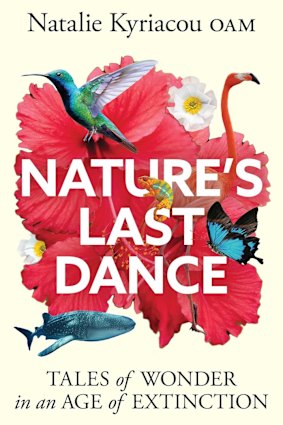
Nature’s Last Dance: Tales of Wonder in an Age of Extinction by Natalie KyriacouCredit:
NK: Well, a bunch of female scientists have been studying the clitoris of the bonobo, which is a great ape. Bonobos look a lot like chimps, but socially, they’re very different; while chimp societies are violent (individuals will tear each other to shreds), bonobos are remarkably peaceful. So these scientists discovered that bonobo females rub their clitorises together to enhance their bonds with one another. And this behaviour has become so beneficial to the species that bonobos have evolved giant clitorises.
Fitz: Lesbian great apes?
NK: It’s not sexual, it’s friendship.
Fitz: Gee. I wish I had a friend like that, but go on.
NK: To put it bluntly, female bonobos rub their clitorises together and overthrow the patriarchy. And the result is that bonobos live in a very peaceful society. Evolutionarily speaking, clitoral rubbing among females (bonobos, that is) offers a genuine advantage to the entire species, by strengthening social cohesion.
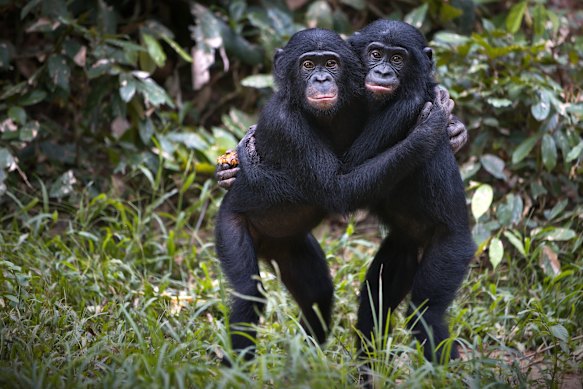
Bonobo apes hug in the Democratic Republic of the Congo wilderness.Credit: Getty Images/iStockphoto
Fitz: And Charles Darwin in this?
NK: Well, it’s highlighted some of the hidden sexism in Charles Darwin’s theory of evolution. Darwin, brilliant though he was, was a product of Victorian society, which deemed women inferior. He likened female animals to “wives” and claimed males were “superior to females”. Unfortunately, these biases shaped his theories: he focused almost exclusively on males, portraying them as dominant and courageous, while largely ignoring females because he deemed them to be passive and weak.
That’s why so many modern narratives about men being like dominant wolves are built on warped understandings of evolution. In reality, nature is full of surprises: in seahorses, males carry the babies; in spotted hyenas, females are the aggressors; in lions, females hunt and are central to pride survival. In fact, less than 10 per cent of research studies are even focused on the female of a species. Most research is on males of a species.
And this is why the bonobo clitoris is so powerful. By studying the bonobos clitoris and the snake’s clitoris and various other species, we’re actually discovering how varied and diverse species are, and all the incredible behaviours are represented across male and females.
Fitz: We’re wandering into sensitive areas of sexual and gender politics – and if it blows up, I am going to say it’s all your fault and you made me do it. But if you accept that one species rubbing their clitorises with each other is making their society stronger, does that – as a serious question – argue for the virtues of militant lesbians in human society? As in, “we don’t need men, we don’t need your damn patriarchy, so naff off and stop spending so much money on guns and tanks while you’re at it, you dickheads!”?
Loading
NK: I don’t think it needs to be political. Truly, we don’t need to make a bonobo clitoris political. It’s simply about recognising that society – human or otherwise – isn’t limited to one type of role or behaviour. Across species, different individuals play different roles, and they all matter. It’s also a reminder that we have centred the traits of a small number of male species and based our whole understanding of humanity on that. Which probably isn’t wise. And it’s also limiting for men. So it’s more about recognising that species have a whole range of behaviours that are beneficial to species survival – and the point isn’t to be the most dominant, because often evolution actually favours those that can form a cohesive society to ensure a species can thrive.
Fitz: OK, moving on. Why did the scientist build a helmet to get her head humped by a flightless bird, and how can this save the species?
NK: So the kākāpō is a critically endangered bird from New Zealand. It is the world’s heaviest parrot and is also the only parrot in the world that cannot fly. There’s under 250 of them left in the wild, and they face a few reproductive challenges, one of which is that the male parrots sometimes try to mate with human heads and inanimate objects. You see, their mating ritual isn’t overly advanced. The men waddle up a hill together, dig a hole and start bellowing into it with the hope that the female kākāpō will be irresistibly drawn to them.
Fitz: This is sounding a tad familiar, but go on.
NK: Unfortunately, the females aren’t often interested in this particular brand of male romance. So the males end up often mating with … other things.
Fitz: Couldn’t they try rubbing their penises with each other, like normal beings?
NK: [Laughing] Maybe they could try that! There was actually a YouTube video that went viral because a kākāpō named Sirocco started humping a BBC presenter’s head, launching him to international fame. Anyway, as we know, the kākāpō struggles to reproduce and is critically endangered. So a scientist called Kate McInnes developed an unusual scientific innovation to help the parrot reproduce. She went out and bought a rugby helmet and then sat in her backyard and repurposed it into an ejaculation helmet.
Fitz: Wait! Excuse me. Dare I ask how – and I am so glad I didn’t know this 40 years ago – one turns a rugby helmet into an “ejaculation helmet”?
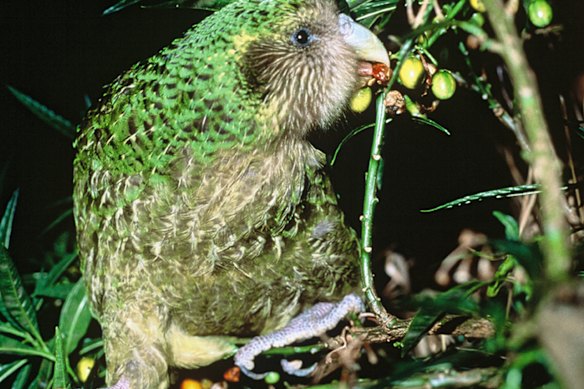
The kakapo, a flightless parrot, is critically endangered.Credit: AP
NK: She put divots in it, so it was like she had a hat of condoms designed to collect the sperm of the parrot.
Fitz: [Uncertainly] Yes …
NK: McInnes set off into the forest wearing her homemade rugby ejaculation helmet and waited for the kākāpō to come and hump her head.
Fitz: As you do.
NK: And it did. For three nights in a row, McInnes sat in the forest with a helmet on her head getting bonked by the world’s heaviest parrot. Unfortunately, the kākāpō mates for quite a long time, so this went on for hours on end.
Fitz: Not that there’s anything wrong with that.
NK: Unfortunately, the helmet didn’t work. Not a drop of semen was produced.
Fitz: And so to my favourite story. Tell us about Barnaby Joyce once trying to give herpes to a species of fish.
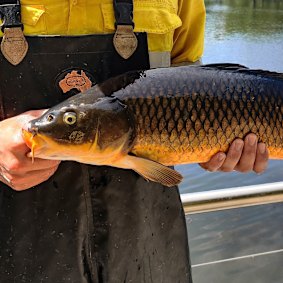
A carp removed from a Perth wetland.Credit: Wetland Research and Management
NK: In 2016, Australia’s then deputy prime minister, the Honorable Barnaby Joyce, declared that he wanted to give herpes to a freshwater fish. The fish was a carp, an invasive species of fish that wreaks havoc on the Australian river ecosystem. In a passionate parliamentary speech, he proclaimed, “We are afflicted in this nation with these disgusting, mud-sucking creatures … for which the only form of control is a version of herpes”. Essentially, he wanted to give herpes to the fish. And, as I said in my book, it wasn’t clear whether the Deputy PM would be directly facilitating the transmission of herpes, but his speech did actually prompt a $15 million investment from the Australian government. See, carp have orgies. So Barnaby thought that if a gathering of carp were in the throes of love making, then that would provide the ideal venue for the mass transmission of herpes. And herpes is deadly to carp, so that meant, theoretically, their populations would reduce through herpes.
Fitz: Have any carp since been spotted nipping into their local doctor’s office with false wigs and sunglasses, to complain that it burns when they urinate?
NK: Not yet! And despite Barnaby’s passion, carp numbers have actually increased. Which had me wondering in my book: if the deputy prime minister can’t give a fish herpes, what hope do we have for mobilising effective political action for nature?
Fitz: Well, congratulations on the book. I enjoyed it. I’ve heard whispers that there might be something in the works for documentaries or TV. Is that true?
NK: Yes, if everything falls into place!
Fitz: In that case, you’re a good chance of going global. Good luck!
Twitter: @Peter_Fitz