
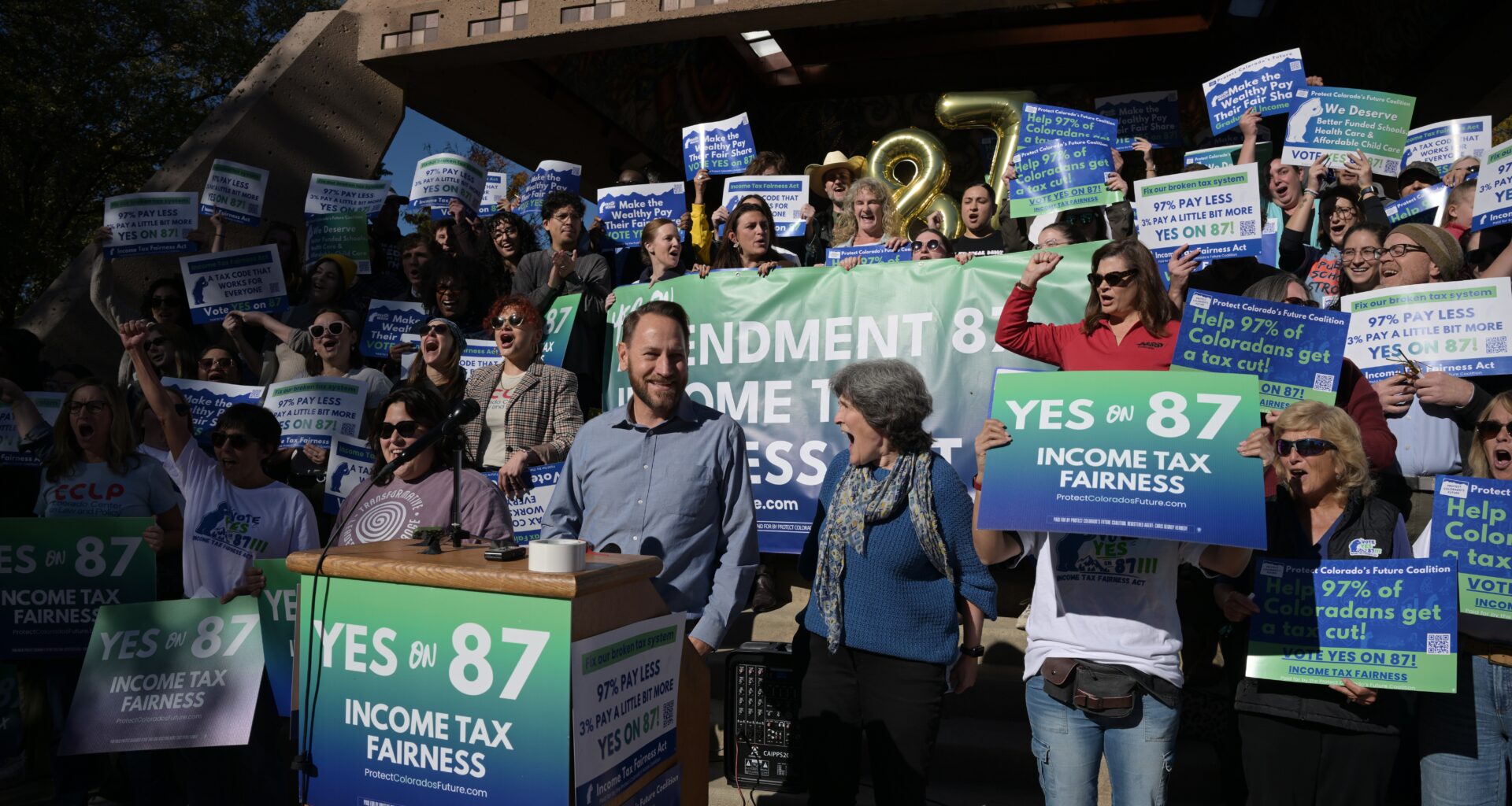
Supporters of Amendment 87, the ballot measure that would raise income taxes on higher earners in a dramatic rewrite of Colorado’s tax code, declared victory on Thursday after two days of vote counting.
The Associated Press had not yet called the measure’s passage, but its narrow margin expanded early Thursday evening as metro Denver counties reported more results. Support was at 51.2% as of 5:35 p.m., or a nearly 2.4 percentage point margin over “no” votes.
Supporters said they felt confident based on where the remaining votes were left to count — with a significant portion in left-leaning Denver and Boulder counties, where the measure has been winning by 2-to-1 margins.
“This is a huge day for Colorado,” Chris deGruy Kennedy, the president and CEO of the Bell Policy Center, the liberal group that placed the measure on the ballot, told supporters during a celebration at La Raza Park in northwest Denver on Thursday afternoon.
“It is a signal by voters,” he said, “that we are fundamentally changing the direction of how we are going to make sure Colorado’s economy supports every working person, every older adult, every child and everyone in between.”
Amendment 87 represents the most seismic change to Colorado income tax policy in over a generation. It’s also a stunning breakthrough for the liberal groups supporting the measure, who had to overcome millions of dollars in spending by dark-money conservative advocacy groups, attempts to block the measure in court and criticism from top-ranking Democrats.
Those included outgoing Gov. Jared Polis, a Democrat who’s a longtime crusader against income taxes, and Gov.-elect Phil Weiser, who came out against the measure just days before Election Day.
Liberal groups also had to fend off a competing measure, Proposition 136, backed by the conservative advocacy group Advance Colorado, that would have capped the state’s income tax rate at its current 4.4%. The measure, which was losing by a nearly 5.5-percentage-point margin as of Thursday night, appeared headed for defeat.
Michael Fields, Advance Colorado’s president, did not respond to a request for comment about 87’s supporters declaring victory. Earlier in the day, before the campaign’s announcement, he declined to comment on the potential impacts of the amendment’s passage.
Under Amendment 87, Colorado’s flat income tax rate would be abolished and replaced with a graduated tax that ratchets up for people and businesses making over $500,000 a year, while cutting taxes for the vast majority of Coloradans. It does that by repealing a requirement in the Colorado Constitution that all taxable income be taxed at one rate.
How the ballot proposal to overhaul Colorado taxes could change your tax bill — and who pays more
Proponents opted to remove language from the constitution, rather than adding words to it, to avoid needing to win 55% support from voters. It would make the most detailed changes in state law instead. As a result, Amendment 87 needs only a simple majority to pass.
The measure is projected to generate around $2 billion in additional state revenue next year, which the legislature could spend on education, healthcare and childcare.
Conservatives and business groups, as well as Democrats like Polis, warned the measure would amount to a massive tax hike that would make Colorado’s business landscape less competitive.
In a statement, Loren Furman, president and CEO of the Colorado Chamber of Commerce, one of the groups that opposed 87, said businesses are already struggling with rising costs as they try to make payroll and support their employees.
“These tax increases would force businesses to make difficult decisions about wages, hiring and future investments,” Furman said.
 Christina Soliz of New Era Colorado, left, hugs Arianna Morales as Amendment 87 supporters celebrate victory for major rewrite of Colorado’s tax code, affecting all taxpayers, at La Raza Park in Denver on Thursday, November 5, 2026. (Photo by Hyoung Chang/The Denver Post)
The amendment’s backers say the money it will raise will be a boon for a cash-strapped legislature that has been beleaguered by $1-billion-plus budget deficits over the past two years, forcing a slew of cuts to government services and programs, including Medicaid.
Now, lawmakers could enter next year under a radically different budget environment.
If 87 ultimately passes, it will join Proposition NN, which allows the state to keep excess tax revenue that would otherwise be refunded and spend it instead on K-12 education. That measure is projected to generate $500 million next year, and up to $2 billion by the end of the next decade.
Voters also appeared likely to pass Proposition 137, which requires the legislature to spend excess revenue generated from state sales taxes on sporting goods – estimated to be roughly $175 million – on wildfire mitigation and conservation.
Staff writer Seth Klamann contributed to this story.
Stay up-to-date with Colorado Politics by signing up for our weekly newsletter, The Spot.