
Data Cutoff: 2:00 PM ET
The Institute for the Study of War (ISW) and The Critical Threats Project (CTP) at the American Enterprise Institute are publishing updates Monday through Friday to provide analysis on the war with Iran and the broader Middle East. Weekday updates cover events from the past 24-hour period, whereas weekend updates are abbreviated and cover the Houthi-Saudi conflict and major breaking developments related to the war with Iran.
Key Takeaways:
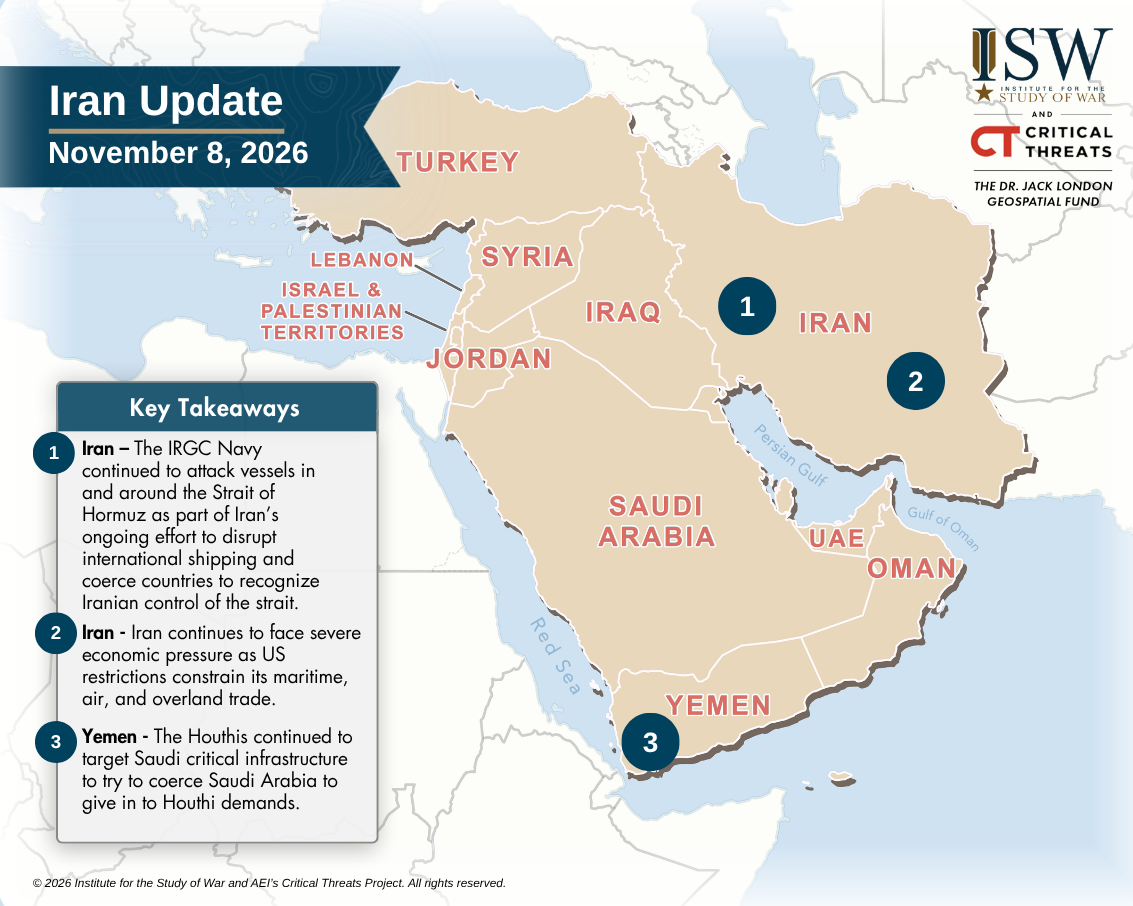
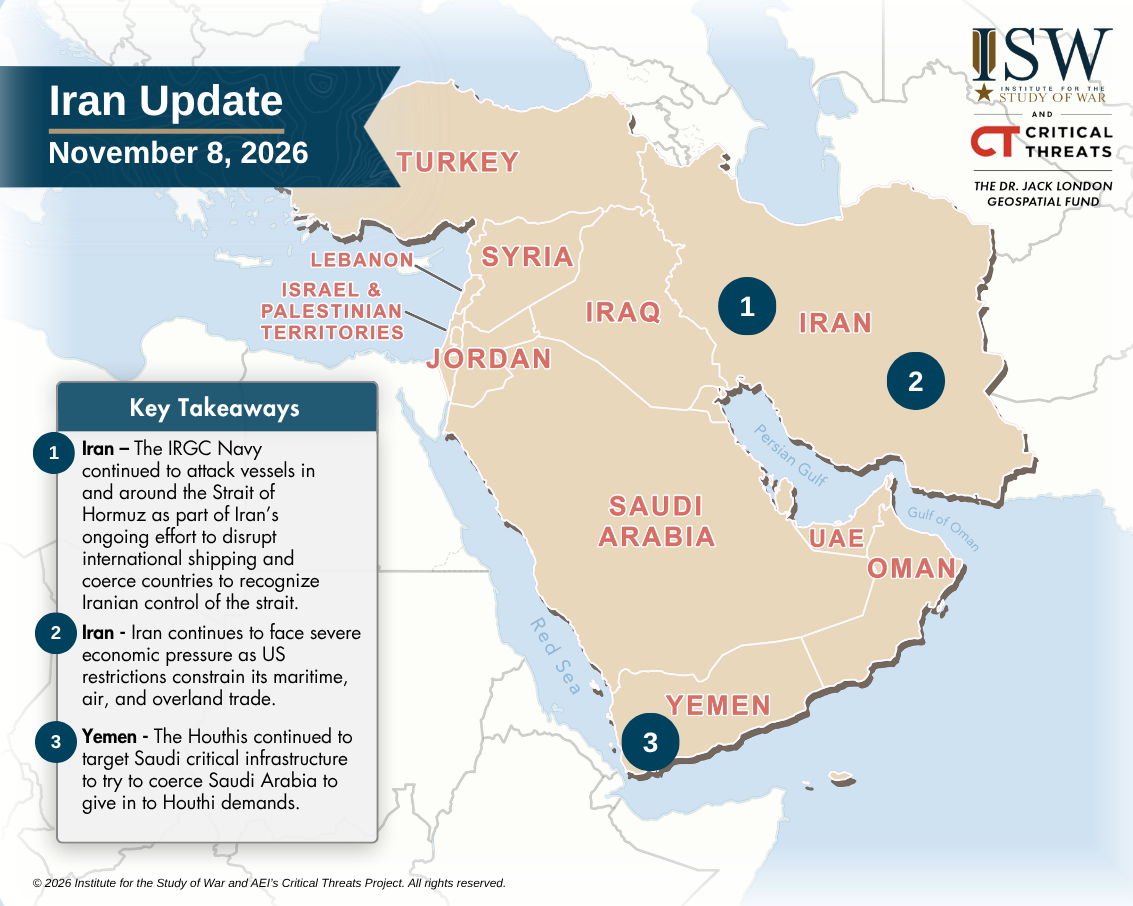
The Islamic Revolutionary Guards Corps Navy continued to attack vessels in and around the Strait of Hormuz as part of Iran’s ongoing effort to disrupt international shipping and coerce countries to recognize Iranian control of the strait.
The United States continued to enforce its blockade on Iranian ports as part of its economic pressure campaign against Iran. Iran continues to face severe economic pressure as US restrictions constrain its maritime, air, and overland trade.
The Houthis continued to target Saudi critical infrastructure to try to coerce Saudi Arabia to give in to Houthi demands. Geolocated footage from November 8 shows damage to an Aramco office building in Riyadh’s financial district. The Houthi decision to target a building in the center of King Abdullah Financial District, which houses residential units and other businesses, may reflect a Houthi effort to target civilian sites to put greater pressure on Saudi Arabia.
Toplines
See “US and Partner Military Operations,” “Iranian Strike Campaign,” and “Arabian Peninsula” sections.
US and Partner Military Operations
The United States continued to enforce its blockade on Iranian ports as part of its economic pressure campaign against Iran. US forces disabled the St. Kitts-flagged oil tanker M/V Huda on November 7 after the vessel attempted to violate the US blockade after visiting an Iranian port.[i] Iran continues to face severe economic pressure as US restrictions constrain its maritime, air, and overland trade.[ii]
Iranian Strike Campaign
Assessed Iranian War Aims:
Secure international recognition of Iranian control over the Strait of Hormuz
Degrade the US ability and willingness to continue the war
Restore deterrence vis-à -vis the United States and its regional partners
Divide the United States and Israel from the Arab states
The Islamic Revolutionary Guards Corps (IRGC) Navy continued to attack vessels in and around the Strait of Hormuz on November 7 as part of Iran’s ongoing effort to disrupt international shipping and coerce countries to recognize Iranian control of the strait. United Kingdom Maritime Trade Operations (UKMTO) reported on November 8 that an unknown projectile struck a vessel leaving the strait on November 7.[iii] UKMTO separately reported a tanker on fire eight nautical miles northwest of Khasab, Oman, on November 7, likely due to an Iranian attack.[iv] The IRGC Navy claimed on November 7 that two unspecified vessels in the strait caught on fire after they struck naval mines while transiting “unauthorized routes.”[v] CTP-ISW has repeatedly assessed that Iran’s claims of ships hitting mines likely seek to create an informational effect to increase shipping companies’ risk perceptions of transiting the strait without Iranian permission.[vi]
US-Iran Negotiations
Nothing significant to report.
Iranian Domestic Affairs
Nothing significant to report.
Lebanon
Nothing significant to report.
Iraq
Nothing significant to report.
Arabian Peninsula
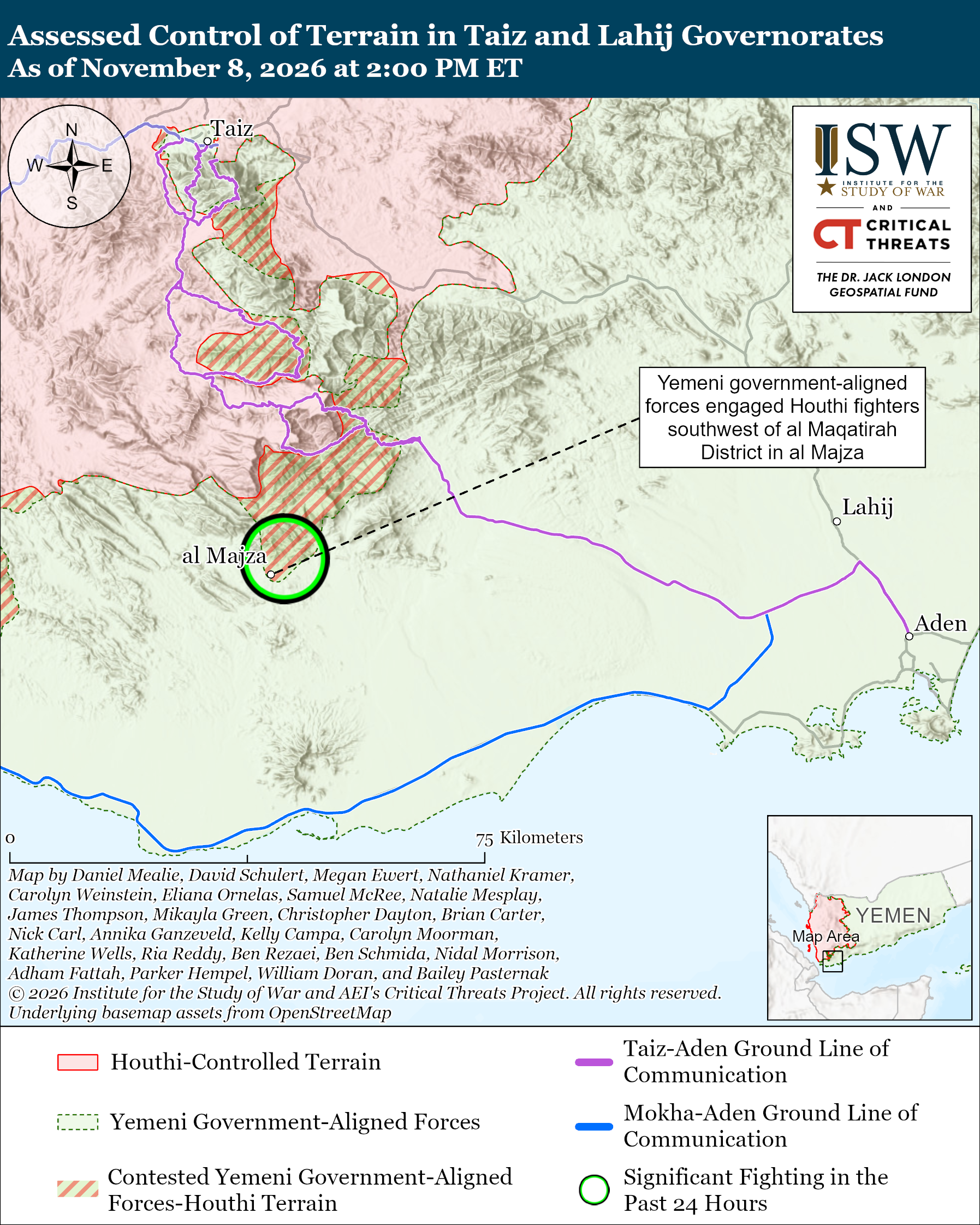
Yemeni government-aligned forces continued to engage Houthi fighters in northeastern Lahij Governorate. An independent Yemeni journalist reported that Yemeni government-aligned forces engaged Houthi fighters in al Majza on November 8 after Houthi forces advanced to the town on November 3.[vii] The Houthis’ advance to al Majza suggests that the Houthis may be trying to approach the Mokha-Aden ground line of communication (GLOC), which is approximately 40 kilometers southwest of al Majza.[viii] The Houthis could attempt to outflank and isolate government-aligned forces on the Red Sea coastal front by advancing toward the Mokha-Aden GLOC, which supplies government forces operating on that front.
Saudi Arabia likely conducted airstrikes targeting Houthi positions in mountainous terrain on Jabal Munif and Jabal Irf in al Maqatirah District, Lahij Governorate, on November 8.[ix] Yemeni government-aligned forces reportedly recaptured Jabal Irf on November 3, which overlooks the last government-controlled sections of the Taiz-Aden GLOC.[x] Ongoing airstrikes in the area suggest that Jabal Irf remains contested, however.
Yemeni government-aligned forces continued to engage Houthi fighters in northwestern Marib Governorate. An independent Yemeni journalist reported that Yemeni government-aligned forces engaged Houthi fighters in Wadi Halhalan in Raghwan District on November 8.[xi] Yemeni government-aligned forces reportedly advanced to Wadi Halhalan on November 6 and have repeatedly repelled attempted Houthi advances in the area.[xii] The Houthis separately claimed that they launched ballistic missiles and drones at Yemeni government-aligned troop concentrations southeast of Wadi Halhalan in Medghal District on November 8.[xiii]

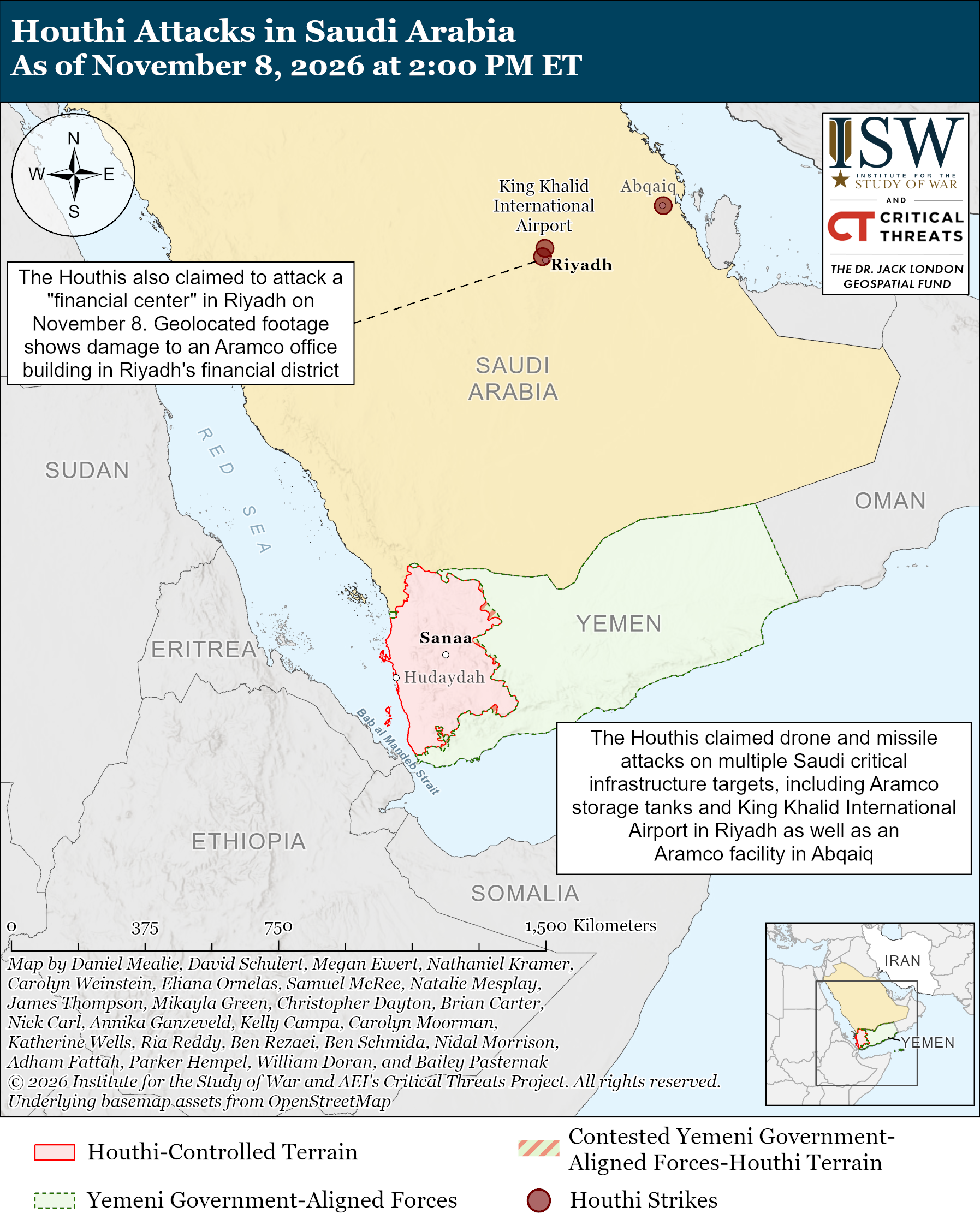
The Houthis continued to target Saudi critical infrastructure on November 8 to try to coerce Saudi Arabia to give in to Houthi demands. The Houthis claimed that they attacked King Khalid International Airport and Aramco storage tanks in Riyadh as well as an unspecified Aramco facility in Abqaiq in eastern Saudi Arabia with drones and missiles on November 8.[xiv] The Houthis previously claimed an attack on the world’s largest crude oil processing plant in Abqaiq on October 29.[xv] CTP-ISW cannot verify the Houthis’ claims at the time of this writing. The Saudi Joint Forces Command announced that its forces intercepted at least three missiles over Riyadh Province and one missile over Eastern Province on November 7 and 8.[xvi] Saudi Civil Defense also issued early warning alerts for Abqaiq and Riyadh City on November 8.[xvii] The Houthis have repeatedly targeted Saudi critical infrastructure as part of their ongoing strike campaign to compel Saudi Arabia to end military operations in Yemen and accept Houthi demands, which include lifting Saudi controls on Houthi-controlled ports and airports and granting the Houthis control over Yemen’s oil and gas resources.[xviii]
The Houthis separately attacked a “financial center” in Riyadh on November 8.[xix] Geolocated footage from November 8 shows damage to an Aramco office building in Riyadh’s financial district.[xx] Regional officials told the Wall Street Journal on November 8 that the building, which was empty at the time of the attack, also houses several residential units.[xxi] The Saudi Energy Ministry confirmed on November 8 that falling shrapnel damaged the building but caused no casualties.[xxii] The Houthis have repeatedly targeted Aramco infrastructure as part of their campaign against Saudi critical infrastructure.[xxiii] The Houthis claimed that the attack was in response to a Saudi attack on civilians in Bani Hashish.[xxiv] The Houthi decision to target a building in the center of King Abdullah Financial District, which houses residential units and other businesses, may reflect a Houthi effort to target civilian sites to put greater pressure on Saudi Arabia.

View Citations