
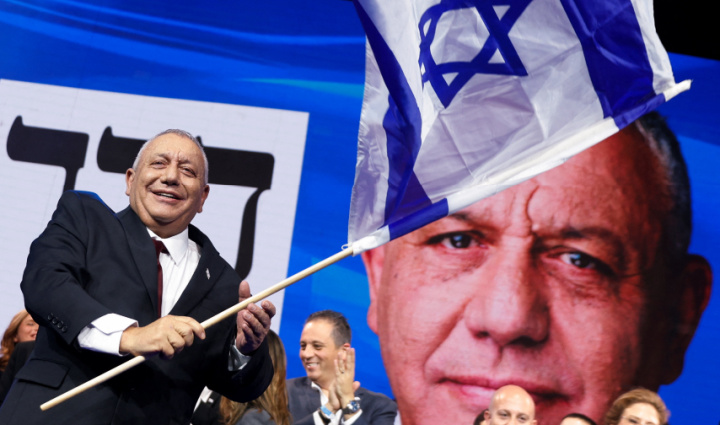
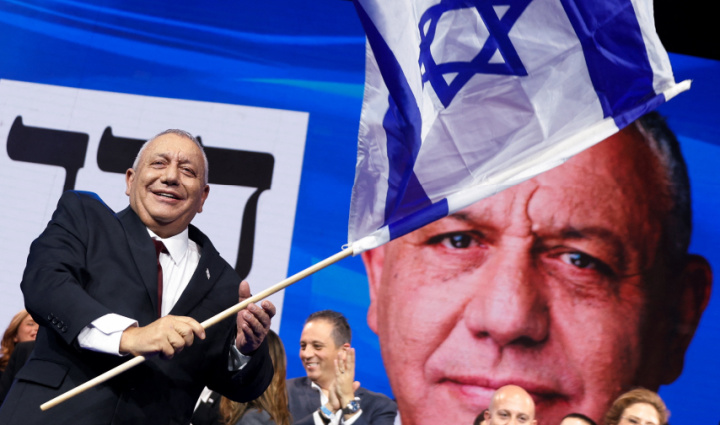
Former military chief Gadi Eisenkot, leader of the Yashar party, waves an Israeli flag following the exit polls at his party headquarters, on the evening of Israel’s national election, in Tel Aviv, Israel Oct. 28, 2026. Photo: REUTERS/Shir Torem
Israeli President Isaac Herzog on Sunday evening formally gave opposition politician and former military chief Gadi Eisenkot the first chance to form the country’s next government.
“I hope with all my heart that whatever government is formed will lead to unity, connection, and healing among all segments of our people — for our very existence depends on it, and we have only one country,” Herzog said at the presidential residence in Jerusalem, where the ceremony took place to give Eisenkot the official mandate.
Eisenkot, the leader of the centrist Yashar party, will have up to six weeks to form a governing coalition which, according to him, will unseat Prime Minister Benjamin Netanyahu.
“Israel is in a challenging and fateful state of emergency,” Eisenkot said during remarks in which he pointed to ongoing combat on multiple fronts, Israel’s declining international standing, and what he described as “one of the most vulnerable moments Israeli democracy has ever known.”
“If we continue in the present situation, we risk descending to dark places, to a point of no return from which it will be very hard for us as a society and country to come back from,” he added. “Therefore, there is great urgency for new leadership, leadership that you can look in the eyes and trust, whose concerns will always be Israel’s welfare and Israel’s security.”
Eisenkot acknowledged that it would be a difficult road to build a functioning, majority coalition of at least 61 lawmakers in Israel’s 120-member parliament, known as the Knesset.
“With the mandate entrusted to me here today, I will lead the establishment of a national emergency government,” Eisenkot said. “This will require creative and unconventional political acts. Israel does not have the privilege of wasting time or repeating endless rounds of elections. The challenges are too urgent.”
Eisenkot had secured the support of 67 of the Knesset’s 120 members earlier in the week, giving him a clear path to receive the mandate despite lingering questions over his ability to assemble a governing coalition.
Factions representing 67 lawmakers recommended Eisenkot for prime minister on Thursday, compared with 46 who backed Netanyahu.
The anti-Netanyahu opposition is divided between a 48-seat, four-party Jewish-led bloc — Eisenkot’s Yashar, Naftali Bennett’s B’Yachad, The Democrats, and Avigdor Lieberman’s Yisrael Beytenu — and a separate 19-seat bloc comprising the two Arab-led parties, the Joint List and Ra’am.
Netanyahu’s Likud remained the largest single party with 27 seats.
Now, despite receiving the backing of all six opposition parties, Eisenkot faces the challenge of turning their parliamentary support into a functioning coalition, as three of the four Jewish-led factions have ruled out joining a government alongside the Arab-led parties, leaving significant uncertainty over which parties could ultimately form his coalition.
Eisenkot has previously said that any lawmaker willing to accept his core principles could join his efforts to form the next government, including recognizing Israel as a Jewish, democratic, liberal, and egalitarian state; upholding the country’s Declaration of Independence; recognizing Hamas as a terrorist organization and dismantling its military and governing capabilities in Gaza; and requiring all citizens to perform military, national, or civilian service.
Meanwhile, Netanyahu has continued pushing for a new government under his leadership, seeking to retain the premiership by appealing to parties willing to join his political camp.
“From the very beginning, we have extended our hand toward forming a broad national government. We are working to establish such a government with our existing partners and any party willing to join us that does not support terrorism. I am open to discussing this possibility,” he said earlier this week.
Herzog has raised the possibility of a unity government that would bring Eisenkot and Netanyahu together.
However, all Jewish-led opposition parties have rejected the prospect of joining a unity government under Netanyahu, instead calling for a change in leadership after his years in office. For his part, Netanyahu has not indicated that he is willing to step aside for Eisenkot to serve as prime minister
Following the new Knesset’s swearing-in on Nov. 10, lawmakers are expected to elect a new speaker to replace incumbent Likud MK Amir Ohana, who oversees parliamentary proceedings and, together with the deputy speakers, determines the legislative agenda.
Under Israel’s political system, forming a new government follows a set timetable, beginning with the current president nominating a candidate who has 28 days to secure enough support to form a coalition, with a possible 14-day extension.
If the candidate fails, the president can appoint someone else for another 28-day attempt. If that also fails, lawmakers have 21 days to nominate a candidate backed by at least 61 members of the Knesset, who then has 14 days to form a government.
If all attempts fail, another election must be held within approximately 90 days.
Netanyahu remains prime minister until another party leader can form a governing coalition of at least 61 lawmakers. If no one can build a stable majority, Israel will hold another election, probably in the spring. Many analysts have argued that Netanyahu would likely perform better in such a scenario.