
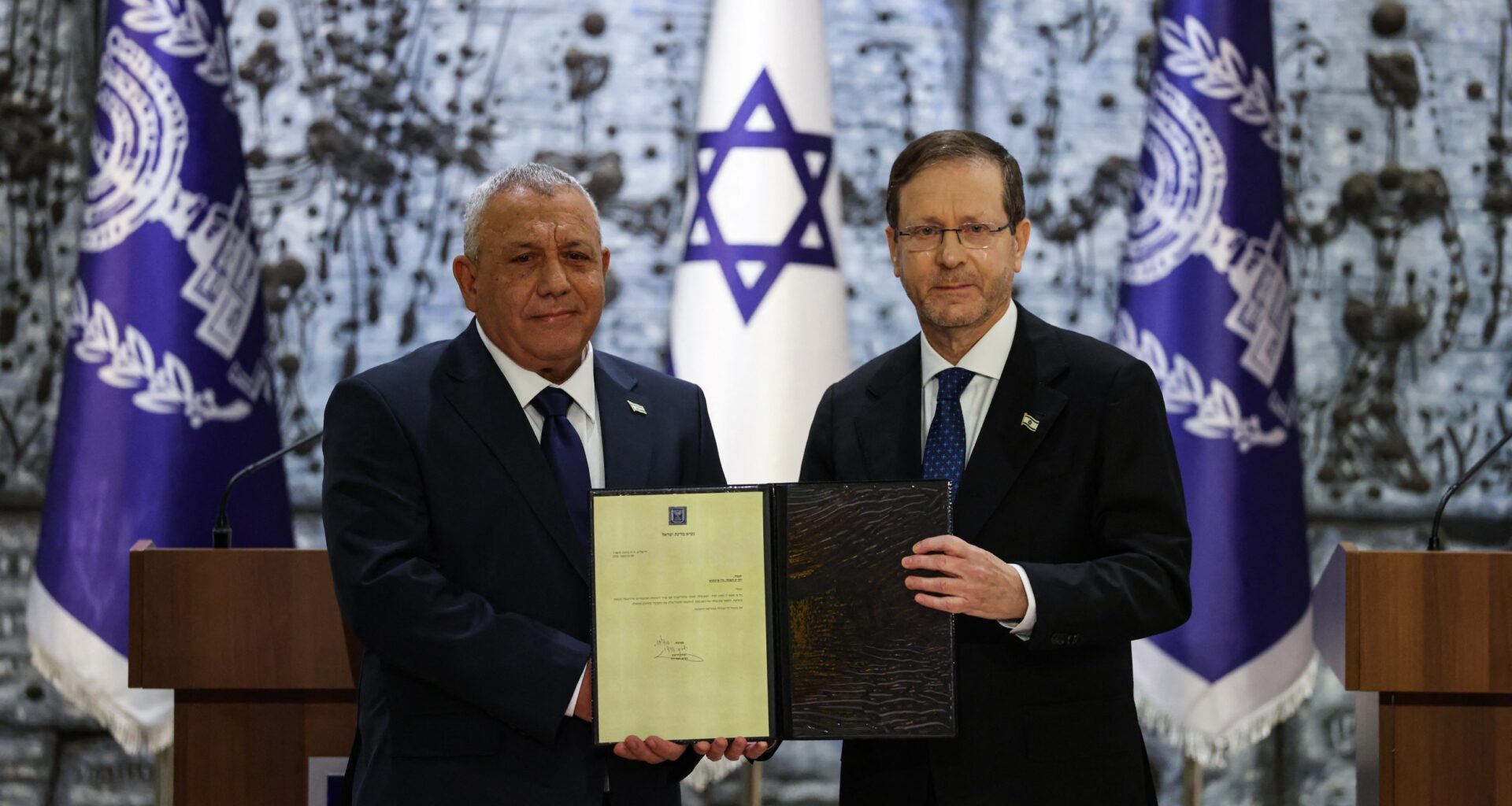
Israel’s President Isaac Herzog (R) and Israeli opposition bloc leader Gadi Eisenkot pose with the signed mandate to form a new government during a press conefernce at the President’s office in Jerusalem on November 8, 2026. Herzog officially tasked Eisenkot on November 8 with forming a new government, warning that the country faces uncertainties after elections in the United States.
Photo by Ilia YEFIMOVICH / AFP via Getty Images
The BriefingGadi Eisenkot, leader of the centrist Yashar party and former IDF Chief of Staff, formally accepted the presidential mandate on November 8, backed by 67 of 120 Knesset members — against 46 recommendations for outgoing Prime Minister Benjamin Netanyahu.The October 27 election produced a deadlocked parliament: Netanyahu’s right-religious coalition holds 53 seats, the four-party opposition bloc 48, and Arab-led parties a combined 19, with 61 required for a majority.Eisenkot has 28 days — extendable by two weeks — to assemble a viable coalition before the mandate reverts to Netanyahu; Arab party support from outside the government represents the most direct arithmetic path to power.A Presidential Charge at a Critical Hour
Standing at the presidential residence in Jerusalem on Sunday evening, Gadi Eisenkot received from President Isaac Herzog the formal charge to build Israel’s next government, casting the moment in terms of national survival. “We are at a moment of emergency, before a point of no return for the State of Israel,” the Yashar party chairman said after the ceremony, extending an offer to rivals across the political spectrum — including the camp of outgoing Prime Minister Benjamin Netanyahu.
The mandate was as much a product of arithmetic as of political will. During presidential consultations held in the days following the October 27 vote, 67 of the 120 incoming Knesset members endorsed Eisenkot — a majority that left President Herzog with little practical choice. Netanyahu, whose Likud-led bloc won 53 seats against the opposition’s 48, drew only 46 recommendations.
The Seat Count That Defines Everything
Israel’s new parliament, the 26th Knesset, reflects a deeply divided electorate. Final results certified by the Central Elections Committee place Netanyahu’s right-religious alliance at 53 seats and Eisenkot’s four-party bloc — Yashar, B’Yachad, Yisrael Beytenu and the Democrats — at 48. Arab-led parties, the Joint List and Ra’am, together hold 19 seats. With 61 required for a stable parliamentary majority, neither camp can govern without outside support.
The October 27 vote was the first national election since the Hamas-led attacks of October 7, 2023, and the wars that followed in Gaza, Lebanon, and against Iran. Turnout reached 77.9 percent, among the highest on record in Israeli electoral history.
Reaching Across the Divide
At the presidential ceremony, Eisenkot directed an unusually open appeal to Likud and other parties that had supported Netanyahu, challenging them to treat the moment as one that demanded national responsibility. “If they truly believe this is the hour for unity, as they declared before the president, I cannot think of a single reason why they would not come to support a government headed by me,” he said.
He paired that overture with a pointed public warning: anyone who moved to torpedo coalition negotiations for personal rather than principled reasons would, in his words, “go down in history as someone who failed to save Israel in a moment of emergency.”
Eisenkot has set four conditions for any party seeking a seat at his table: recognition of Israel as a Jewish, democratic and liberal state; commitment to the values of Israel’s Declaration of Independence; support for mandatory military or national service; and recognition of Hamas as a terrorist organization to be dismantled.
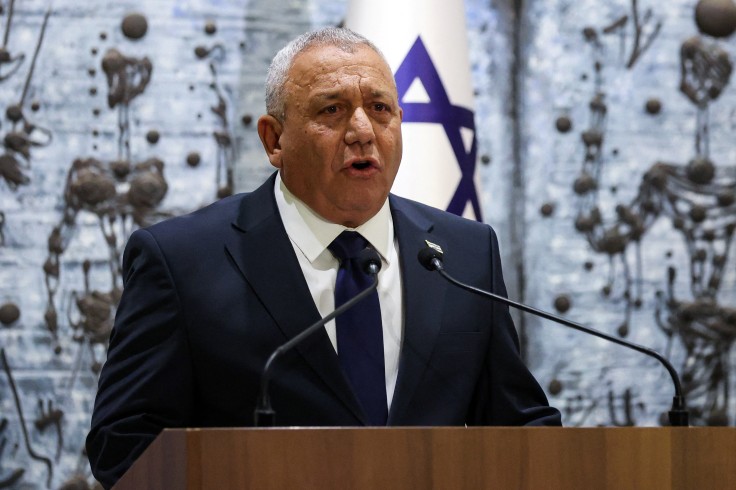
Israeli opposition leader Gadi Eisenkot speaks during a press conefernce with Israel’s President Isaac Herzog (not pictured) at the President’s office in Jerusalem on November 8, 2026. Herzog officially tasked Eisenkot on November 8 with forming a new government, warning that the country faces uncertainties after elections in the United States.
Photo by Ilia YEFIMOVICH / AFP via Getty Images
Likud’s Sharp Counteroffensive
Netanyahu’s camp moved quickly to frame the mandate as a threat rather than a turning point. Likud warned that the opposition intended to construct “a dangerous government relying on supporters of terror,” pointing to Eisenkot’s dependence on Arab-party endorsements as the core of its objection. Transport Minister Miri Regev warned during the consultation process that a “black flag” would fly over the next cabinet if a government were assembled without broad Zionist backing — a phrase understood across the Israeli political spectrum as a sharp condemnation of any minority government propped up by Arab support.
The Arab Factor: Kingmakers by Default
Ra’am leader Mansour Abbas confirmed that his party had backed Eisenkot during the consultations, describing the moment as an opportunity to establish “a government of hope and change.” Ra’am previously participated formally as a governing partner in the Bennett-Lapid coalition beginning in 2021, the first Arab party to do so in Israeli history. The Joint List, which holds 11 seats, indicated its willingness to support Eisenkot from outside the coalition — without demanding ministerial posts — a configuration that Israeli parliamentary law permits: a government does not need 61 affirmative votes to be sworn in, only more votes in favor than against.
Three of Eisenkot’s four bloc parties — Yashar, B’Yachad and Yisrael Beytenu — had pledged during the campaign not to include Arab parties as formal coalition members. Any Arab-backed arrangement would therefore most likely take the form of external support: abstaining or voting in favor on confidence matters without holding cabinet portfolios.
The Clock, and What Happens If It Runs Out
Under Israeli law, Eisenkot now has 28 days — a window that closes December 6 — to close enough deals to present a viable government. President Herzog may grant an extension of up to 14 additional days, pushing the outer deadline to December 20. Should the mandate expire without result, Herzog would assign the task to Netanyahu, who would then have 28 days with no extension available. If that effort also collapses, the Knesset enters a final 21-day period during which 61 members may jointly nominate a candidate in writing. If no candidate clears that process, the parliament dissolves automatically and Israelis would be summoned back to the polls for a sixth time since 2019.
“This Time, We Must Do It Differently”
Eisenkot framed his candidacy as a deliberate break from the cycle of division that has defined Israeli governance for the better part of a decade. “After the very hard years we have lived through, this time we must do it differently,” he told reporters Sunday. “This time, for the sake of all Israelis. The days when Israelis felt excluded by their government must end and must never return.”
Whether the coalition math can be aligned with that ambition remains the central unresolved question of Israeli politics as the country moves through the final weeks of November — and toward a reckoning that will determine either the opening of a new political chapter or the beginning of yet another campaign.
© {{Year}} Latin Times. All rights reserved. Do not reproduce without permission.