
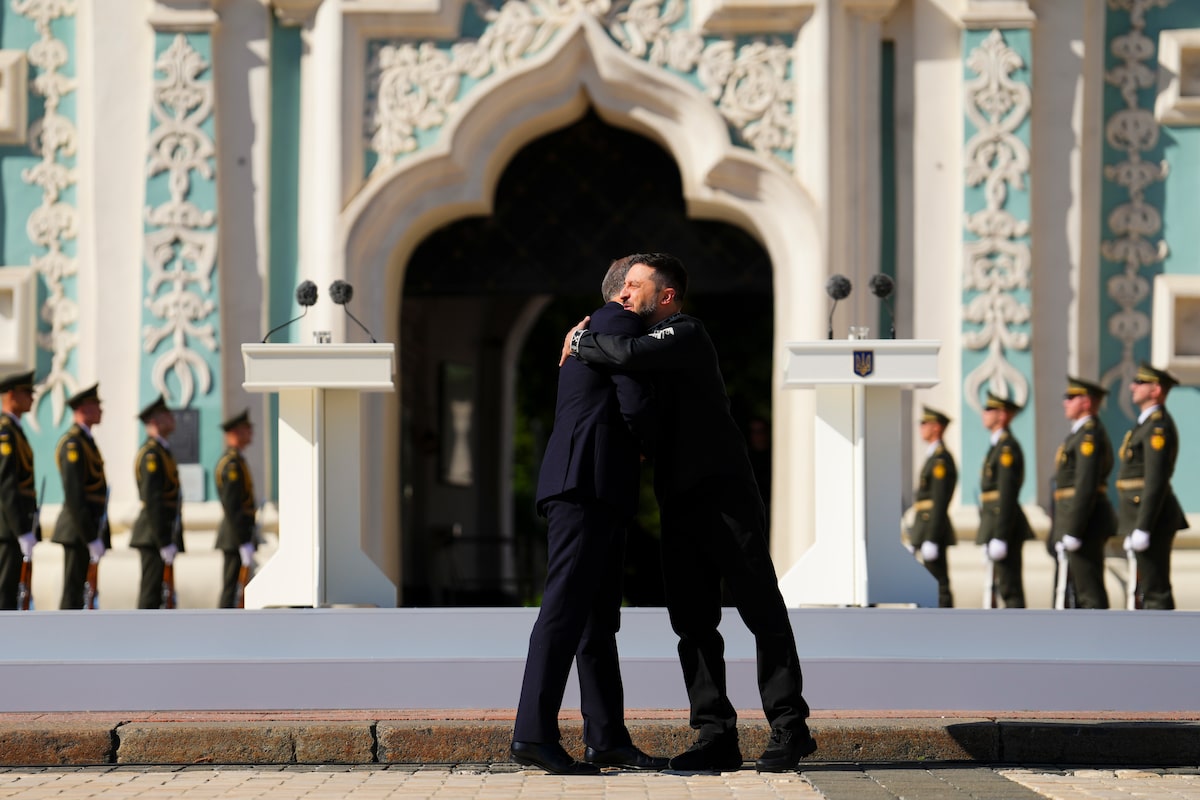
Prime Minister Mark Carney and Ukrainian President Volodymyr Zelenskyy hug as they take part in a ceremony for Ukraine’s Independence Day in Sophia Square in Kyiv on Sunday.Sean Kilpatrick/The Canadian Press
Prime Minister Mark Carney visited Kyiv Sunday to mark Ukraine’s Independence Day, where he pledged Canada’s support for the country’s war efforts against Russian aggression and to help secure and rebuild Ukraine once peace is achieved.
Speaking in the capital’s Sophia Square alongside Ukrainian President Volodymyr Zelensky, Mr. Carney delivered a speech that highlighted the deep historical ties between the two countries.
“Mr. President, dear friends, my message today is simple: Canada will always stand in solidarity with Ukraine,” he said.
He also unveiled new details related to the $2-billion in Canadian funding for Ukrainian defence that was first announced at the G7 summit in Kananaskis in June.
In his speech in Sophia Square during a surprise visit to Kyiv, Prime Minister Mark Carney said Ukrainians should have no doubt about Canada’s commitment to their country.
The Canadian Press
The money will fund advanced drone manufacturing in Canada and Ukraine and will provide ammunition and armoured vehicles that will start to arrive next month.
There will also be funding for emergency medical and shelter assistance and support to counter digital attacks.
The day marks 34 years since Ukraine declared its independence from the Soviet Union in 1991. Mr. Carney noted in his speech that Canada, under former Prime Minister Brian Mulroney, was the first Western nation to recognize Ukraine as an independent nation.
After Russia invaded Crimea in 2014, Mr. Carney noted that Prime Minister Stephen Harper launched Operation Unifier, which sent hundreds of Canadian Armed Forces personnel to train Ukrainian security forces.
And he credited his predecessor, Prime Minister Justin Trudeau, for welcoming over 300,000 displaced Ukrainians and making Canada the largest per capita contributor of financial aid to Ukraine.
Mr. Carney’s speech also touched on the personal links between the two countries, as Canada is home to more than 1.3 million people with ties to Ukraine.
Prime Minister Mark Carney, middle, is greeted by Ukrainian Minister for Foreign Affairs Andrii Sybiha and Andriy Yermak, head of the Office of the President of Ukraine, as he arrives in Kyiv.Sean Kilpatrick/The Canadian Press
“I grew up on the Canadian Prairies, where my horizon looked like your flag. Where my classmates bore your names. Where their parents and grandparents spoke your language,” he said. “Canada and Ukraine are more than friends and allies. The Ukrainian people are at the heart of the Canadian story, a story whose best chapters are still to be written.”
Events marking Ukraine’s 34th Independence Day are also scheduled to take place across Canada and worldwide Sunday.
The prime minister’s visit, which was not announced in advance, is part of a broader tour that also includes stops in Poland, Germany and Latvia.
Mr. Carney’s first visit to Ukraine as Prime Minister took place during a potentially pivotal moment in its war with Russia.
The focus of the trip is to talk with European leaders about efforts to bring the Russia-Ukraine war to an end, meet with Canadian Forces and build on Mr. Carney’s efforts to diversify international trade at a time of economic tension with the United States.
Canada’s military has helped train thousands of Ukrainian soldiers, and Mr. Carney plans to meet with Canadian troops in Warsaw, as well as in Riga, where Canada leads a multinational NATO brigade.
Prime Minister Mark Carney joins Ukrainian President Volodymyr Zelenskyy and his wife, Olena Zelenska, as they take part in a wreath-laying ceremony at the memorial wall.Sean Kilpatrick/The Canadian Press
There are approximately 2,000 Canadian Armed Forces members deployed in Latvia as part of Operation Reassurance, which is Canada’s largest overseas mission.
The NATO mission is aimed at deterring Russian aggression in Eastern Europe.
U.S. President Donald Trump recently raised expectations of a potential end to the war with his Aug. 15 meeting with Russian President Vladimir Putin.
That was followed by a White House summit where Mr. Trump hosted President Zelensky and several European leaders, during which Mr. Trump stepped out to update Mr. Putin by phone.
Despite the flurry of diplomacy, talks have reached an impasse, and Mr. Trump recently expressed his strong frustration at the lack of progress.
Trump threatens Russia sanctions if no progress toward peace deal with Ukraine
In the first two years of the full-scale invasion, Ukraine marked its Independence Day with a display of destroyed Russian tanks and military vehicles, lined up in a parade that stretched more than 500 metres down Khreshchatyk Street, in the heart of Kyiv.
It was intended as a statement of resilience, a tongue-in-cheek retort to reports that Russians had planned a military parade in the capital: in 2022, Ukraine’s Ministry of Defence wrote on X (formerly Twitter) that it was a “reminder to all dictators how their plans may be ruined by a free and courageous nation.”
But in 2024, and again this year, there was no such display. On Sunday, Khreshchatyk remained open to normal vehicle traffic, and public events to mark Independence Day were few and muted.
In Kyiv, for the most part, Ukrainians approached the holiday as a day like any other.
Russia launched a full-scale invasion of the country in February, 2022 and is now in control of parts of eastern Ukraine.
On Sunday, Canada announced that the $2-billion in funding for Ukraine would include $835-million for critical equipment, such as ammunition; $680-million for the purchase of military equipment sourced from the United States to strengthen Ukraine’s air defence capabilities; $220-million to purchase drone and counter-drone technologies; $165-million in support for the Armed Forces of Ukraine; and $100-million to source ammunition and explosives through the Czech Ammunition Initiative.
A Canadian flag is seen in a vast makeshift memorial for fallen soldiers in Independence Square in Kyiv on Saturday.Sean Kilpatrick/The Canadian Press
During a news conference Friday in Ottawa, Mr. Carney said Canada may play a role in security guarantees for Ukraine in the event that an agreement is reached to end the war.
A senior government official said cabinet will ultimately have to decide what form this support might take, but added that Canadian boots on the ground in Ukraine has not been ruled out. The Globe is not identifying the official because the comments were made in a background briefing for journalists.
During Friday’s news conference, Mr. Carney said he will meet German Chancellor Friedrich Merz on Tuesday.
He said those talks will focus on expanding trade opportunities in critical minerals and energy, as well as discussions related to defence and security.
Mr. Carney’s Liberal Party campaigned on a pledge to expand trade with Europe and other allies as a way of countering Mr. Trump’s economic foreign policy of higher tariffs on imported goods.
Carney’s cabinet is 100 days into its term. Here’s how it’s changed Canada
This is his fourth trip to Europe since he became Prime Minister in March.
An Aug. 25 meeting with Polish Prime Minister Donald Tusk is expected to focus heavily on economic matters related to energy, aerospace and defence.
After his Tuesday meetings in Berlin, Mr. Carney’s last stop of the trip will be a meeting on Wednesday in Riga with Latvian Prime Minister Evika Silina. He will also visit members of the Canadian Forces at the Adazi Military Base.