
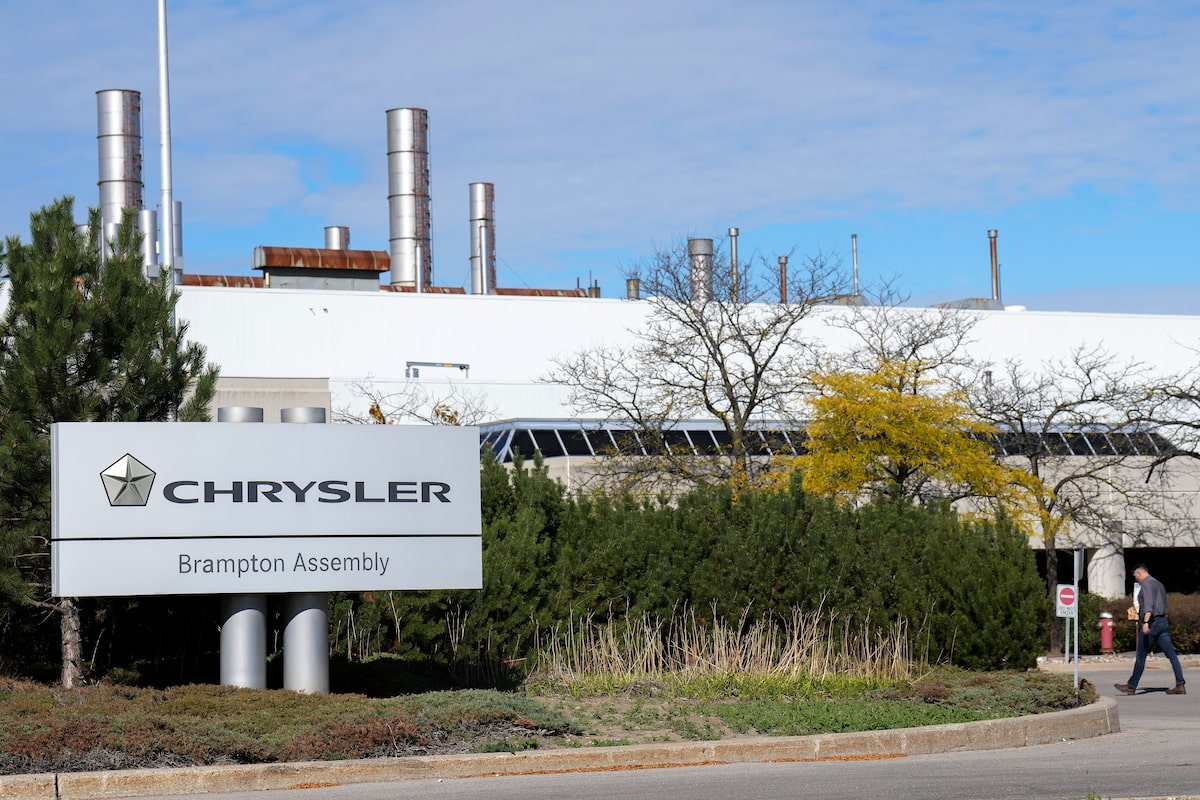
The Stellantis assembly plant in Brampton, Ont., that has been sold to defence company Roshel.Nathan Denette/The Canadian Press
Prime Minister Mark Carney called Stellantis NV’s STLA-N sale of its car plant in Brampton, Ont., to defence contractor Roshel Inc. “completely outrageous,” vowing to protect workers and ensure subsidies to the automaker are returned.
“Stellantis is failing to respect their commitment to the workers of this plant and also to the Canadian government and Canadians,” Mr. Carney told reporters in Montreal.
Stellantis said on Monday that Roshel has bought the idled plant near Toronto for an undisclosed amount. There had been rumours for months about a sale of the factory, which closed for retooling in 2023. That work was paused in 2025, after U.S. President Donald Trump placed 25-per-cent tariffs on Canadian-made cars. Stellantis, based in the Netherlands and Michigan, then moved planned production of the Jeep Compass to Illinois.
The automaker said on Tuesday it has offered to repay money the federal government gave it to retool the plant, but did not say how much, citing confidentiality provisions.
“We recognize that Canadians expect accountability for public funding and that is why Stellantis has offered to voluntarily return the government support received for Brampton Assembly’s original retooling plan,” Stellantis said in a statement.
Mr. Carney said Stellantis’s abandonment of the plant violates “several” agreements Stellantis has made, including the funding arrangement. The Unifor union, which represents the plant’s workers, accuses Stellantis of violating its collective agreement.
“It’s a betrayal of the workers as it is a betrayal of the obligations to Canada and by extension to all Canadians,” Mr. Carney said. “We will fully enforce our rights in protection of those workers and protection of Canadian funds.”
The plant employed more than 3,000 people when it closed in 2023, and about 2,200 remain on layoff.
Honda, Ford show commitment to Canadian auto plants despite tariffs
Ottawa contributed as much as $529-million to Stellantis for work on plants in Brampton and Windsor, Ont., according to the 2022 agreement obtained by The Globe and Mail under the Access to Information and Privacy law. The heavily redacted document says Stellantis must operate the Brampton plant until 2035, unless levies, adverse market conditions or other factors have a “material impact” on the plant.
It is not clear exactly how much money went to the Brampton plant, or if the government provided other subsidies.
Industry Minister Mélanie Joly said at the press conference in Montreal that she will convene a meeting in Toronto on Thursday with officials from Unifor, Stellantis and the Ontario government.
“Patience has its limits,” Ms. Joly said. “We’ve been working for more than a year now with Stellantis, with Unifor, to try and come to a solution. But Stellantis has decided to move forward and to once again violate their contract, the contract they signed with us.”
Ms. Joly said last year Stellantis’s move to shift production and leave the plant idle was a violation of the funding agreement. At the time, she threatened to take the carmaker to court.
“We’ll use all the means we have available to us to protect jobs but also to get justice for workers who for far too long now have been asking Stellantis to honour their commitments to them,” she said.
Unifor national president Lana Payne has repeatedly called on the federal government to save the plant, and called its sale a failure of the government strategy to protect jobs in the face of the U.S. trade war.
“Selling an auto assembly plant and losing vehicle production capacity is devastating for the Canadian industry, for our country, but mostly for the workers who have given so much to this company,” Ms. Payne said on Monday.
From 2025: Laid off for years, Stellantis workers in Brampton confront a grim new reality
Roshel is a Brampton-based maker of armoured vehicles with factories in several countries. Company owner Roman Shimonov told The Globe and Mail he is seeking contracts for the plant, including a bid for the federal government’s light utility vehicle program, valued at about $5-billion.
“I have a lot of plans and they’re very solid,” he said by phone on Monday, “and they’re based on specific activities that are within defence and automotive.”
Unifor walked away from collective bargaining with Stellantis in September when the company confirmed it had a preliminary agreement to sell the plant. Workers then voted for a strike mandate, if needed.
Stellantis also operates a casting plant in Toronto and a minivan plant in Windsor. That factory’s assembly line is shut down this week – the sixth week since mid-September – owing to tariffs and sales.
With files from Laura Stone