
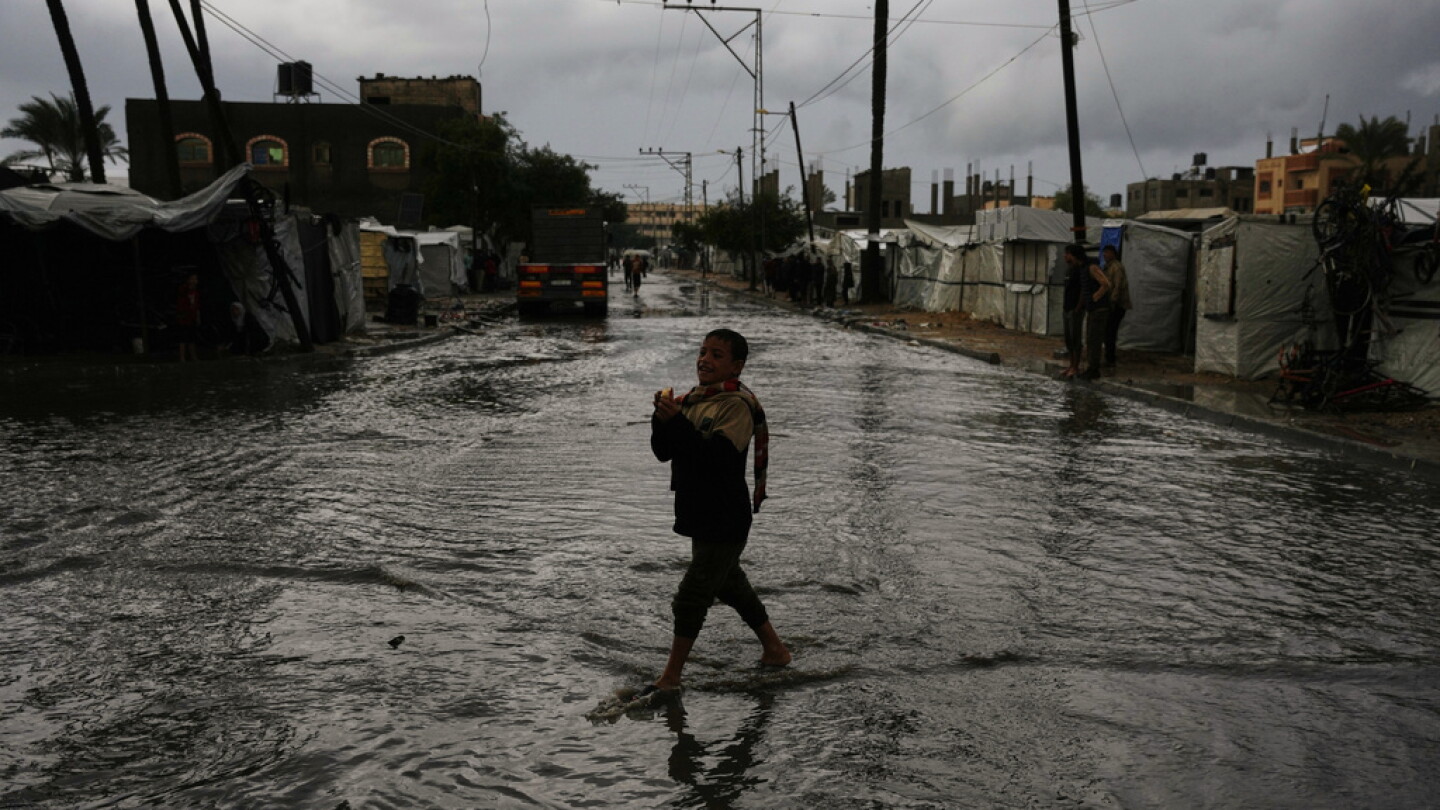
Humanitarian groups and experts are desperate for the U.S. to take a tougher approach to force Israel to let supplies into Gaza as worsening winter weather causes death and severe damage. Diplomatic sources tell The Washington Sun a shift looks unlikely.
Although officials in the Trump administration and President Donald Trump’s Board of Peace have pressed Israel to allow in more supplies for winter weather, the pace of shipments has remained slow and insufficient, with too little pressure from the U.S. side and constant pushback from Israel, sources said.
“The asks have been just that — asks. Not demands,” a diplomatic source involved in humanitarian access told The Sun. The source spoke on the condition of anonymity because they were not authorized to speak to reporters.
“Israel has realized over the past year or so that the U.S. won’t actually use leverage,” despite being Tel Aviv’s chief source of international support, the diplomatic source said.
Heavy rain and wind damaged tens of thousands of makeshift shelters in Gaza last weekend, killing at least five Palestinians, including three children. International aid groups have said Israel must allow emergency shelter kits, tarps and other essentials into Gaza, where an estimated 1.4 million residents now live in tents and other ad-hoc accommodation due to Israel’s military campaign against Hamas.
The Board of Peace criticized Israel on Monday for its “insufficient” response to the worsening humanitarian crisis, accusing it of delaying approvals for already-prepared supplies.
“For months, the Board of Peace has warned of the very conditions now unfolding,” the body said in a statement.
But the U.S. approach hasn’t led to more flexibility from Israel, which controls all entry points into Gaza and has imposed unprecedented restrictions on incoming shipments since it launched an offensive in the region in October 2023. Despite agreeing to Trump’s “peace plan” for Gaza in October 2025, Israel is still rejecting and stalling many shipments.
A recently departed State Department official told The Sun that the U.S. has created a dynamic in which “massive political lifts” by top officials like Aryeh Lightstone, a senior adviser to the Board of Peace, are required for even small, common-sense shipments.
Last week, four sewage trucks were permitted to enter Gaza almost two years after a request for Israel to approve them was made, the diplomatic source said.
The source added that Israel often makes similar objections to sanitation supplies as to those for winter relief, arguing that the metal, fastening equipment like nails or wire and wood represent “dual-use items,” or material that could be used for weaponry.
Humanitarian personnel say Israel has never provided a comprehensive list of “dual-use” goods and has been inconsistent in what it blocks from the region.
“It’s this very clear pattern of imposing all these little restrictions to force you to have to raise the little issues so you never talk about big issues,” said the former State Department official. The former official spoke on the condition of anonymity for fear of retaliation.
Both sources said the National Security Council at the White House reviewed even minor possible requests to Israel before they are made, which they said was unusual during a crisis.
Amid “a high level of centralization of decision-making,” humanitarian professionals find it “almost possible to get any engagement” with U.S. officials who do talk to Israeli counterparts, said an aid group representative who sought anonymity to preserve relationships.
Officials at the State Department did not respond to The Sun’s request for comment. The White House referred The Sun to the Board of Peace, which sent a statement saying: “We have made important gains. … As the Board stated on Monday, it is important that these gains are solidified and accelerated, not undermined through delay or inaction.”
Addressing a perception that the Trump administration is linking Israeli behavior around aid to steps by Hamas, the statement also said: “Humanitarian relief is not tied to disarmament, but that doesn’t make disarmament an optional requirement of Hamas” under Trump’s plan.
Israel’s Embassy in Washington directed The Sun to a statement on X by Israeli Prime Minister Benjamin Netanyahu saying: “Israel has facilitated a winterization plan in coordination with the Board of Peace, the United Nations, international organizations, and donor countries.” Netanyahu’s statement continued by blaming “Hamas alone… for the suffering of the people of Gaza” and accusing the group of “systematically diverting humanitarian aid.” Israeli and U.S. intelligence have previously cast doubt on such allegations.
Aid advocates seek that the U.S. rethink that strategy. James Hoobler, the humanitarian policy adviser at Oxfam America, told The Sun the Trump administration could explicitly “state that the U.S. doesn’t accept collective punishment” and reiterate Israel’s obligations under international law — to provide for civilians in an occupied territory — and as a recipient of U.S. military aid and weaponry.
Democratic lawmakers and some career government personnel have for years said U.S. and Israeli policy in Gaza is in violation of Section 620i of the Foreign Assistance Act, which bars American military support for countries blocking American-funded humanitarian aid.
Washington could push for “honest, accurate reporting about aid access,” Hoobler added. He said Israel’s promotion of specific increases in commercial shipments ignore how overall restrictions on supplies have caused severe price inflation. For example, per an international coalition of humanitarian groups, a tarp that could be bought internationally for $11 now costs $142 in Gaza.
And Hoobler said meeting Palestinians’ needs is bigger than addressing the current deterioration.
“Over and over again we come to the brink of bigger catastrophe, whether famine or rats and we’ll see token gestures that … don’t address the underlying conditions,” he told The Sun. “As long as you have almost 1 million people in tents in flood-prone areas, giving them an extra blanket isn’t going to address the problem.”
In addition to the Trump administration, Congress could nudge Israel, particularly with Democrats wielding increasing influence following the midterms. House Democrats have rallied around the “Ceasefire Compliance Act” and the “Block the Bombs Act,” legislation that would put the pipeline of American weaponry for Tel Aviv into question.
Sen. Ron Wyden (D-Oregon) has introduced the AWARE Act proposing sanctions on Israeli or other officials who block aid. Amid the flooding, likely future No. 2 Senate Democrat Brian Schatz wrote on X: “The Israeli government must allow building materials and winter supplies into Gaza immediately.”