
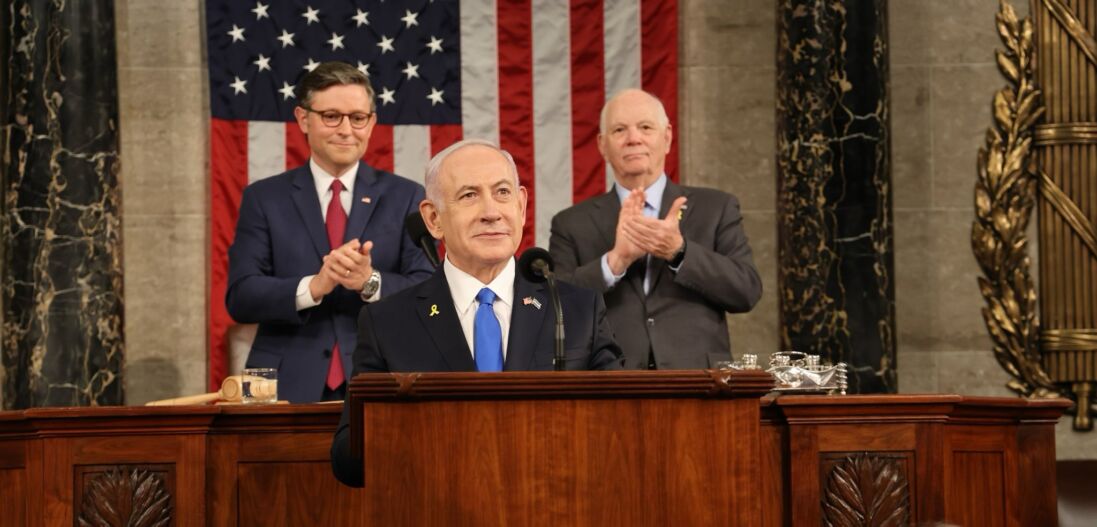
 Israeli Prime Minister Benjamin Netanyahu addresses a joint session of Congress, July 24, 2024. (Photo credit: wikicommons/Office of Speaker Mike Johnson)
The most consequential development for Israel in last week’s American midterm elections may not be the Democrats’ capture of Congress or President Donald Trump’s announcement that he intends to end American military assistance. It may be the realization that the bipartisan consensus sustaining the U.S.-Israel alliance can no longer be taken for granted.
For generations, that consensus survived disagreements over Israeli policies, American administrations and Middle Eastern diplomacy. Supporting Israel was understood not simply as a moral commitment, but as an investment in American security. The midterms exposed how much that understanding has weakened.
Among Democrats, criticism of Israel has moved beyond the progressive margins. Newly elected lawmakers are challenging military assistance and demanding greater scrutiny of Israeli conduct. Republicans remain more supportive, but an increasingly vocal faction questions why America should devote resources to Israel or become involved in Middle Eastern conflicts.
The objections differ, but their political effect is similar: Israel is increasingly treated as a liability rather than an asset. That characterization overlooks what America receives from the relationship.
Israel provides intelligence on Iran, terrorist organizations and regional threats that directly affect American security. Its military capabilities help counter adversaries Washington would otherwise confront with greater American involvement. Joint missile defense programs, cybersecurity cooperation and advanced military technologies strengthen both countries. Israel also serves as a capable regional partner in an area where American interests remain substantial, even as public enthusiasm for deploying American troops has diminished. These are not acts of generosity toward Israel. They are investments in American interests.
The alliance has costs, of course. American support can complicate regional diplomacy, and Israeli decisions sometimes create problems Washington neither anticipates nor welcomes. The war with Iran has intensified legitimate questions about the risks and consequences of military cooperation. But those concerns demand serious strategic evaluation, not the assumption that disengagement would leave America safer or less burdened.
Trump’s Election Day announcement illustrated the problem. Whatever the merits of reducing Israel’s dependence on American military assistance, he presented the decision partly as a way to escape domestic political criticism. A strategic relationship was being reconsidered through the lens of electoral convenience.
Liel Leibovitz, writing in Tablet, argues that ending aid could create a more mature partnership grounded in mutual interests. He has a point. But eliminating the annual appropriation will not resolve the deeper problem. Those who oppose Israeli policies, question its legitimacy or reject American involvement in the Middle East will not necessarily become supporters when the checks stop. Nor can Israel rely on its relationship with any particular American president. Personal friendships and partisan alliances cannot substitute for a durable national consensus.
Rebuilding that consensus requires explaining what America gains from the relationship, while acknowledging that friendship does not require agreement with every Israeli decision. It also requires recognizing that younger Americans increasingly approach Israel without the historical experiences that shaped their parents’ understanding.
Israel should pursue greater military independence. But America must also decide what kind of Middle Eastern partnership serves its own future.
The question raised by the midterms is not simply whether America should continue supporting Israel. It is whether Americans still understand why the relationship serves their own interests.