
The forest, seen from a drone, appeared as a vast, monotonous landscape of black tree trunks, shadows and patches of snow.
To the human eye, it appeared deserted. But to an artificial intelligence system looking for people, it did not. The system put a red box around a tiny human form, probably a soldier lurking in the trees.
Behind this feat lay vast volumes of data. Just as ChatGPT and other A.I. chatbots must be exposed to how humans write, military A.I. systems must be exposed to how humans fight. In Ukraine, this happens through a huge trove of battlefield videos, audio and text data collected over nearly five years.
The war database is being used by about 30 Ukrainian defense companies to develop A.I. weapons. Ukraine is now opening this repository, which it calls Avenger Labs, to firms in allied countries, hoping to deepen security partnerships.
Ukraine is providing the data at no charge, but companies must give the Ukrainian military licenses to any software they develop. Under the first agreement to be reached, 12 British defense companies will gain access. Ukraine is in talks with other countries.
While there is no shortage of Western companies developing autonomous weapons, there is a shortage of the data needed to train them. Ukraine can offer more of it than any other potential partner.
Ukraine is sharing the data even as it remains unsettled internationally how the Geneva Conventions and other laws of war apply to A.I. weapons. Kyiv, which is struggling to draft enough soldiers to hold the front line and is running out of traditional antiaircraft weapons to defend its cities, wants to hasten the development of such weapons for its defense.
Russia, too, has been collecting war data for use in A.I. It is unclear how Moscow handles this information, or whether it shares it with allies like Iran, China and North Korea.
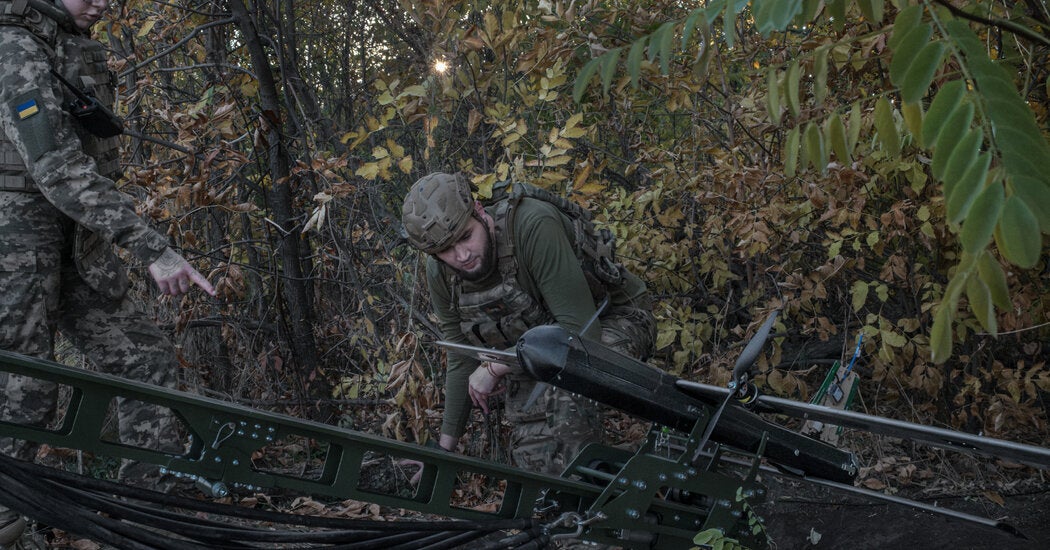
Most A.I. drone systems now in use require a human pilot to confirm a target before striking. But both Russia and Ukraine have employed small numbers of fully autonomous exploding drones, including one model made by Russia that killed three people in a southern Ukrainian city in July.
A former Ukrainian defense minister, Mykhailo Fedorov, who directed the development of the Avenger Labs platform, has formed an investment fund with a goal of deploying a fully autonomous A.I. weapon next year. Alex Karp, the chief executive of the data analysis company Palantir, is a lead investor.
Recently, the Ukrainian Defense Ministry provided a demonstration of how Ukraine creates A.I. weapons.
When training a killer drone, a first step is deciding what it will kill. A data set must be chosen — thousands or tens of thousands of images of the type of target the weapon should hunt.
Avenger Labs holds more than five million drone surveillance and strike videos. Many of them are raw footage of small, buzzing drones that chase Russian soldiers and blow them up. But a menu bar in the platform can call up thousands of annotated battlefield videos matching a wide range of targets. Among them are tanks during wintertime; trucks at night; and exploding Russian drones viewed through thermal imaging cameras.
The encrypted platform is hosted by a cloud service outside Ukraine. Defense companies do not directly view the videos. They run the data within a so-called sandbox, or isolated computer system. Over time, as they are fed the wartime videos, they learn to identify military targets.
Once an A.I. model becomes proficient in the sandbox, as measured by false positives and false negatives, a company can load it into the targeting computer of an aerial drone, ground robot or sea drone.
With that, the menu item on the Avenger Labs platform — for example, tanks — becomes a menu item on the A.I. weapon. A soldier can click on this menu item, then release a drone to autonomously hunt for the target.
An executive for one company that has used the system for an A.I. model now deployed on the battlefield said statistics from training showed false positives of less than 5 percent. The executive spoke on the condition of anonymity because of a secrecy agreement with Avenger Labs. Whatever the qualms about killer A.I. weapons, the executive said, they will be developed one way or another.
The Ukrainian war database has limitations. It is not clear how relevant the images are to conflicts outside Ukraine, said Kateryna Bondar, a senior fellow at the Wadhwani AI Center at the Center for Strategic and International Studies in Washington.
“If you train your computers to recognize Russian assets, what are you going to do with that” away from Ukraine, she asked. In a war in the Middle East, A.I. weaponry might need to recognize, for example, Iranian missile launchers in a desert landscape.
There are also questions about potential unlawful use of the data. The licensing agreement does not include a human rights clause. Ukraine is opening access under government-to-government agreements. These governments, Ukrainian officials say, are responsible for ensuring that their militaries adhere to the Geneva Conventions and other treaties.
In any case, Ukraine is opening its war data into a legal void. Last month at United Nations talks in Geneva, Russian and U.S. diplomats opposed a requirement for “meaningful human control” of lethal autonomous weapons. These talks will resume on Monday to consider a draft treaty.
The software models created by A.I. are a black box to humans because their internal reasoning is largely opaque. That is a problem, said Anna Bacciarelli, an analyst of A.I. and conflict at Human Rights Watch, because the “black box obscures accountability” in self-targeting weapons. “It’s hard to pinpoint the moment when something goes wrong,” she said.
Oleksandra Matviichuk, a Nobel Peace Prize laureate and director of the Center for Civil Liberties in Kyiv, said Ukraine and other countries that had ratified the Rome Statute, the agreement that created the International Criminal Court, were obliged to extradite for trial military officers responsible for war crimes, regardless of the weapon used.
Ukraine should be cautious, Ms. Matviichuk said, in sharing data with countries that have not accepted this principle of international law, such as the United States.
Evelina Riabenko contributed reporting.