
When China’s leader, Xi Jinping, endorsed the expulsion of dozens of disgraced officials at a recent Communist Party meeting in Beijing, one man stood out as a clear winner.
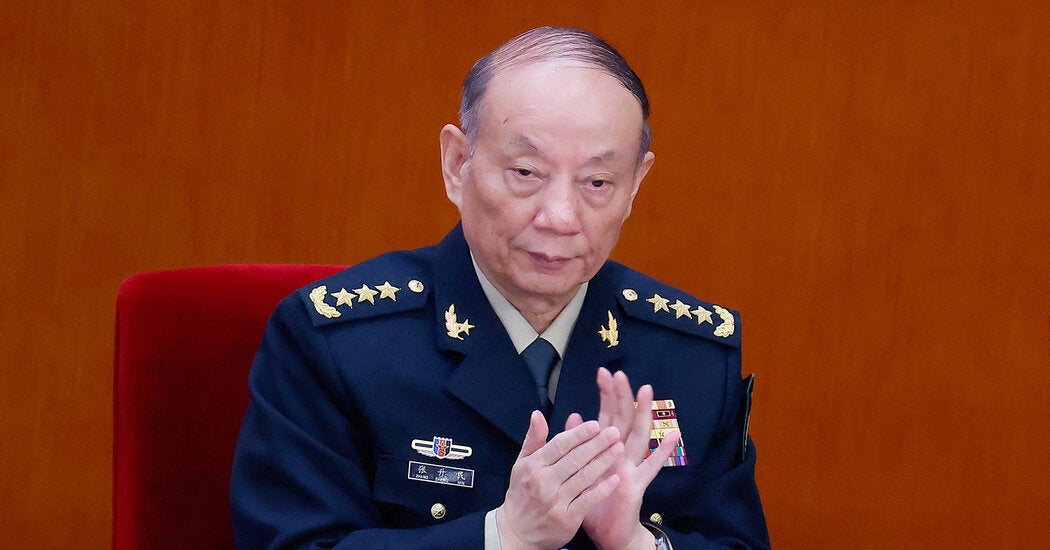
Taking his new place at the front of the meeting was Gen. Zhang Shengmin, the somber-faced enforcer of Mr. Xi’s purges inside the military. He had been promoted to the Politburo, the party’s top leadership council, the latest step in his improbable rise from low-profile inspector to a position second only to Mr. Xi in China’s military hierarchy.
General Zhang has been the principal overseer of Mr. Xi’s campaign to purify the People’s Liberation Army. His latest elevation signaled that the investigations, indoctrination drives and loyalty tests could continue for years, as Mr. Xi searches for officers he believes are irreproachably loyal, experts and officials said.
“Twist the blade inward, with strict measures to cure disorder,” China’s main military newspaper said after the party meeting that was held late last month, referring to the continued discipline campaign.
Three officials in Taiwan said they believed Mr. Xi’s loyalty campaign would keep the Chinese military focused on its own problems. That could hinder preparations for possible war over Taiwan, the self-governed island democracy that Beijing claims. The officials spoke on condition of anonymity to discuss internal assessments.
The leadership uncertainty comes as China’s military has continued to pressure Taiwan. Dozens of P.L.A. ships held unannounced drills in seas off the Chinese coast in recent weeks, with some, including a carrier strike group, still remaining, Joseph Wu, the secretary-general of Taiwan’s National Security Council, posted on X on Thursday.
But the exercises appeared less sophisticated than earlier ones — potentially reflecting disruptions to the P.L.A. command, another Taiwanese official said. He spoke on the condition of anonymity, citing rules about sharing military intelligence with reporters.
John Culver, a former Central Intelligence Agency analyst who studied the Chinese military, said that “Xi’s animating motivation isn’t war or preserving his own power as goals in and of themselves.”
“It’s saving the party, and ensuring that the P.L.A. will fulfill its role as the armed wing of the Chinese Communist Party,” said Mr. Culver, a nonresident senior fellow at the Brookings Institution, referring to the People’s Liberation Army.
A Military Leader With a Political Background
General Zhang’s promotion was unusual. He was the first official in 32 years to join the Politburo outside its regular five-year leadership cycle.
He has scant experience in leading military operations. He was for many years a political officer, enforcing party rule over the military, and then an investigator hunting for corruption and misbehavior. Outside the military, he became best known for his Chinese brushstroke calligraphy.
His rise is the story of Mr. Xi’s declining faith in many of his handpicked generals. Dozens have been removed, often accused of corruption and betraying Mr. Xi’s orders.
General Zhang has no elite family background or powerful patrons in the armed forces, said Joseph Torigian, an associate professor at American University in Washington who studies China’s political and military elites.
“Xi Jinping has lost trust in so many people, but he maintains trust in this one person and may want to keep him around simply because a good deputy is so hard to find,” Mr. Torigian said.
But he noted the risks for General Zhang. “It’s going to be tough politics for Zhang Shengmin to manage, because if you’re the only one, you have to be so careful to not raise doubts in the top leader,” he said.
In Taiwan, many observers expect China to step up its military pressure on the island if its president, Lai Ching-te, wins another term in elections in early 2028. Beijing has denounced Mr. Lai for rejecting its claims of sovereignty over Taiwan.
But the leadership upheaval in the Chinese military could make it harder for Mr. Xi to marshal a full suite of military options against Taiwan, possibly for years, experts said.
“Because going to war demands certain victory, he harbors no illusions about the severe leadership deficit hollowing out the Liberation Army,” Ma Cheng-kun, a professor at the National Defense University in Taiwan who studies the People’s Liberation Army, said at a recent seminar in Taipei.
“Fully replenishing personnel cannot be done that rapidly,” Professor Ma said, “especially when virtually all generals, well-qualified senior officers, are gone.”
Mr. Xi controls the armed forces as chairman of the Central Military Commission, a council that has usually included six or more senior commanders. After the expulsion of five members, the commission is now made up of just Mr. Xi and General Zhang.
An Enforcer and Calligrapher
General Zhang enlisted in the military in 1978 and for decades served as a political commissar, instilling the party’s values in troops and rooting out those who violated its rules.
In the 1980s, as Deng Xiaoping opened China’s economy to a commercial boom, General Zhang, then a junior officer in northwest China, wrote about the threat the changes posed to military discipline. He warned that relationships in the armed forces were being warped by greed. “Some can fulfill their individual interests and aspirations only by relying on personal connections,” he and a co-author wrote in a paper in 1988.
Outside the military, General Zhang earned a reputation for his calligraphy. He often wrote “cursive script,” or cao shu — a free-flowing style that exudes spontaneity.
At work, though, General Zhang focused on discipline and obedience. After Mr. Xi came to power in 2012, General Zhang echoed Mr. Xi’s warnings that corruption was sapping the army’s fighting strength. By then, he was an officer in the Second Artillery, the missile force that would later emerge as a nest of corruption scandals.
“The conduct of senior officers is a barometer in the military,” General Zhang wrote in a military journal in 2014. “If leading officers pursue pleasure and wallow in luxury, that seriously harms the relationship between officers and troops and undermines cohesion and combat effectiveness of the military.”
In 2015, he was promoted to a position under the Central Military Commission. Two years later, he was made head of the military’s Discipline Inspection Commission, which investigates corruption and disloyalty, and promoted to full general rank with a seat on the Central Military Commission.
Even so, he remained overshadowed by the more senior commanders leading China’s rapid military buildup.
That began to change in 2023, when investigators under his authority targeted China’s missile force and ousted commanders accused of corruption. The investigations spread to other arms of the military and to higher levels of its hierarchy.
As the scandals spread, General Zhang became increasingly important to Mr. Xi’s renewed drive to clean out generals accused of defying him and taking bribes.
That campaign reached a peak early this year, when Gen. Zhang Youxia, China’s most senior uniformed officer, was placed under investigation, along with Gen. Liu Zhenli, the chief of the Joint Staff Department. One theory is that their violations included questioning Mr. Xi’s proposal to elevate General Zhang Shengmin to the position of vice chairman of the military commission. He gained that position in October.
General Zhang’s latest promotion to the Politburo raised the possibility that he could remain as China’s top general after a Communist Party congress late next year, when Mr. Xi is all but sure to win a fourth term in power. At 68 now, General Zhang would be older than usual to stay in office, but Mr. Xi has set aside retirement norms for some officials. Still, the purges are a warning that not even those close to Mr. Xi are secure.
General Zhang “could be discarded at any point,” said Mr. Culver, of the Brookings Institution. “If there’s one lesson we should have drawn, it is that there are no essential Xi allies.”