
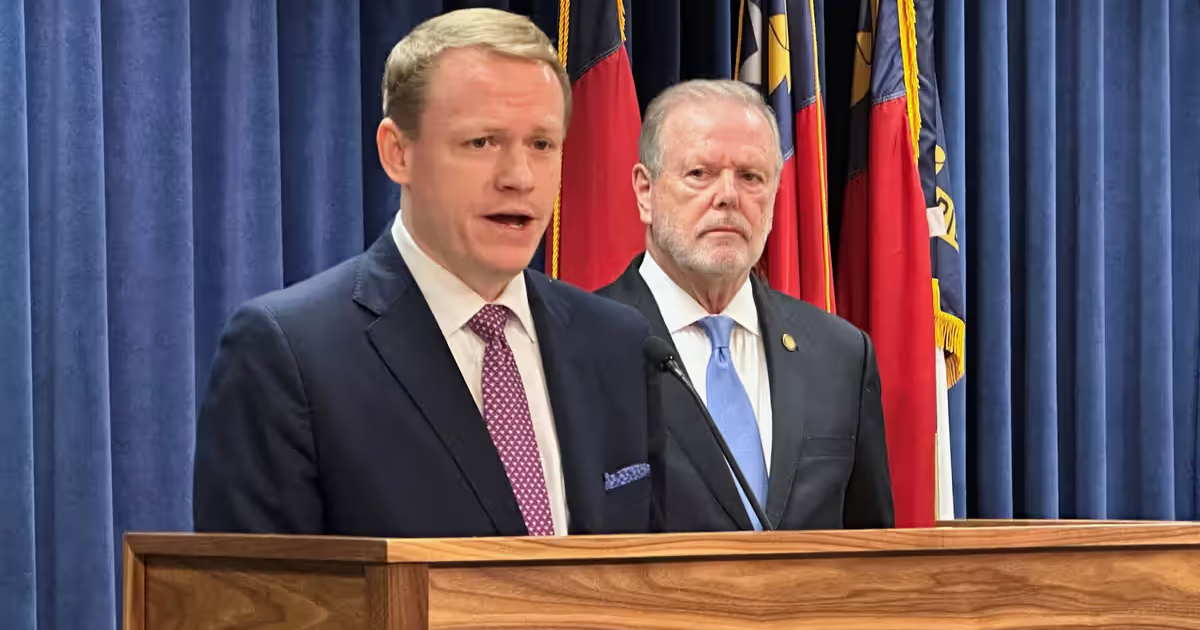
North Carolina voters unseated two dozen Republican state lawmakers in the 2026 midterms, breaking the GOP’s veto-proof supermajority in the state Senate and giving back control of the state House of Representatives to Democrats for the first time in over a decade.
But those new lawmakers won’t be sworn in until January. So the shift in power they’ll bring is still about two months away.
In the meantime Republicans still control large majorities in the state legislature. And they’re coming back to Raleigh next week for a final session to put that power to use before they lose it.
One of the top priorities for Republican House Speaker Destin Hall, the week of November 16, will be to fill open roles within state government. Legislative leaders appoint members of many commissions, from minor boards to high-profile jobs like public university board members. There are hundreds of such positions, and it’s unclear exactly how many are vacant at the moment, but Hall and other Republicans will likely fill as many as they can before Democrats take control.
Money is also going to be a big focus. The long-delayed state budget process wrapped up this year, with GOP leaders agreeing to a budget deal after the state went over a year without a new budget. But while the House and Senate agreed on how to spend most of the state’s available funds — $34.37 billion, to be exact — they left $1 billion unspent.
Additional money for Hurricane Helene relief will be considered, Hall spokeswoman Demi Dowdy said. So will additional funding for state agencies, many of which were required to eliminate jobs as part of this year’s budget deal.
They are also expected to make some technical corrections to the budget passed in July, which could entail shifting money around or tweaking some of the policies the budget enacted.
The presumptive new Speaker of the House starting in January, Democratic Rep. Robert Reives, told reporters this week he wants to make deals with Republicans in the state Senate when the 2027 session starts and accomplish some bipartisan deals.
But it’s unclear who he’ll be negotiating with next year.
Senate leader Phil Berger lost election this year in the March primaries, so these coming weeks will be his last in power. And a top Berger lieutenant who was seen as a possible replacement, Wilmington Sen. Michael Lee, was among the Republicans unseated this month.
A numbers question
One factor that could determine how aggressively GOP lawmakers act in the upcoming session is how many of their members — many of whom just lost reelection bids or were planning retirement anyway and didn’t seek reelection — they can convince to show up this fall around their holiday plans.
Democratic Gov. Josh Stein would be likely to veto any bill that targeted his power, or that of the speaker’s office before Democrats take over the House.
Republicans still have a veto-proof supermajority in the Senate, but only by a single vote. And Republicans don’t have a supermajority in the House but have been able to override many of Stein’s vetoes regardless with help from three Democratic or formerly Democratic lawmakers who were all unseated in their primaries this March.
Successfully overriding any hypothetical vetoes would require not only perfect attendance among Republicans in the coming weeks, but also unanimous buy-in, as long as all Democrats also show up for votes.