

Minimum wage hasn’t kept pace with the cost of living across Canada amid high food prices, rents and other everyday necessities, according to a series of new reports.
Of the 59 cities and regions in the reports for every province reviewed by CBC News, none had a provincial minimum wage equal to the calculated living wage — the amount a full-time worker needs to meet their basic needs.
A gap between the two wages means a person working full-time at minimum wage would not be able to cover their basic expenses. Some of the widest gaps were found in Alberta, which has the lowest minimum wage in the country, and in parts of Nova Scotia, where living wages were driven up in some areas by significant rises in rental costs.
Brandon, Man., had just a $1 gap between its estimated $17.40 living wage and $16.40 provincial minimum wage, according to data published by the Manitoba Federation of Labour on Sept. 28. But on the other end of the spectrum, Montreal; Halifax; the northern peninsula of Labrador; Banff, Alta.; and Whitehorse had some of the widest gaps, each between $12 and $14.
Taken as a whole, the data suggests the wage floor has been permitted to “lag considerably” behind the cost of providing for the basic necessities of life, says Tom McDowell, a lecturer in politics and public administration at Toronto Metropolitan University.
“The minimum wage is a political measure that is largely disconnected from the actual costs of living,” McDowell, who researchers living wage and basic income, told CBC News.
“The failure of the minimum wage to keep up with the rising costs of essentials can help to explain why so many households today are falling short on basic needs.”
WATCH | You need $30/hour to live in Halifax, report says:
Halifax living wage $30 an hour: report
Melissa Marsman, president of the Nova Scotia Federation of Labour, says the province’s current minimum wage rate of $17 an hour isn’t enough.What’s a living wage?
A living wage represents the hourly income required to cover basic expenses like shelter, food, transportation and child care, with enough buffer to avoid chronic financial stress and manage unexpected expenses, and to participate meaningfully in society — all based on the actual costs in that person’s community.
It assumes each adult is working 35 hours per week, and considers government transfers and tax deductions, according to the Alberta Living Wage Report, released last week.
“It is also a conservative, bare-bones budget without the extras many of us take for granted,” said the Canadian Centre for Policy Alternatives in its recent living wage update for Regina and Saskatoon.
CBC News reviewed data from nine separate provincial and regional reports compiled by different organizations, though they didn’t all use the exact same methodologies to calculate living wage. Montreal’s, for instance, is based on a single-person household, while the reports for Ontario, Alberta and B.C. use a weighted average of different household types.
In addition, some reports looked at specific cities, while others looked more broadly at regions. There was also no current data available for Nunavut or the Northwest Territories. So the city comparisons shouldn’t be interpreted as a definitive ranking between provinces or territories.
Still, the fact remains that in all the data that’s available from coast to coast, the living wage surpasses the minimum wage — and the living wage is climbing in most areas.
WATCH | Why minimum wage doesn’t cover the cost of living:
Struggling to get by? Here’s why minimum wage doesn’t cover the cost of living
Ontario’s minimum wage just went up by 35 cents to $17.95 an hour. Meanwhile, workers’ advocates say a living wage in Toronto would actually hover around $27. So what accounts for the gap? As CBC’s Kate McGillivray reports, it’s the latest chapter in a debate has been raging in the province for decades over how to address poverty and balance the interests of businesses and workers.
For instance, in Whitehorse, the living wage jumped 13.3 per cent from 2025, according to the Yukon Anti-Poverty Coalition. And provincial average living wages increased just under four per cent in Nova Scotia, 5.75 per cent in P.E.I., and and 7.39 per cent in Newfoundland and Labrador compared to 2025, according to a new report from the Canadian Centre for Policy Alternatives.
Who isn’t earning a living wage in Canada?
All told, it means there’s a significant proportion of Canadians unable to raise themselves out of poverty even if they’re working full time, says Molly McCracken, the Manitoba director at the Canadian Centre for Policy Alternatives.
“These are more likely to be women, immigrants and racialized people because that’s just how the labour force is stratified,” McCracken said.
In Metro Vancouver, for instance, 35 per cent of all employees earn less than the region’s living wage of $27.85 per hour, according to Living Wage B.C. The majority of them are women, and three-quarters are racialized. Nearly half of all racialized women working in Metro Vancouver earn less than the living wage, notes Living Wage B.C.’s May report.
On the other side of Canada, half of women workers in Newfoundland and Labrador do not receive a living wage, according to the Canadian Centre for Policy Alternatives. This includes many home-care workers and early childhood educators, the centre says.
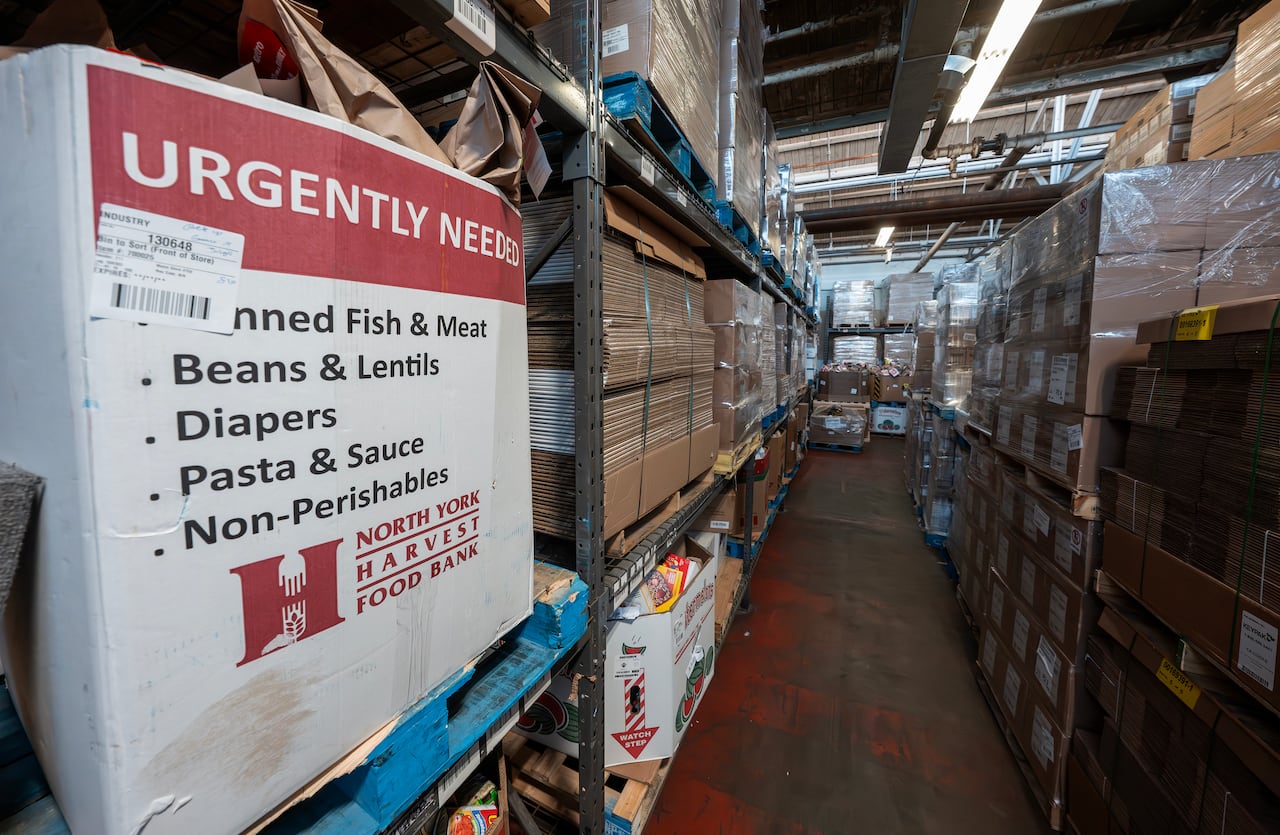
Shelves at the North York Harvest Food Bank in Toronto on Oct. 20. A new report from the Salvation Army says nearly one in three Canadians is skipping or reducing meals because they can’t afford groceries. (Frank Gunn/The Canadian Press)
In downtown St. John’s, demand at the Bridges to Hope food bank is up this year by 20 per cent over last year, executive director Lesley Burgess said earlier this week, and she says inadequate incomes and high costs are driving the need.
“Food banks are designed to [provide] a few days of food to get you through an emergency until your next cheque comes,” she said.
“The problem that we’re seeing now is that the cheque coming is not enough to cover even the basics.”
Canadian food bank usage hit record highs this year, and a new report from the Salvation Army says nearly one in three Canadians is skipping or reducing meals because they can’t afford groceries.
So what needs to change?
The failure to provide an adequate living wage leaves workers chronically stretched to afford the basics of life, says McDowell, the lecturer at Toronto Metropolitan University. Some have to work additional hours or take on extra jobs to make ends meet.
The reality for those making about minimum wage may be even more dire than the data suggests, adds McCracken, because a living wage assumes someone is working full time. When more often, someone making a lower wage might be working part time or have precarious work with shifting schedules and no sick days.
So, what’s the answer? The Canadian Federation of Independent Business told CBC News earlier this week that it isn’t very realistic for many small- and medium-sized businesses to offer a living wage while lower profits and trade and tariff pressures are dampening bottom lines.
McDowell says the minimum wage should be formally indexed to the local living-wage benchmark and to the actual costs of living, “rather than being left to the discretion of politicians and policymakers.”
“The underlying principle, however, is that full-time work should be sufficient to cover the essentials of life,” he said.
There are a lot of potential benefits to increasing provincial minimum wages, McCracken added, like less employee turnover and fewer costs to the public sector for resources like employment insurance. But there also needs to be better low-income supports, like tax breaks, rent control and stronger employment standards, she says.
Manitoba’s minimum wage increased to $16.40 on Oct. 1. But even then, it falls about $4 short of the living wage in Winnipeg, which, as McCracken points out, was the site of the famous 1919 general strike.
“The fight for a living wage was one of the main asks of that movement and still to this day we’re fighting for it,” she said.
WATCH | Living wage varies widely across Alberta:
Alberta’s living wage all over the map in 2026
A 2026 report on the cost of living in Alberta suggests this year’s living wage varies by community. CBC’s Chelsey Mutter breaks down what you need to know.