

Esmail Sagheb Esfahani, a vice president who heads the state energy efficiency agency, admitted this week that “we really have a supply problem.” He told Iranians they could no longer count on fuel stations to cover what they need, and should save part of their monthly ration before traveling.
“All the gasoline the government has, it has given to the people,” he said. “Nothing has been held back to supply more.”
On Thursday night, residents of Bandar Abbas, the main port on the Persian Gulf, blocked a road near a fuel station in the city’s Rajaei district with their cars, protesting long lines and empty pumps. Drivers on the Minab–Bandar Abbas route had protested earlier over the lack of fuel.
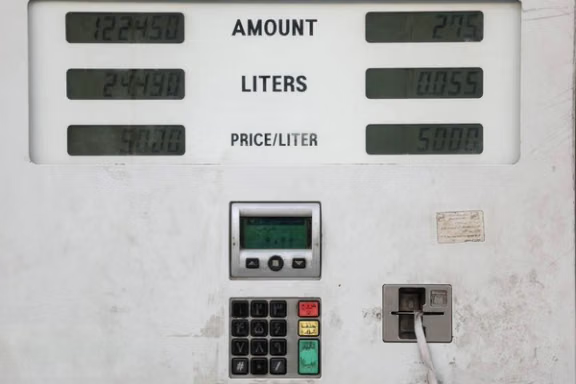 Price of gasoline is displayed on a fuel dispenser. Seven years after ‘Bloody November’
Sunday marks seven years since the government announced, shortly after midnight on November 15, 2019, that gasoline prices would rise by 50 to 200 percent. Drivers who had paid 10,000 rials a liter would now pay 15,000 for their first 60 liters a month and 30,000 after that.
Protests broke out within hours and spread to more than 100 cities. Demonstrators blocked highways with their cars, burned banks and tore down images of Supreme Leader Ali Khamenei. On the second day, Khamenei told senior officials, “Do whatever it takes to end it,” Reuters later reported, citing people close to his inner circle.
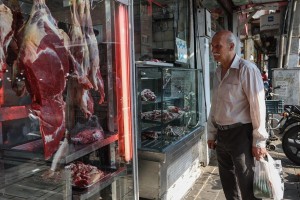 Hardline daily accuses government of scaring Iranians, says there is no crisis
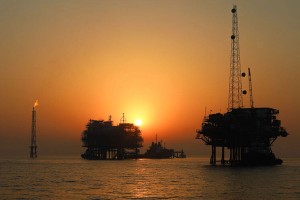 Iran’s oil output plunges below pre-war domestic needs
The state cut off the internet for about a week, and security forces shot protesters with live ammunition, including from rooftops, in Mahshahr in the southwest and in cities across the country. Hundreds of people were killed and more than 7,000 arrested. Iranians call it “Bloody November,” or “Bloody Aban,” after the month in the Iranian calendar.
Those two prices, 15,000 and 30,000 rials, are still the two cheapest tiers today. In 2019 the cheaper one was worth about 12 cents. After seven years of inflation and a collapsing rial, it is worth about half a US cent.
The state has not risked a general price rise since. Each time economic pain has boiled over, it has turned on the state: fuel stations in Tehran were set on fire when rationing began in June 2007, and the uprising over the economic collapse in December 2025 ended in the January massacre.
That memory hangs over every decision. Sagheb Esfahani said this week that the price of the third tier would be reviewed every season, but that “a range of security, military and law enforcement bodies” had to give their opinion first. Government spokeswoman Fatemeh Mohajerani said the two cheapest tiers would not change.
Gasoline for half a cent
Each private car gets a monthly ration on its fuel card: 60 liters at 15,000 rials a liter, half a US cent; 50 liters at 30,000 rials, about one cent; and, since September 8, 50 liters at 100,000 rials, under four cents. A full month’s ration of 160 liters costs about 7.4 million rials, or $2.70.
What the government is doing instead of increasing prices is cutting access.
Until now, drivers who ran out of their ration could fill up with the station’s own “emergency” card at the third-tier price. On September 7, those station cards supplied 41 percent of all gasoline sold, about 59 million liters a day, the national fuel distribution company said.
Since November 1, station cards have been withdrawn in 11 provinces, almost all of them along Iran’s borders with Pakistan, Afghanistan, Turkmenistan, Iraq, Turkey and the Caucasus, plus the Persian Gulf coast, where officials say subsidized fuel is smuggled out. The plan began in Kerman, the first to lose the cards, before spreading.
Tehran, which burns about 20 million liters a day, as much as 15 other provinces combined, has been spared for now. There, each fill-up with a station card is tied to the car owner’s national ID instead. Drivers anywhere who need more than their ration are told to buy premium gasoline at about 1 million rials, or 37 cents, a liter, more than 60 times the cheapest rate.
Executive Vice President Mohammad Jafar Ghaempanah said the cards would be collected province by province within weeks, blaming smuggling.
“Several thousand Nissan pickups do nothing but collect fuel from different provinces and take it across the border,” he said, putting smuggling at 30 million liters a day. A liter of gasoline sells for about 2.6 million rials, or 96 cents, in Pakistan.
Former lawmaker Nezam al-Din Mousavi said about 90 percent of smuggled fuel was diesel, not gasoline. “Stop making excuses and say you are after price rises,” he said.
‘Neither the capacity nor the money to import’
Behind the measures is a supply gap that the war has made impossible to close.
Iran consumed about 133 million liters of gasoline a day on average through October, peaking at 144 million in September, while refineries produce between 112 and 135 million, according to official figures cited by Rouydad24.
Hossein Taeb, head of the Basij militia, said on Thursday that Iran still imports about seven million liters a day. The US naval blockade of Iran’s ports, in place since April, has made those imports harder and costlier, and refineries and fuel depots were damaged in the war.
“Every effort of the government is to match gasoline consumption with domestic production,” Ata Hosseinian, an economic and energy journalist, told Iran International. “There is neither the capacity nor the money to import gasoline.”
The government, he said, is applying the method it used for electricity and gas bills: a fixed cheap ration, and a much higher price above it, while station supplies are released “drip by drip.”
“People have to go to five stations to maybe get the cheaper gasoline at one of them after standing for hours,” he said.
“The Islamic Republic is threatening people with death so they’ll settle for a fever,” he said, citing a Persian saying. Once the fate of Hormuz and the blockade is settled, he expects the third-tier price to rise step by step, each season, toward 500,000 to 700,000 rials a liter, 18 to 26 cents.
‘Please stop talking’
The rationing has also split the establishment.
Within a day of Sagheb Esfahani’s remarks, First Vice President Mohammad Reza Aref ordered officials to stop commenting on gasoline, saying decisions would be announced only by the government spokeswoman or the national refining and distribution company.
A former lawmaker, Ahmad Amirabadi Farahani, posted a message to Sagheb Esfahani: “Doctor, please stop talking, stop giving interviews, stop getting on people’s nerves.”
The hardline daily Kayhan accused “a current” in the government of pursuing higher prices “by other methods,” called the two vice presidents’ remarks “provocative” and said they had fed “hostile media.”
“Regulatory and security bodies must step in as a deterrent,” it wrote. It also warned that without station cards, Iranians could not flee cities if war resumed, as many did during the 12-day and 40-day wars.
The hardline Farhikhtegan called the policy “a media game with society’s psyche in the middle of a war.”
‘What can you do with 110 liters a month?’
Online, the measures drew anger and ridicule.
“With the fuel use of domestic cars, what can you do with 110 liters a month?” one user wrote,. Another asked what the plan was for millions who drive into Tehran every day “to earn 350 or 400 million rials a month,” about $130 to $150, “and survive on bread and eggs.”
“The government’s message is that the real price of gasoline is 1.1 million rials,” a third wrote. At that price, a month’s ration of 160 liters would cost more than the minimum wage of about 166 million rials, or $61