
Columnist is ‘nervous’ about outrageous speeds on city streets but it also ‘unsettled’ by the ubiquitous around-the-clock surveillance that is now prevalent
The City of Orillia envelope was waiting for us in the mailbox when we got home from a short, lovely holiday.
I picked it up gingerly, as if it might go off in my hand.
I don’t mean to be unkind, but by their nature, envelopes from the city usually contain mandatory demands for money.
“Our taxes are paid up?”
“Yep.”
“Garbage tags?”
“Got ’em.”
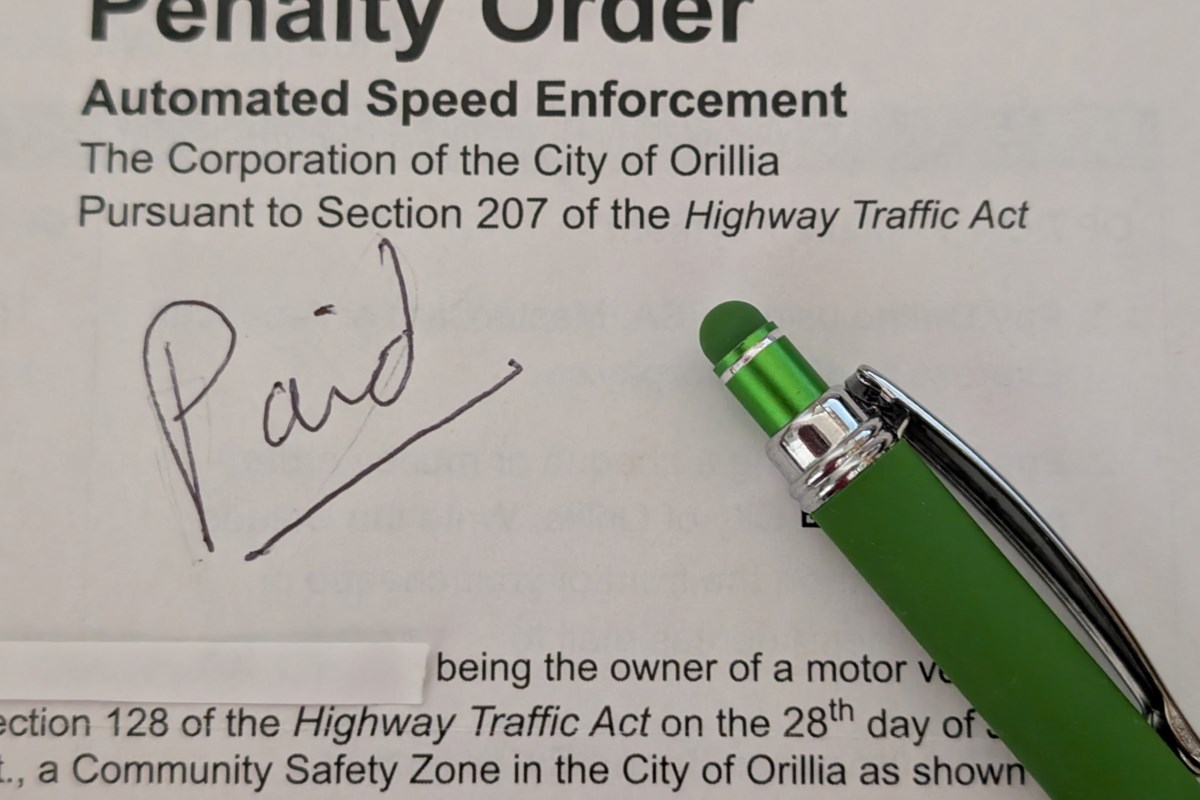
I tore it open. Inside was a “Penalty Order” with a photo of our car on it and an accusation that said car had been going 61 km/h in a 40 km/h community safety zone.
Two hundred dollars, please.
We stood at the front door looking at each other with big eyes and an odd mixture of sheepishness and hopeful accusation playing across our faces.
I read it more carefully.
“July 28 at 8:46 am,” I said, feeling the sheepishness starting to lift. “Fittons Road.”
We deduced that was the morning Sandi went to get groceries early to beat the crowds. I was off the hook, but we were still on the hook for the $200, so the relief was short-lived.
We looked at each other some more.
We could challenge, but what would our argument be?
“Your Honour, the ice cream was melting. We had to book it home.”
“Your Honour, we thought those speed limits were just helpful suggestions.”
“Your Honour, those signs warning about the coming speed cameras for the last three months were pretty much the same colour as every other speed limit sign we ignore. That’s entrapment.”
“I’ll pay it,” Sandi said.
All across Orillia, you could hear the gnashing of teeth. Petitions were being prepared. Pitchforks were being sharpened.
It was revealed that more than 4,000 tickets had been issued in the month since the cameras were turned on. One poor woman received 17 tickets over a 12-day period, racking up nearly $3,000 in fines.
I open the mailbox with tongs these days.
The truth is, for most of us driving around in outrageously powerful machines, it’s pretty easy to forget yourself and slip over the speed limit. Those of us who haven’t done it, please cast the first stones.
But the slippage has seemed to me to be getting more and more egregious since the pandemic. Maybe it was the weeks and weeks of nearly empty streets that unleashed collective demons.
I’m regularly astounded now by the speeds some people reach on my residential street. And I’m nervous. There are kids here. A lot of people walk along this road, which has no sidewalks. Horrible accidents have occurred in town.
One person managed to hit 100 km/h in one of the new community safety zones, according to OrilliaMatters. This is not slippage; it’s wilful negligence. A licence should be revoked.
But at the same time, I’m unsettled by the unsleeping eye.
As we work to solve one problem after another with around-the-clock surveillance — a camera here, another there — I worry that we’re trading something profoundly precious, profoundly human, for some impossible standard of safety.
It’s the slow, drop-by-drop creation of a tidal wave that may one day sweep away all sense of autonomy and freedom, including the freedom to transgress. We’ve done it to ourselves with the ubiquitous cell phone camera and social media. We welcome government use of surveillance more and more.
I’m not going to sign a petition.
But I’d prefer a speed bump to a camera.
Mark Bisset spent the past 14 years of his working life as the executive director of the Couchiching Conservancy before retiring in 2024. In a previous iteration of himself, he worked in every news department at the Orillia Packet & Times, a daily newspaper from a bygone era. Mark was the managing editor when he stepped down in 2009. And before all of that, he was a pretty happy kid. He’s a lifelong sailor and gardener who has chosen Orillia as his beloved home for the past 38 years.