
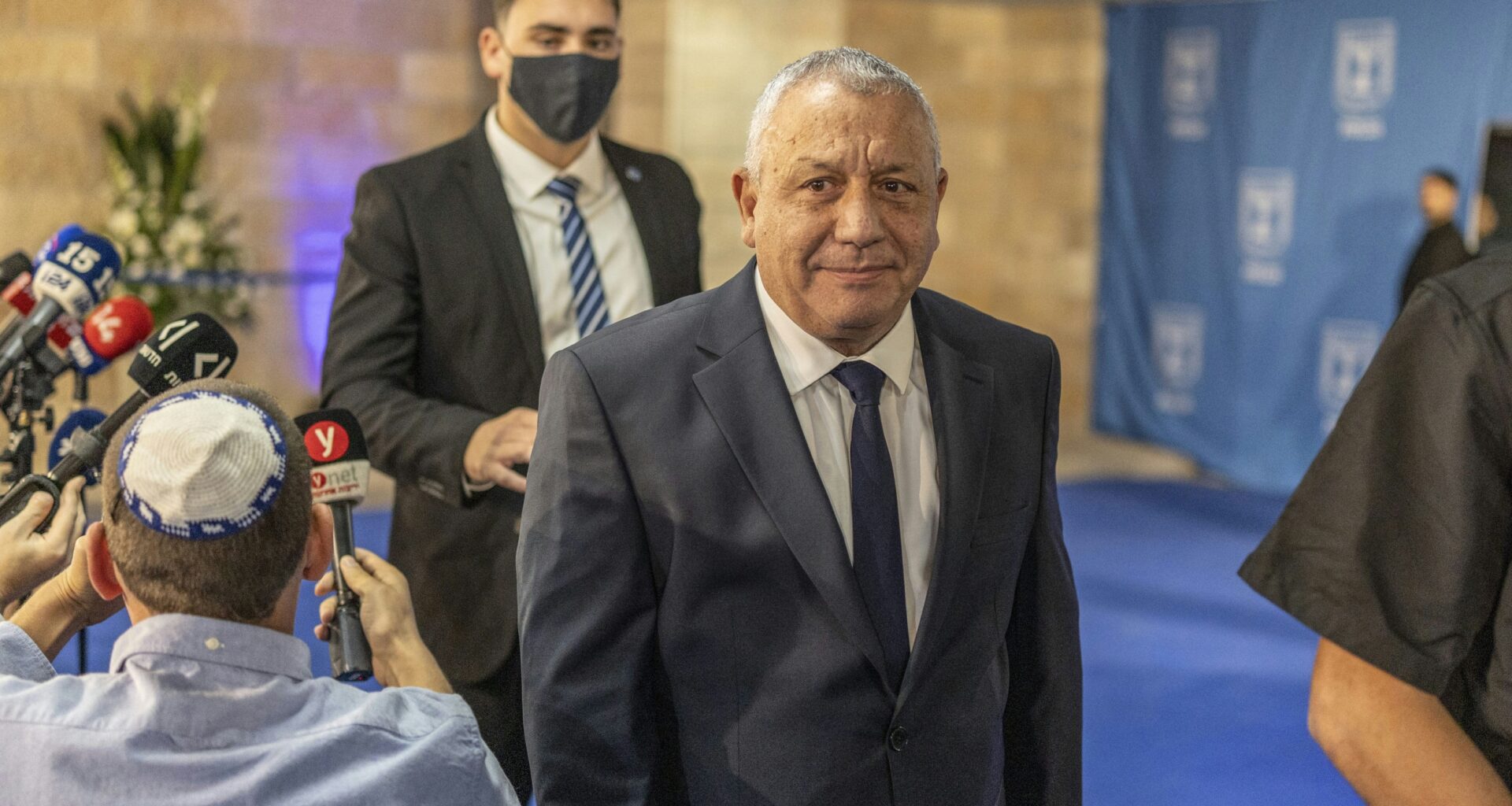
Israeli opposition leader Gadi Eisenkot walks past journalists as he arrives at the Israeli parliament (Knesset) on the opening day of the new parliament in Jerusalem on November 10, 2026.
Photo by Ilia YEFIMOVICH / AFP via Getty Images
The Briefing:Opposition leader Gadi Eisenkot, tasked with forming Israel’s next government after earning 67 lawmakers’ endorsements, condemned Netanyahu’s campaign linking Arab legislators to Hamas as “racist and violent.”Arab-led parties Ra’am and the Joint List captured a record 19 seats in the October 27 elections, giving them pivotal influence over any coalition-building effort.Eisenkot sent a formal letter warning Netanyahu against launching military operations during the transition period and separately asked the attorney general to guarantee security briefings for the opposition.
Israeli opposition leader Gadi Eisenkot went on the offensive Friday, denouncing a coordinated effort by Prime Minister Benjamin Netanyahu and his right-wing allies to tie Arab lawmakers to Hamas, labeling the smear campaign “racist and violent” and vowing he would not stand aside while an entire community bore collective blame.
The statement from the Yashar party leader — who was tapped by President Isaac Herzog to attempt government formation after 67 lawmakers backed his candidacy — arrives at a moment of acute political tension, with Arab-led factions holding substantial sway over whether Eisenkot can reach a governing majority of 61 seats in the 120-member Knesset.
‘An Entire Sector Cannot Be Defamed’
Writing on X, Eisenkot drew a firm boundary between principled political opposition and ethnic targeting. “You can disagree with representatives of Arab parties, even deeply despise some of them,” he wrote, “but you cannot, it is not dignified, and I will not allow an entire sector to be defamed.”
The statement was a direct rebuke of tactics deployed by Likud and allied far-right figures, who have repeatedly attempted to cast Arab legislators as proxies of Hamas. During the campaign, Netanyahu’s party challenged Eisenkot by questioning how he could “destroy Hamas without getting permission from your partners, Mansour [Abbas] and [Ahmed] Tibi” — a line designed to exploit Israeli Jewish voters’ fears rather than engage substantive policy disagreements.
Eisenkot anchored his defense in Israel’s founding principles, arguing that attempting to collectively corner Arab citizens “runs against the spirit of statesmanship and dishonors the Declaration of Independence and the values we pride ourselves on as a Jewish and democratic state.” He also noted that Arab citizens represent 21 percent of Israel’s population — a demographic weight no governing coalition can responsibly dismiss.
A Record Election Night That Reshaped the Math
Eisenkot’s public defense of Arab political participation follows an election outcome that dramatically altered Israel’s political landscape. Arab-led parties captured a record 19 seats in the October 27 elections — one-sixth of the full Knesset — driven by high turnout and deep frustration with Netanyahu’s far-right government. Ra’am and the Joint List emerged from election night as genuine kingmakers in any coalition-building scenario.
Eisenkot has openly acknowledged the arithmetic reality. While he has stopped short of formally inviting Arab parties into his coalition, he has not foreclosed the option of a minority government sustained through their external support — a scenario Netanyahu’s camp has aggressively weaponized to stoke anxieties among right-leaning voters.
The Letter to Netanyahu — and What Eisenkot Is Watching
Eisenkot also revealed that he had reached out directly to the outgoing prime minister, though he disclosed no specifics of what was communicated. His only public remark on the matter: “I made clear that I will not allow a lack of oversight.”
That statement followed a formal letter Eisenkot had sent earlier in the week urging Netanyahu to refrain from launching military operations unless faced with “a direct and immediate threat,” at least until a new government is formally sworn in. He also requested that Israel’s attorney general intervene to ensure the opposition receives regular security briefings throughout the transition period.
“For me, Israel’s security is above any other consideration and must never be used for political gain,” Eisenkot wrote — a pointed reference to what he and his allies describe as Netanyahu’s pattern of conflating security decisions with political survival.
National Unity as the Foundation of Eisenkot’s Bid
Friday’s statement is fully consistent with the governing identity Eisenkot has built throughout Israel’s most consequential electoral cycle in years. Running on a platform centered on judicial independence, the rule of law, minority rights and press freedom, the former IDF chief of staff has positioned himself as a sharp contrast to what he characterizes as Netanyahu’s divisive and self-serving leadership style.
His endorsement of Arab political participation as legitimate — if conditional — signals that he sees Israel’s Arab citizens not as a threat to be managed or a liability to be hidden, but as a constituency deserving of respect. “Arab citizens of Israel are an integral part of Israeli history,” he wrote in the closing lines of his post — a quiet but pointed repudiation of the othering language coming from the Netanyahu camp.
Twenty-Eight Days and Counting
Eisenkot now has 28 days from the presidential mandate to assemble a governing coalition. Should he fail, a second candidate would be nominated; if that effort also collapses, Israel would head back to the ballot box — keeping Netanyahu in a caretaker role that Eisenkot has pledged to constrain at every turn.
Whether his public defense of Arab lawmakers translates into stable political support remains an open question. But on Friday, Eisenkot made his position unambiguous: in the Israel he intends to lead, smearing citizens by ethnicity is not a legitimate campaign tactic — it is a disqualifying one.