
Sign up for the Slatest to get the most insightful analysis, criticism, and advice out there, delivered to your inbox daily.
In another act of defiance following midterms that delivered a resounding critique of his presidency, Donald Trump doubled down last week on his biggest foreign-policy failures. He continued to seek a peace accord with Russian President Vladimir Putin—who clearly doesn’t want peace—and stepped back from talks with Iranian leaders, who have shown some interest in making a deal.
One might think that after sending his son-in-law and an old real-estate buddy on countless major diplomatic missions without the slightest effect, Trump would say, “Hey, guys, I gave you a shot, now I’m sending in the pros.” But no, last week, Jared Kushner and Steve Witkoff flew to Moscow—the tenth time they’ve met with Putin himself, this session lasting three hours—again to no avail.
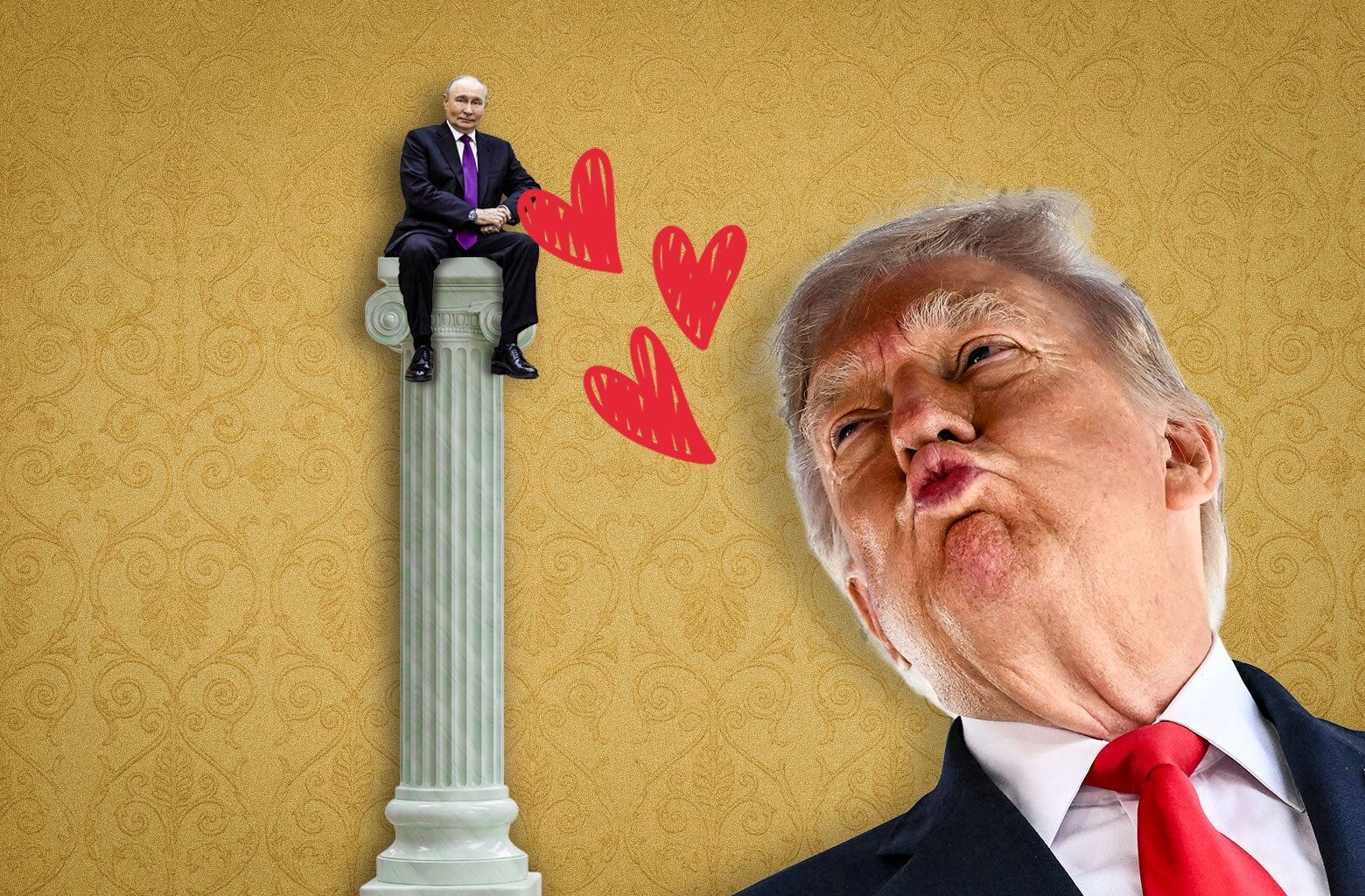
In fact, remarks by Putin and his top aide, before and after the visit, should have told the pair that all these talks are futile—a waste of time and jet fuel—but Trump and his team seem incapable of learning uncomfortable lessons. That seems doubly true when it comes to Putin, whose absolute power Trump seems to envy and whose friendship he desperately desires.
At the same time, Trump—who, a few weeks ago, had given Vice President JD Vance permission to hold direct talks with Iran—changed his mind, said the U.S. no longer needs a deal with the Islamic Republic, and ordered Vance instead to spend the remainder of his term rooting out “crime and corruption” in the Democrat-run cities of the homeland (this, despite the fact that crime in most cities is down and the nation’s most blatant corruption can be found in Trump’s own White House).
So, what’s going on? With Trump, it’s hard to say with any certainty, but here’s some context.
It’s been clear for some time, in some ways since the beginning of his presidency, that Trump venerates Putin and despises Ukrainian President Volodymyr Zelensky, whom he recently criticized for showing the Russians “great disrespect.” (Imagine that: disrespecting the leaders who invaded your country and deliberately bomb your people every night.)
At the latest meeting, Kushner and Witkoff “asked” Putin to include Europeans in any peace talks with Ukraine—as if they shouldn’t demand it as precondition to further discussions of any sort, since Ukraine is part of Europe.
The real issue here is not a quarrel over how to divide some parcel of land (contrary to Kushner and Witkoff, who think all disputes are about money and land) but rather that Putin and his team don’t regard Ukraine as part of Europe or even as an independent nation. “I think it is not their territory,” Putin recently said, disputing Ukrainians’ right to stave off his invasion, “but the historical territory of Russia.” Similarly, his chief negotiator, Vladimir Medinsky, said, “Every inch of Russian land will be returned to Russia, one way or another.”
It’s ambiguous whether Medinsky was referring to Ukraine’s Donbas region, which Russian troops only partially occupy, or all of Ukraine, as in Putin’s distorted view of history. But in the context of appraising a peace plan’s plausibility, it hardly matters.
Zelensky and European leaders have insisted on a ceasefire before any discussions of future boundaries or security can be discussed.
By contrast, Russia’s position is that there be no ceasefire without a broad agreement on a “new security framework.” While Kushner and Witkoff have postured as if they agree with Zelensky and Europe, they treat it as more of a suggestion than a demand. And Kushner has adopted Moscow’s language in some of his statements. Trump did as well, telling reporters last week that he would soon sign “a big beautiful agreement” that “might involve all of Europe,” adding, “Everyone’s going to be thrilled.”
Actually, no one in Europe is thrilled. As Ivo Daalder, senior fellow at Harvard’s Belfer Center and a former U.S. ambassador to NATO, recently noted, there already is a security framework in Europe: it consists of NATO, the European Union, and various accords that guarantee sovereignty and territorial integrity—the 1975 Helsinki Final Act, the 1990 Charter of Paris, among others—all of which Russia co-signed.
Kushner, who listed various provisions that a future framework might contain, apparently didn’t know that they are already cited in the existing accords—it’s just that Moscow isn’t abiding by them. It’s no surprise. He and Witkoff have no experience in these sorts of talks; nor are any foreign service officers or other experts advising them as they wade into muddy waters way over their heads.
It gets worse: The New York Times reported Friday that Russian envoys revived an old demand that, in exchange for peace in Ukraine, NATO pull back its positions to where they were in 1997, before the alliance expanded. This would mean withdrawing troops from all the countries that were once part of the Soviet Union’s Warsaw Pact—a demand that, one would hope, even Trump finds unacceptable. He should also treat it as evidence that Putin is completely unserious about any peace that doesn’t include Ukraine’s—and the West’s—surrender.
As for Trump pulling Vance away from negotiations with Iran, this may mark the beginning of a pullback from the Middle East generally. That may not be a bad thing, especially since Trump tends to make matters worse when he goes full-bore into the region. (In fairness, the same can be said of other American presidents.)
But his stated reasons for calling off these peace talks are bizarre. “We don’t need a deal with Iran,” he posted on social media Thursday. “Those days have long since passed. We’ve got their money. Hundreds of Billions of Dollars, and we’ve got their Strait!”
None of this makes sense. What money, much less Hundreds of Billions of Dollars, is he talking about? (His secretary of defense has had to request tens of billions to replace the weapons he depleted while attacking 15,000 Iranian targets, for no purpose and with little effect.) And we certainly haven’t “got” the Strait of Hormuz. (Other countries have cut deals with Iran to get oil flows, but we haven’t.)
In any case, money and oil aren’t the only issues here. As Trump has said the war was worth fighting to keep nukes out of Iran’s hands. But if Iran does have the capacity to restart its nuclear program (a big if), some deal is worth making there. And what about Iran’s ballistic missiles (which they have resumed building) or support for terrorist groups (which never stopped) or suppression of its people (which Trump pretended to put front and center at the start of the war but which he clearly doesn’t care anything about)?
Something else is going on here that keeps the self-proclaimed master of the “art of the deal” from even pursuing a deal. One possibility is that he realizes no deal can be made without making concessions—for instance, unfreezing Iranian assets—which will make his Iran deal look all too much like President Obama’s deal, which Trump has lambasted as the worst deal ever made.
But there’s another possibility and it has nothing to do with diplomatic strategy: he’s roaring pissed at Vice President Vance. The morning after the midterms, Vance posted on social media that Republicans lost the House and Senate because of the war in Iran. He was careful to note that Trump agreed with him on this the previous night, but in fact Trump had only said the war might have been one reason for the outcome. More than that, Vance was going against Trump’s broader PR themes—that the war was a success (“We won,” he said at Arlington Cemetery on Veterans’ Day) and that the midterms were not a repudiation of Trump’s presidency (“I wasn’t on the ballot,” he posted, after urging voters 63 times to pretend that he was—which they seemed to do).
Vance hopes to be the next president. (That’s why most people agree to be vice president.) He has long made it known that he spoke out against the war in behind-closed-door meetings. He’s now pushing that point as a way of dissociating himself from Trump’s most unpopular legacy, but he’s trying to thread the needle of doing it without dissing Trump or the MAGA movement. Trump no doubt sees through this attempt to have it both ways, probably views it as an act of disloyalty (the worst sin in Trump’s book), and may want to put the kibosh on Vance’s ambition to succeed him.
This Content is Available for Slate Plus members only
For the Next Six Weeks, We’re All Basically Going to Be Getting “GOP After Dark”
This Content is Available for Slate Plus members only
I Never Imagined My Cocktail Book Would End Up Part of a Censorship Battle—but I’m Not Taking It Sitting Down
Who knows if direct talks with the Iranians would have led anywhere. Negotiations mediated by Oman seemed productive back in mid-February, but Trump had his emissaries—again, the hapless pair of Kushner and Witkoff—walk away and started bombing instead. It’s a damning commentary on how badly Trump fluffed this war that the Iranians now have more leverage than they did before all the death and devastation they’ve since suffered. It’s also the case that Vance has no more experience at diplomacy than the Trump’s son-in-law and fellow tycoon do, so he might have been incapable of getting a deal even if one was there to be had.
But here’s the point: If there was even a chance that direct talks might lead to some semblance of peace and stability, Trump might not want Vance to be able to claim credit for it—especially since Trump and his handpicked pair made no headway.
It is a sorry thing that, at this time of shifting geopolitics and great turbulence, despite his massive repudiation at the polls, Trump remains president for another two years.

Jim Newell
For the Next Six Weeks, We’re All Basically Going to Be Getting “GOP After Dark”
Read More
Copy Link
Share
Gift Story
You have remaining gift available this month. This gift link is valid through .
There was an error with your gift link. Please try again.
Copy link
Link copied!
Only Slate Plus members can gift Slate stories. Become a member to share 10 free articles a month.Become a Plus Member