
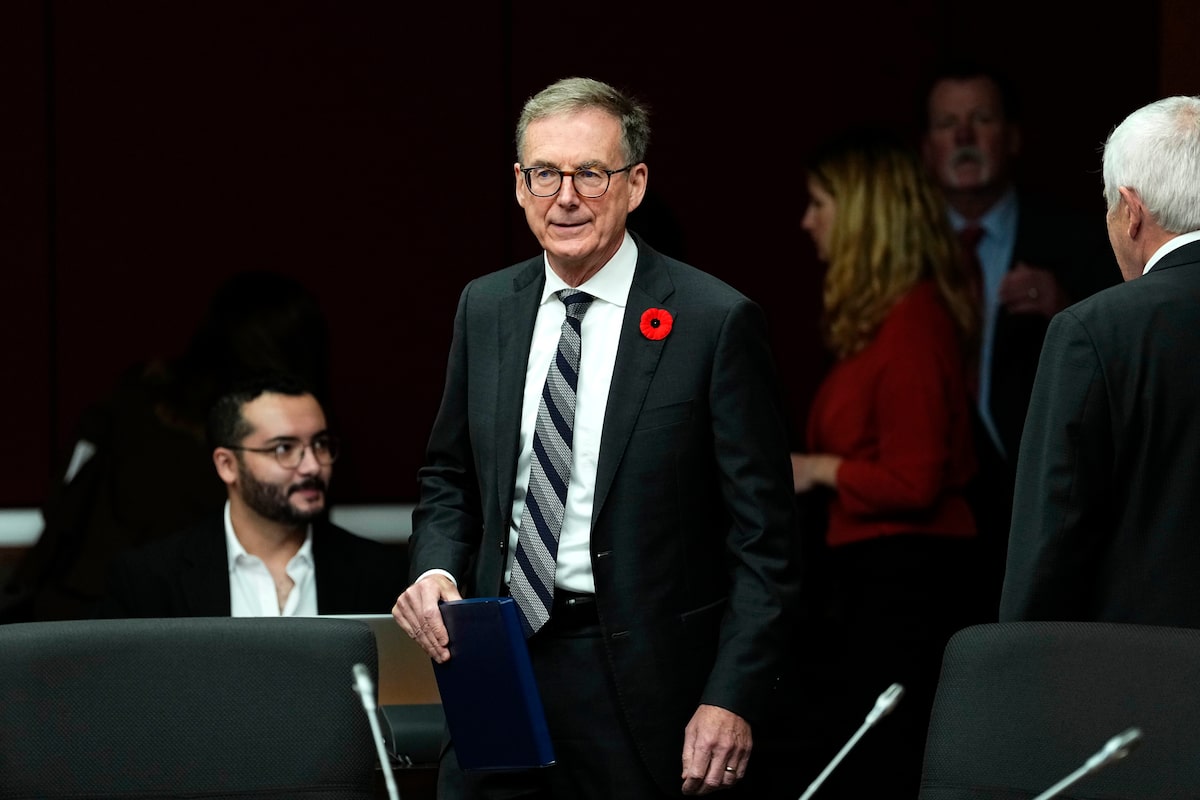
BoC Governor Tiff Macklem arrives to a Senate banking committee meeting in Ottawa this month. He has confirmed he will not seek a second term as head of Canada’s central bank.Justin Tang/The Canadian Press
The Bank of Canada is officially launching its search for a new governor, with Tiff Macklem confirming on Monday that he will not seek a second term when his seven-year appointment ends next June.
The bank’s 12 independent directors have formed a search committee to select the next governor, and the recruitment process is expected to be completed by spring 2027, the bank said in a news release.
The governor is technically chosen by the board of directors. In practice the final decision will rest with Prime Minister Mark Carney, himself a former governor of the bank, and Finance Minister François-Philippe Champagne.
With one year left for Bank of Canada’s Tiff Macklem, it’s still one battle after another
“It has been the highlight of my career to serve as the tenth Governor of the Bank of Canada,” Mr. Macklem said in a statement. “My time as Governor has seen Canada navigate a more fragmented, shock-prone world. The Bank has faced these challenges by acting decisively, by using sound judgment in the face of uncertainty, and by serving Canadians with humility and a steadfast commitment to its mandate.”
The central bank governor is one of the three most important roles in the Canadian economy, alongside the prime minister and finance minister. He or she sets the benchmark interest rate that underpins borrowing costs across the country and manages a vast institution that sits at the core of the Canadian financial system.
BoC hikes rate to 2.5%, suggests more may be needed to contain oil-price shock
Whoever takes over from Mr. Macklem will inherit a complex economic environment, defined by supply shocks and elevated inflation, trade tensions with the United States, heightened financial stability risks and rapid technological change driven by artificial intelligence. They’ll also be running an institution whose responsibilities have grown in recent years to encompass regulatory oversight of the country’s retail payments system.
Who are possible candidates to replace Macklem?
The Globe and Mail spoke to nine leading economists and former central bankers to get a read on the field of potential candidates.
The odds-on favourite is Jean Boivin, the head of the BlackRock Investment Institute and a former Bank of Canada deputy governor during Mr. Carney’s term at the bank. The two other most commonly mentioned names are former senior deputy governor Carolyn Wilkins and current deputy governor Nicolas Vincent.
Several Big Six bank chief economists are thought to be in the running, including Jean-François Perrault of Bank of Nova Scotia and Frances Donald of Royal Bank of Canada. Former deputy governor Paul Beaudry and Deputy Finance Minister Nick Leswick were also mentioned as potential candidates.
The board of directors has already begun reaching out to candidates it wants to interview, according to one of the sources. The search committee will be assisted by executive recruiting firm Egon Zehnder.
The Globe and Mail is not naming the sources as they were not authorized to comment on the bank’s selection process.
The last four central bank governors – Mr. Macklem, Stephen Poloz, Mr. Carney and David Dodge – were all recruited from outside the bank. Immediately prior to their appointments, Mr. Macklem was dean of Rotman School of Business at the University of Toronto, Mr. Poloz was chief executive of Export Development Canada, Mr. Carney was an associate deputy minister of finance and Mr. Dodge was deputy minister of health.
Several of the former central bankers The Globe spoke with said that the bank typically looks for candidates who have PhDs in economics, senior management experience, excellent communication skills in both English and French, and international knowledge and exposure.