
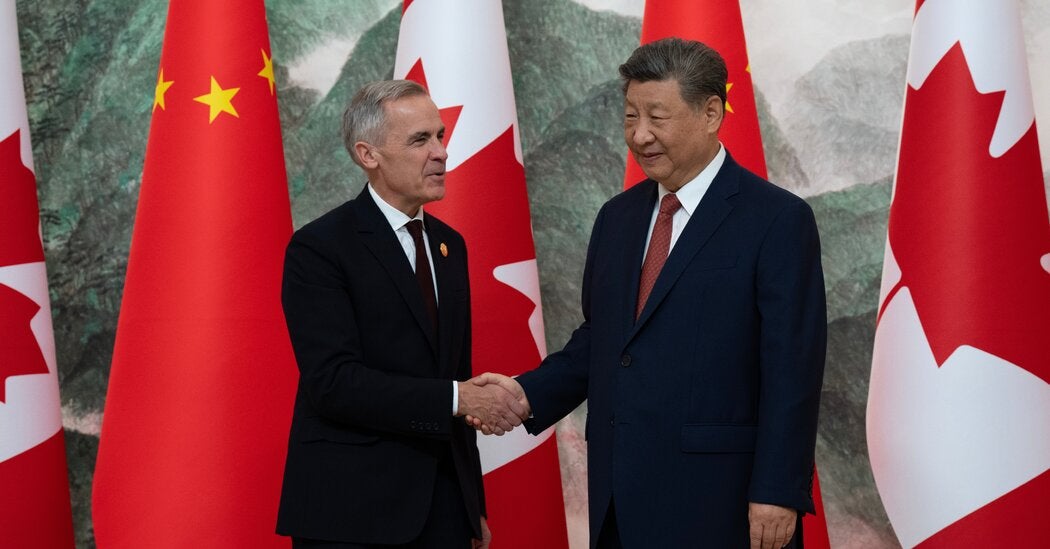
Prime Minister Mark Carney of Canada and China’s leader, Xi Jinping, have struck an agreement to reduce some tariffs between their countries, a largely symbolic move that shows relations between the two countries are warming as Canada’s ties to the United States falter.
While the expanded trade between China and Canada resulting from the accord in the Chinese tech and financial hub Shenzhen will be modest, involving just $280 million in exports, the pact — as well as the seemingly amicable meeting — illustrates a contrast to Mr. Carney’s relationship with President Trump. Earlier this year, Mr. Carney said that the United States was “at war” with Canada after trade negotiations between the two countries collapsed in acrimony.
Talks are restarting between Canada and the United States but there is no indication that Washington will back away from key irritants including tariffs of up to 50 percent on Canadian autos, steel and aluminum.
Since entering politics last year, Mr. Carney has been traveling the world to diversify Canada’s economic and political ties away from the United States. Those efforts include current talks to make Canada the European Union’s first associate member and Mr. Carney’s second formal meeting this year with Mr. Xi.
“The stabilization of our bilateral trade arrangement is indicative of how we can work together more broadly, pragmatically, to solve problems,” Mr. Carney said at the start of the meeting with Mr. Xi on Tuesday.
He added that Canada is ahead of schedule with its goal of a 50 percent increase in exports to China by the end of the decade.
China and Canada were in a trade war after the Canadian government under Justin Trudeau, Canada’s former prime minister, followed the lead of the Biden administration and imposed a 100 percent tariff on Chinese-made electric vehicles. China responded with tariffs on a variety of Canadian products, particularly canola, an oil seed.
That dispute was largely resolved in January during the first formal meeting between Mr. Xi and Mr. Carney. China lifted its canola tariff after Canada agreed to allow a relatively small number of Chinese E.V.s into the country at a minimal tariff rate.
Before Tuesday’s meeting, Mr. Xi attempted to put the frosty relations firmly in the past, which were worsened by China’s arrest in 2018 of two Canadians in retaliation for Canada detaining a Chinese telecommunications executive under an extradition request from the United States.
“The development of Chinese-Canadian relations over the years has provided us with an important lesson,” Mr. Xi said at the start of the meeting. “We must respect each other, pursue equality and mutual benefit and seek common ground while setting aside differences.”
Tuesday’s announcement will largely eliminate tariffs on frozen Canadian pork and several seafoods. Both were caught up in China’s E.V. retaliation. Canada, in turn, will continue to suspend tariffs on some Chinese steel and aluminum products that were set to expire at the end of the year. It will also expand the list of products covered by the suspension.
A Canadian government document said that since March car plants in China have exported 16,211 vehicles to Canada under an annual quota of 49,000. Half of those autos, it said, are priced at under 35,000 Canadian dollars. It said that a second Chinese automaker has been given safety approval by Canada for its cars. That company, which the government will not name, plans to offer only cars that cost less than 35,000 dollars, Canada’s price limit target.
On Monday in Phnom Penh, Cambodia, Mr. Carney said that Canada will turn to China, Japan and Europe to save its auto industry if it is unable to eliminate Mr. Trump’s tariffs.
The meeting between Mr. Carney and Mr. Xi came ahead of the Asia-Pacific Economic Cooperation forum, which is being held in Shenzhen later this week.
Since his address to the World Economic Forum in Davos, Switzerland in January Mr. Carney has become something of a champion for nations with advanced economies that are not super powers — a group he calls “middle powers.”
But the main event of the APEC summit will be a meeting between Mr. Xi, Mr. Trump and Vladimir V. Putin of Russia.
When asked earlier in his Asia trip about the super power summit, Mr. Carney repeated Canada’s support for Ukraine following Russia’s invasion.
Canadian officials said they do not expect that Mr. Trump and Mr. Carney will meet in Shenzhen. Mr. Carney is also unlikely to meet Mr. Putin. He said over the weekend that he would not boycott a summit group photo including Mr. Putin, but only out of respect for China.