
Head west out of Paris, and well-heeled suburbs give way to sleepy commuter towns. There, two dots on the map illustrate one of the most dizzying pipelines of wealth on the planet: Saudi Arabia. About 14 miles outside the capital sits Château Louis XIV, a close copy of the nearby real thing in Versailles; Saudi Crown Prince Mohammed bin Salman bought the Château in 2015 for $300 million.
Turn north from there and you arrive at the small town of Cergy, where MBS inked a €6 billion deal in August to build three theme parks, apartment blocks, hotels, and infrastructure upgrades. “This project is designed to breathe new life into the territory,” Jean-Paul Jeandon, the area’s president, told me one rainy October evening. Without the Saudi deal, he said, Cergy faced poor growth prospects.
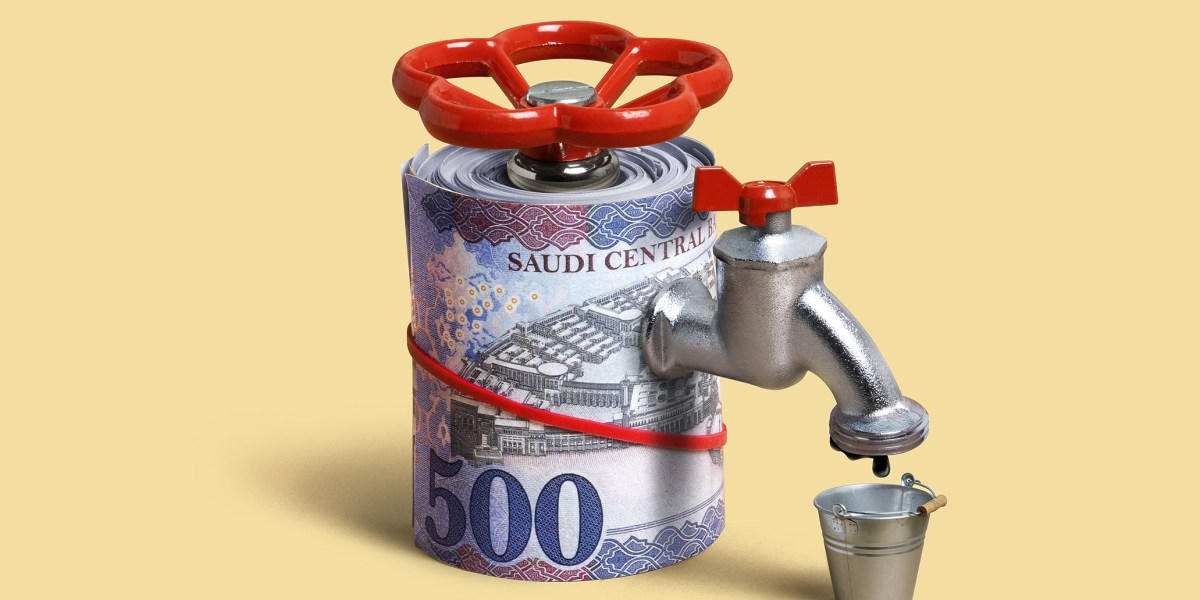
The town is not alone in tapping funds thousands of miles away—for good reason: For the past decade, the pool of Saudi money has seemed bottomless. With a steady influx of cash from vast oil reserves, the kingdom’s Public Investment Fund, or PIF—of which MBS is chairman—has seen its assets rocket 600% since 2015, to more than $900 billion, and has splurged on soccer, tech giants, California EV manufacturer Lucid, London’s Heathrow Airport, and numerous other investments, all while building mega-size tourism sites, arenas, and entertainment complexes back home.
Driving the action has been one defining project: Vision 2030, MBS’s signature strategy to transform the country by ending its overwhelming dependence on oil. No investment has seemed too big or costly; in fact, mammoth spending was the point: It positioned Saudi Arabia as a major player in tech, AI, entertainment, and other fields. Host the six-month World Expo extravaganza in 2030 in Riyadh? And the 2034 FIFA World Cup? The answer to both: We must.
But that giant pool may be drying up, and with it, Saudi Arabia’s splashiest plans for remaking its economy. After a decade of frenzied spending, MBS’s ambitions have been battered by the Iran war and Houthi attacks, rattling the kingdom’s business partners and other foreigners, including the millions of visitors the country had touted as proof of its transformation. Increasingly, Saudi officials worry whether businesses will seek partners elsewhere, rather than risk being embroiled in a country at war. If they do, the impact will be felt long after peace returns, not only by 36 million Saudis, but global business too, especially in the U.S., the biggest recipient of Saudi investment.
Companies will need to hunt hard for funding as deep as the PIF’s. The UAE’s sovereign wealth fund, an obvious alternative, is also feeling the war’s strain. “There is no obvious, equally large capital source waiting in the wings,” the Council on Foreign Relations warned in May.
The success of Vision 2030 rests on breaking the country’s isolation and cementing its global clout. When MBS unveiled the plan in 2015, the logic was clear: With 71% of Saudis younger than 35, millions more jobs were needed, including for women (who were finally allowed to drive). Entire new sectors—tourism, entertainment, sports—were necessary to break the dependence on oil and to stop fun-starved Saudis from blowing an estimated $1 billion a year traveling abroad to go to the movies and sample good restaurants.
A decade into MBS’s rule, the country remains an autocracy that sentences even mild critics to long prison terms and regularly executes nonviolent offenders. So even if MBS’s Vision 2030 dreams falter, his own grip is firm.
Despite that, witnessing the kingdom’s transformation up close has been a startling experience.
In 2017, a business consultant I met in a hotel lobby gawked at a speaker that was piping in soft music—until then forbidden under Saudi Islamic rules. By 2021, thousands were attending live concerts and dozens of AMC multiplexes had cropped up, ending a 35-year ban on cinemas. At the inaugural Formula 1 race in Jeddah in 2021, I gaped at dancers in skintight, hot-pink bodysuits gyrating on stage to ear-blasting DJ sets. And in 2024, when I asked Munira Aldayood, Riyadh’s director of conferences and exhibitions, why she’d returned home after 23 years of living in the U.S., her answer probably would have stunned people a decade earlier. “As a female, Saudi Arabia is now the best place to live,” she said. “It’s heaven.”
But for all Vision 2030’s ambitions, the country is still heavily dependent on oil. Oil production, fully controlled by the state-owned Saudi Aramco—whose strategy is overseen by MBS—still constitutes 60% of fiscal revenue, billions of which have been transferred to the PIF to pay for Vision 2030 projects. “Oil is the enabler of everything,” says Helima Croft, RBC Capital Markets’ global head of commodity strategy.
But oil is also a wartime vulnerability. The sharp rise in oil prices pushed Aramco’s third-quarter profits up 9%. Yet the war’s deleterious effects inside Saudi Arabia became clear not long after the U.S. and Israel dropped bombs on Iran last February. Iran shut the Strait of Hormuz to critical oil shipments, forcing Saudi Arabia to cut millions of barrels in exports a day or to pipe them overland to its Red Sea port. Glittering Vision 2030 events, geared to attracting global talent and tourists, were shelved. The PIF dropped its $5 billion LIV Golf investment in May, ditching efforts to acquire the PGA and sign top players. It rescheduled an international tennis tournament, postponed a film festival in Jeddah, and canceled the city’s Formula 1 race. Foreign direct investment into Saudi Arabia plunged 18% in the second quarter, and the country predicts its economy will shrink 3.6% this year, its steepest drop since the pandemic, with a $51 billion budget shortfall. “A lot of investment will sit on the sidelines and wait for some more signs of stability,” says Monica Malik, chief economist at Abu Dhabi Commercial Bank.
Riyadh, meanwhile, was closing its own wallet. The PIF set out to limit foreign investments to 20%, down from 30% in 2020; it withdrew its planned $200 million partnership with New York City’s Metropolitan Opera.
But for a time, the belt-tightening seemed isolated. The PIF kept spending, especially in the U.S. It plowed $10 billion into the Paramount-Warner Bros. merger in April, snapped up $26.3 million worth of SpaceX shares in June, and in August completed its $55 billion takeover of Electronic Arts, the Silicon Valley gaming giant.
That all suggested the Saudi bonanza would continue regardless. For companies looking for funding, “they believed it was an easy ATM,” says Croft.
-3.6%
SAUDI ARABIA’S EXPECTED DECLINE IN 2026 GROSS DOMESTIC PRODUCT IS THE STEEPEST DROP SINCE THE PANDEMIC.
$51 billion
ITS EXPECTED BUDGET SHORTFALL FOLLOWS A CUT IN OIL EXPORTS.
Source: Saudi Finance ministry
The flaws in that belief became stunningly clear one steamy afternoon in October, when Houthi rebels in Yemen fired a ballistic missile into Riyadh’s international airport—a core project of Vision 2030—killing 12 people outright. A second missile hit the airport the next day, forcing a shutdown and stranding thousands. Days later, a missile hit Saudi Aramco’s headquarters, forcing the world’s biggest oil company to evacuate its sprawling campus.
By late October, the PIF had canceled the country’s flagship business conference, the Future Investment Initiative, or FII, after it emerged that few Wall Street hedge funders or corporate execs dared risk traveling to the so-called Davos in the Desert. Aramco’s office in Riyadh was hit on Nov. 8. Reeling from the strikes, the PIF scrapped five of the multibillion-dollar stadiums it had promised to build for the 2034 World Cup. Even if peace returns, “they are going to be very focused on their own citizens, their own infrastructure needs,” says Croft.
For investors who’ve long become accustomed to bloated sovereign wealth funds in the Gulf, it will be a tough adjustment. In the PIF, U.S. execs found a ready taker for their startups and expansions. Buying into SpaceX’s public listing tripled the PIF’s U.S. holdings to $38.9 billion.
In fact, the Saudis have plowed billions into Silicon Valley startups in the past decade. The PIF’s $3.5 billion investment in Uber in 2016 helped power the company’s global growth, giving the fund a seat on the board and cementing close ties with Big Tech.
But the Iran war could change all that. With bombs hitting Saudi oil pipelines and refineries, “there’s going to be less to go around in terms of sovereign wealth funds cutting big checks for asset managers and hedge funds overseas,” Croft says.
Trying to calm jittery markets in October, Energy Minister Abdulaziz bin Salman (MBS’s half-brother) told industry representatives: “The word ‘fear’ in the Saudi dictionary does not exist.” But foreign businesses are far less blasé after the airport attacks. “If you’re a potential investor looking at a Vision 2030 project, and you see the main gateway attacked, you’ll say, ‘Well, I’ll invest in Singapore or Sweden,’” says James Reeve, a senior PIF director in Riyadh until last January.
Flying over Aramco’s Shaybah oilfield in 2017, I was stunned by its vastness, with rigs and pipelines stretching to the Persian Gulf. “We are cut off from the world,” Shaybah manager Khalid Al-Jamea told me. But the war has shown that sense of isolation was illusory. In October, Houthi rebels aimed a drone at Shaybah from 600 miles away, killing two oil workers before Saudi air-defense weapons shot it down.
No such dangers exist in Cergy, outside Paris. There, locals gathered one rainy October evening to debate whether to back the PIF’s projects, voicing concerns about traffic, pollution, and inflated rents. For the kingdom, the worries are more existential—including whether MBS’s grand plan for his country can stay on track.
This article appears in the December 2026/January 2027 issue of Fortune with the headline “The world got used to endless Saudi cash. That flow is slowing”