
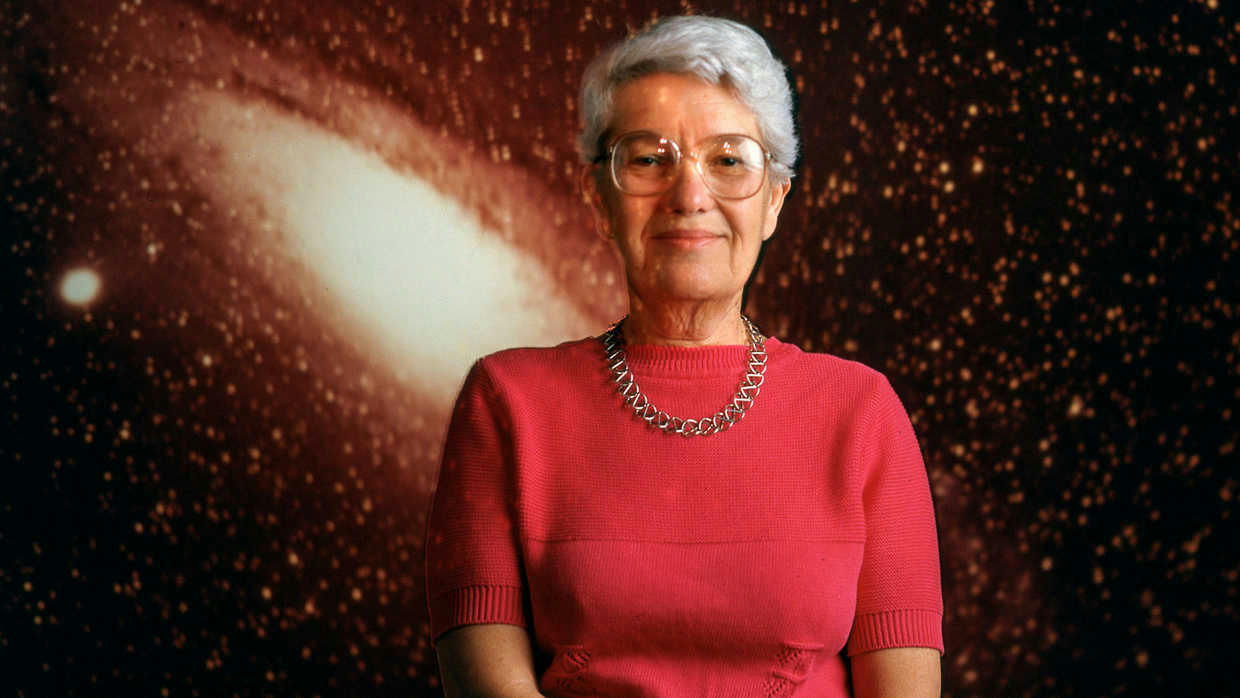
The universe is revealing its secrets like never before, thanks to the recently inaugurated Vera Rubin Observatory in Chile—an ambitious initiative by the U.S. Department of Energy and the National Science Foundation. Equipped with some of the most powerful telescopes ever built, the observatory promises to collect more data about the cosmos than all previous astronomical efforts combined. “The Rubin Observatory will capture more information about our universe than… throughout history combined,” said Brian Stone, acting director of the NSF.
In just its first few hours of operation, the observatory discovered over 2,100 previously unknown asteroids—an astonishing feat that hints at the groundbreaking discoveries to come. Fittingly, this monumental scientific endeavor bears the name of Vera Rubin, the pioneering American Jewish astronomer whose revolutionary work on dark matter reshaped our understanding of the universe. Though her contributions were long overlooked, Rubin’s legacy now rises with the stars she once studied.
Supportive Jewish Family
Vera Rubin was born in Philadelphia in 1928 and fondly remembered her upbringing in a warm, close-knit Jewish family. “My father, Pesach Kobchefski, was born in Vilna, Latvia,” she recalled. Her maternal grandmother, who hailed from Bessarabia, kept strictly kosher—a detail Vera remembered vividly.
From an early age, Vera was captivated by the mysteries of the natural world. “As a very young child, I was continually puzzled by the curious workings of the world,” she said. “As we drove home from… Bubba (Grandma in Yiddish) Cooper’s house, the bushes, trees and even distant hills passed behind us, but the moon sat steadily outside my window. How could the moon know that we were going home?”
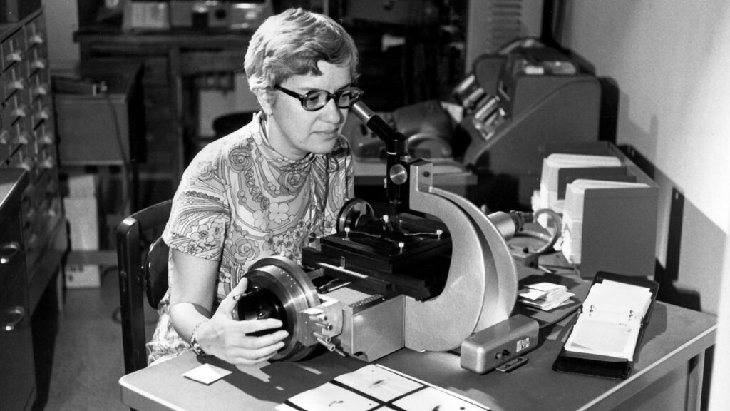 Measuring spectra recorded on photographic plates at the Carnegie Institution’s Department of Terrestrial Magnetism in 1972.
When her father took a position with the Department of Agriculture, the family relocated to Washington, D.C. There, Vera shared a bedroom with her sister. “From my bed against the window, I had a clear view to the north sky,” she remembered. “Soon it was more interesting to watch the stars than to sleep. I started reading library books, thinking that if I read enough books I would ‘understand it all.’”
Her parents nurtured her growing passion for science. Together, she and her father built a homemade telescope. Meanwhile, her mother successfully convinced the local library to let young Vera check out “adult” science books—fueling a lifelong pursuit of understanding the universe.
Though Vera’s parents believed in her abilities, she encountered overt sexism in school during the 1940s. Her high school physics teacher openly dismissed the idea of women pursuing science, going so far as to mock female scientists in front of the class. When Vera proudly shared that she had been accepted to Vassar College on a scholarship, he offered a chilling piece of advice: “Stay away from science.”
At Vassar—then an all-women’s college—Vera stood out. She was the only student in her year to major in Astronomy. After graduating, she began applying to graduate programs. Princeton, which did not admit women at the time, refused to even acknowledge her application. Undeterred, Vera went on to earn a Master’s degree from Cornell, followed by a Ph.D. from Georgetown.
Searching for “The Center of Creation”
At Cornell, Vera focused her research on the velocities of distant galaxies—a critical piece of evidence supporting the Big Bang theory. This foundational idea holds that the entire universe burst into existence in a single moment, and galaxies are still racing outward at astonishing speeds, a cosmic echo of that moment of Creation.
Her thesis was so compelling that one of her professors offered to present it at an upcoming scientific conference—on the condition that he receive all the credit. Vera declined. Instead, she insisted on presenting the research herself.
It wasn’t an easy decision. By that time, Vera had married Bob Rubin, a young Navy officer introduced to her by her parents, and they had a baby at home. On top of that, she didn’t yet know how to drive. Even so, she managed to make it to the conference—only to be met with hostility. She was heckled by “many angry sounding men.”
One voice, however, stood out amid the skepticism: renowned Jewish German astrophysicist Martin Schwarzschild told her the research was “very interesting” and deserved further exploration.
The next day, The Washington Post ran a striking headline across its front page: “Young Mother Finds Center of Creation.” Vera’s work helped shift scientific consensus and brought the Big Bang theory closer to accepted fact.
Discovering Dark Matter
Vera went on to have three more children while continuing her academic career as a professor at Georgetown University. In 1965, she began working at the Carnegie Institution of Washington, where she broke new ground by becoming the first woman permitted to conduct scientific research under her own name at the Mount Palomar Observatory in San Diego.
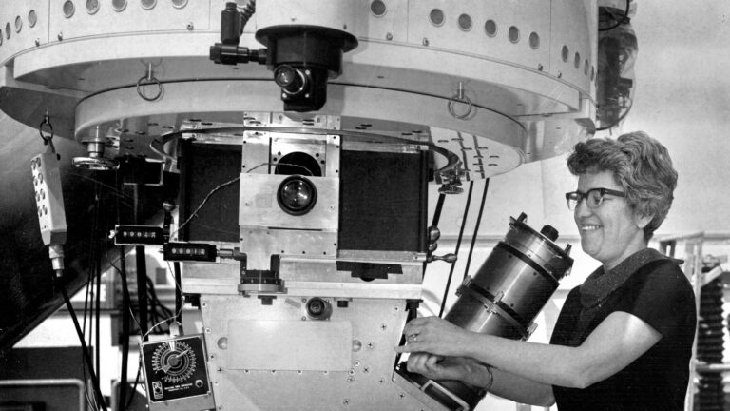 Using an image tube spectrograph on a telescope at Kitt Peak National Observatory.
There, she partnered with astronomer Kent Ford and delved deeper into the study of spiral galaxies—vast, rotating systems of stars. Together, they made a remarkable discovery: these galaxies were far more structurally cohesive than traditional physics would predict. Vera observed that stars on the outskirts of spiral galaxies were rotating just as quickly as those near the center. This defied expectations—according to Newtonian physics, the gravitational pull at the edges should be too weak to maintain such alignment. “What you see in a spiral galaxy is not what you get,” Vera famously remarked.
As she wrestled with this conundrum, Vera was reminded of earlier research by astrophysicist Fritz Zwicky. In 1933, Zwicky had studied the Coma galaxy cluster and noticed an unusually high gravitational force. Like Rubin, he observed that stars on the outer edges moved far faster than expected. Zwicky proposed that a mysterious, invisible substance—dunkle Materie, or “dark matter”—must be present, exerting gravitational force while remaining unseen.
Could the same unseen force Rubin and Ford had measured be the very phenomenon Zwicky had proposed decades earlier?
Their observations gave powerful momentum to the dark matter hypothesis. Vera calculated that dark matter must be about ten times more abundant than visible matter in the universe and that it exerts a gravitational pull across vast cosmic distances. For years, Rubin and Ford were widely considered strong contenders for the Nobel Prize. In 2015, many believed they would finally be honored with the Nobel Prize in Physics—but the award instead went to researchers studying neutrino oscillations. The decision sparked controversy, with some critics arguing that gender bias had once again denied Vera the recognition she so clearly deserved.
Committed Jew
Vera and her husband Bob were lifelong members of a synagogue in Washington, D.C., and Vera consistently described herself as a religious Jew. In a 1996 interview, she reflected, “I’m Jewish, and so religion to me is a kind of moral code and a kind of history. I try to do my science in a moral way, and, I believe that, ideally, science should be looked upon as something that helps us understand our role in the universe.”
She firmly believed there was no contradiction between science and religion. For Vera, scientific discovery deepened—not diminished—her sense of wonder and her understanding of the world and her place within it.
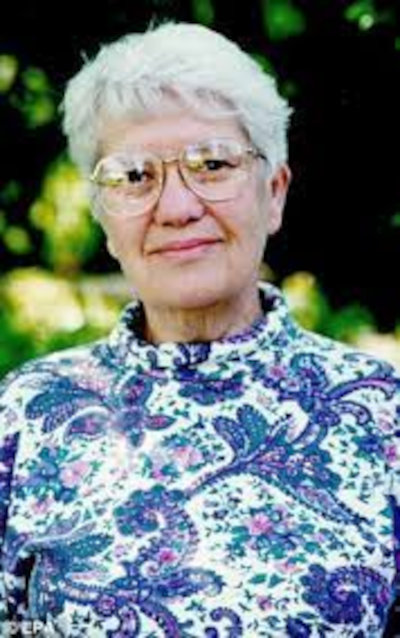
Though celebrated as a pioneer of dark matter theory, Vera remained humble about the limits of human knowledge. “In a spiral galaxy, the ratio of dark-to-light matter is about a factor of 10,” she once remarked. “That’s probably a good number for the ratio of our ignorance to knowledge.”
One value Vera held above all was our shared responsibility to be decent, fair, and kind. In a 1996 lecture at Berkeley, she urged students: “I hope you will love your work as I love doing astronomy. I hope that you will fight injustice and discrimination in all its guises. I hope you will value diversity among your friends, among your colleagues, and… among the student body population. I hope that when you are in charge, you will do better than my generation has.”
Vera Rubin passed away in 2016 at the age of 88. Today, the observatory that bears her name is beginning to chart the most expansive view of the night sky ever recorded. Like Vera, we too can look to the stars—seeking not just knowledge, but meaning. Inspired by her legacy, may we carry forward her spirit of inquiry, and continue to marvel at the extraordinary wonders of creation.