

People in high-income countries could dramatically improve lives worldwide with minimal financial commitment, yet few do.
Few things are more surprising than data about income inequality around the world. Our intuitions about this can be wildly off the mark.
In the Netherlands, the average person’s income over two weeks is more than the entire yearly income of the average person in Malawi.1 Global income inequality is staggering.
But we can also flip this insight around. Given vast inequality, those of us living in rich countries — even on an average income — find ourselves in an extraordinary position to do good.
In this article, we explain the data that shows the scale of this opportunity and explore how those in rich countries might seize it.
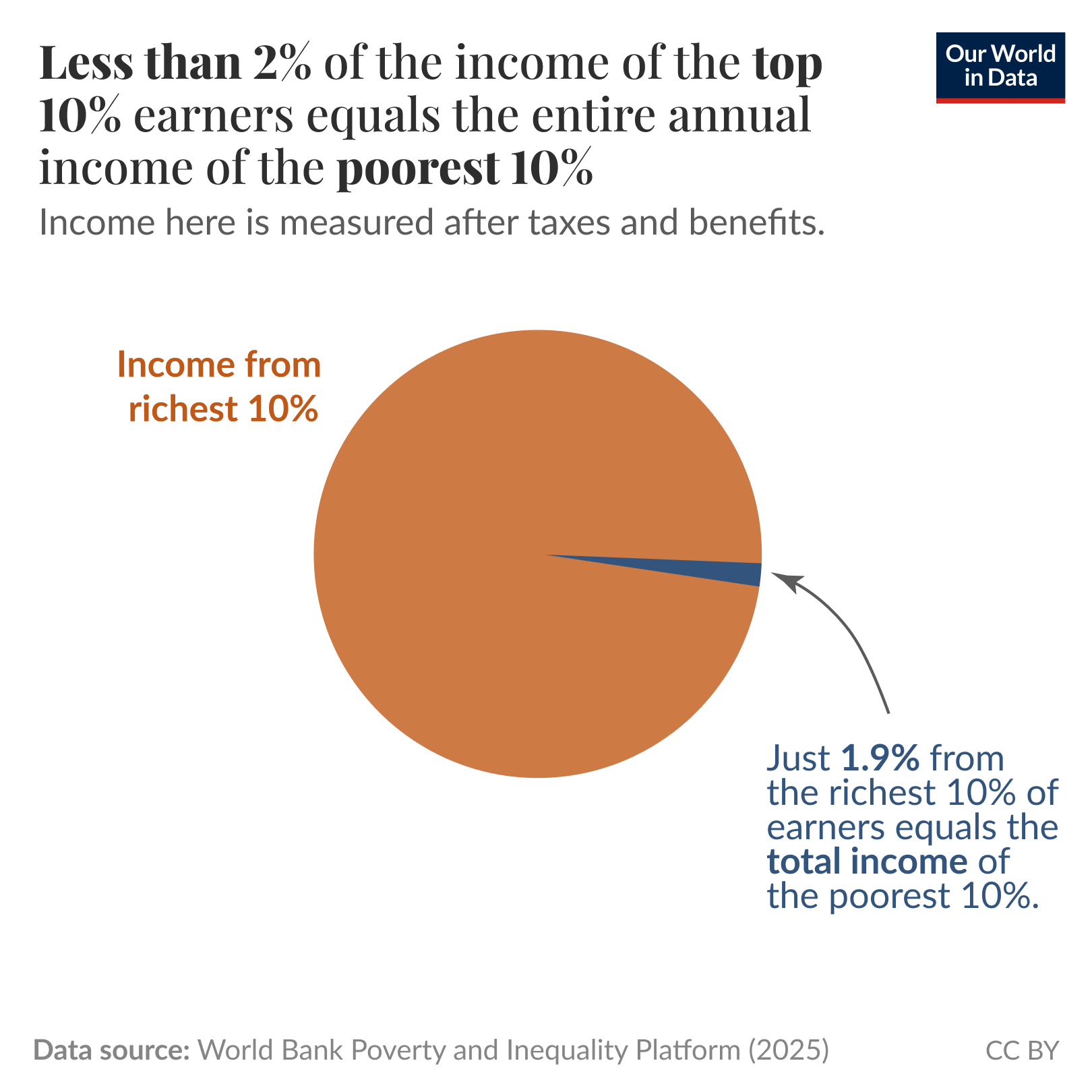
Here’s the question that shifted our perspective on global inequality: how much would it take from the richest 10% of people in the world to match that of the poorest 10%?
Our colleague Pablo Arriagada calculated the answer using data from the World Bank’s Poverty and Inequality Platform.2 As the chart below shows, it takes less than 2 cents out of every dollar. That’s less than one-fiftieth of their income, or one week of income in a year.
 For a one-person household, an annual post-tax income of $20,000 already puts you in the richest tenth of the world
The second revelation that shifted our perspective on global inequality is that we are in the richest 10%. When we think of global inequality, it’s easy to picture “the rich” as someone else — those with garages full of sports cars or taking private trips to space. But the richest tenth of the world includes us and likely many others who don’t intuitively think of themselves as “the rich”.
For a one-person household, an annual post-tax income of $20,000 puts you in this category. That income bracket captures more than half the population in rich countries, like the Netherlands, the US, or Germany.
Realizing this is both sobering and empowering. It means we’re not just observers of global inequality — we’re participants with big levers to act on it. We can reduce it. We’ll explore three avenues through which we can use this opportunity to support others.
1. Support global redistribution through government foreign aid
Foreign aid still dwarfs private philanthropy and is one of the biggest channels of global redistribution. Some of its accomplishments have been remarkable:
Gavi, the Vaccine Alliance, has vaccinated hundreds of millions of children against diseases and has been estimated to have saved 1.5 million lives.3Between 2004 and 2023, the United States dedicated just under 0.2% of its national income to foreign aid programs. Still, its program combating the HIV epidemic, primarily in low-income countries, has saved an estimated 19 million lives. And that represents just one program among many.A recent study in The Lancet estimates that USAID programs helped prevent over 91 million deaths between 2001 and 2021, including 30 million child deaths.4
Foreign aid is far from perfect, and money can easily be wasted on ineffective programs.5 But from where we stand, its challenges and inefficiencies are arguments for improving efficiency rather than cuts.
People may disagree on how useful foreign aid is. But rich countries have seen that it can work, and they’ve committed to continuing to help the poorest countries.
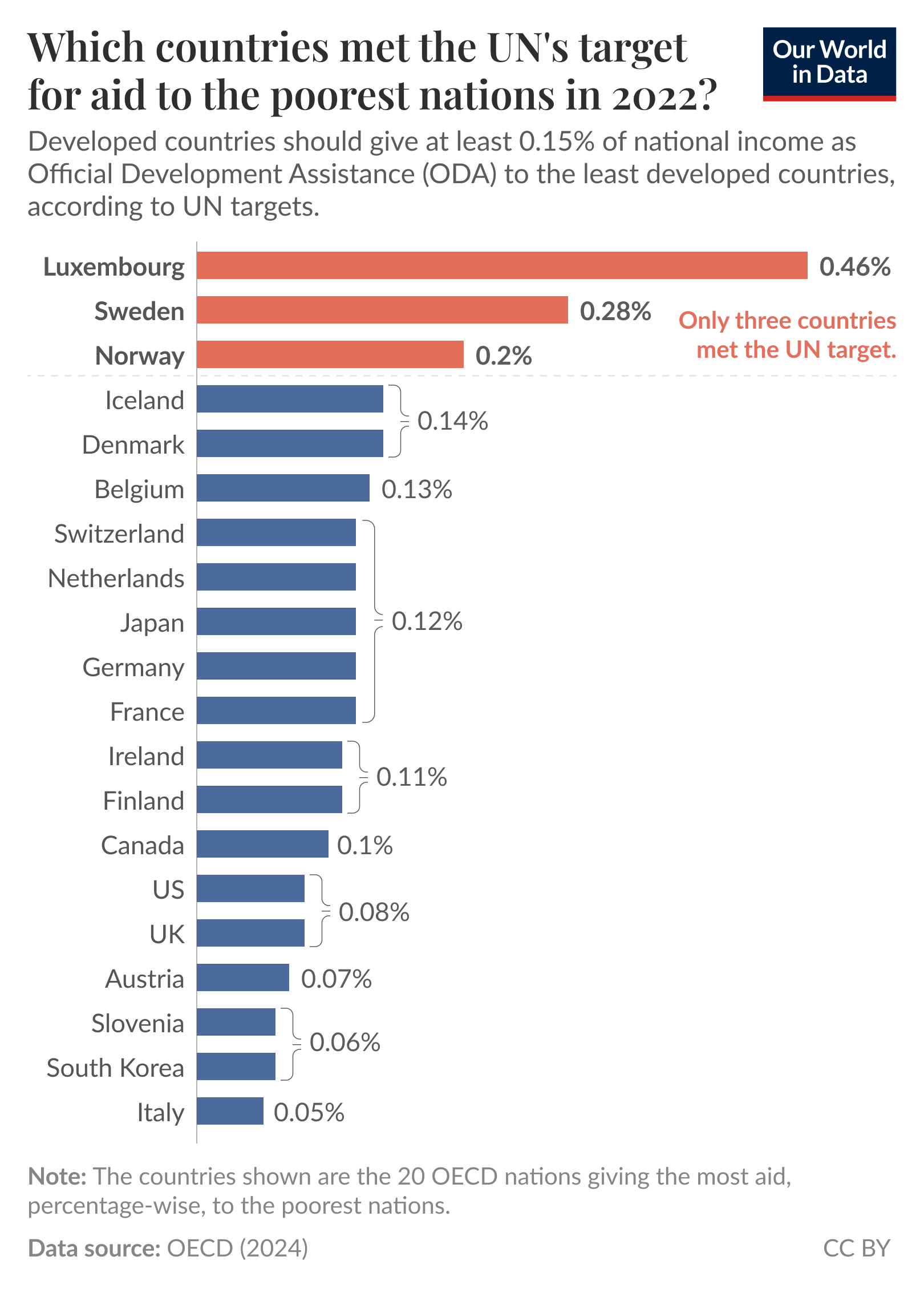
In 1981, the major foreign aid donor countries made a promise at the UN: at least 0.15% of their national income would go to the world’s least-developed countries. That’s far less than the 2% mentioned at the start of the article. These least-developed countries, such as Malawi and Mozambique, are home to populations largely among the poorest 10% of the global income distribution.
Over the years, the major donor countries repeated their pledge. However, according to the most recent data (from 2022), most countries failed to honor this promise. The chart shows the 20 OECD countries giving the most aid (as a percentage of their national income) to the world’s poorest nations. Only three countries met the target in 2022: Luxembourg, Sweden, and Norway.
Given the extreme global inequality outlined earlier, increasing aid to the least developed countries represents a modest step toward addressing a profound imbalance — one that rich nations have repeatedly promised but failed to take.
Many countries, including the United States and the United Kingdom, have proposed aid cuts instead. Projections indicate that the American reductions alone could lead to 14 million additional deaths by 2030.6
It can feel like there’s not much one person can do about government cuts. But this isn’t a reason to despair. People in rich countries can not only demand that their governments do better; each of them also has the power to make a difference through direct donations that reach those in need.
2. Address global inequality through charitable giving
Reaching the world’s poorest was once extremely complicated for individuals. But today, reliable channels exist that handle the logistics for you.
For evidence-based giving, GiveWell researches and ranks charitable organizations by their cost-effectiveness, helping donors find where their contributions will have the greatest measurable impact. Their research shows that many of us can save a child’s life through simple interventions, like providing vitamin A supplements to children in low-income countries or distributing bednets to protect against malaria.
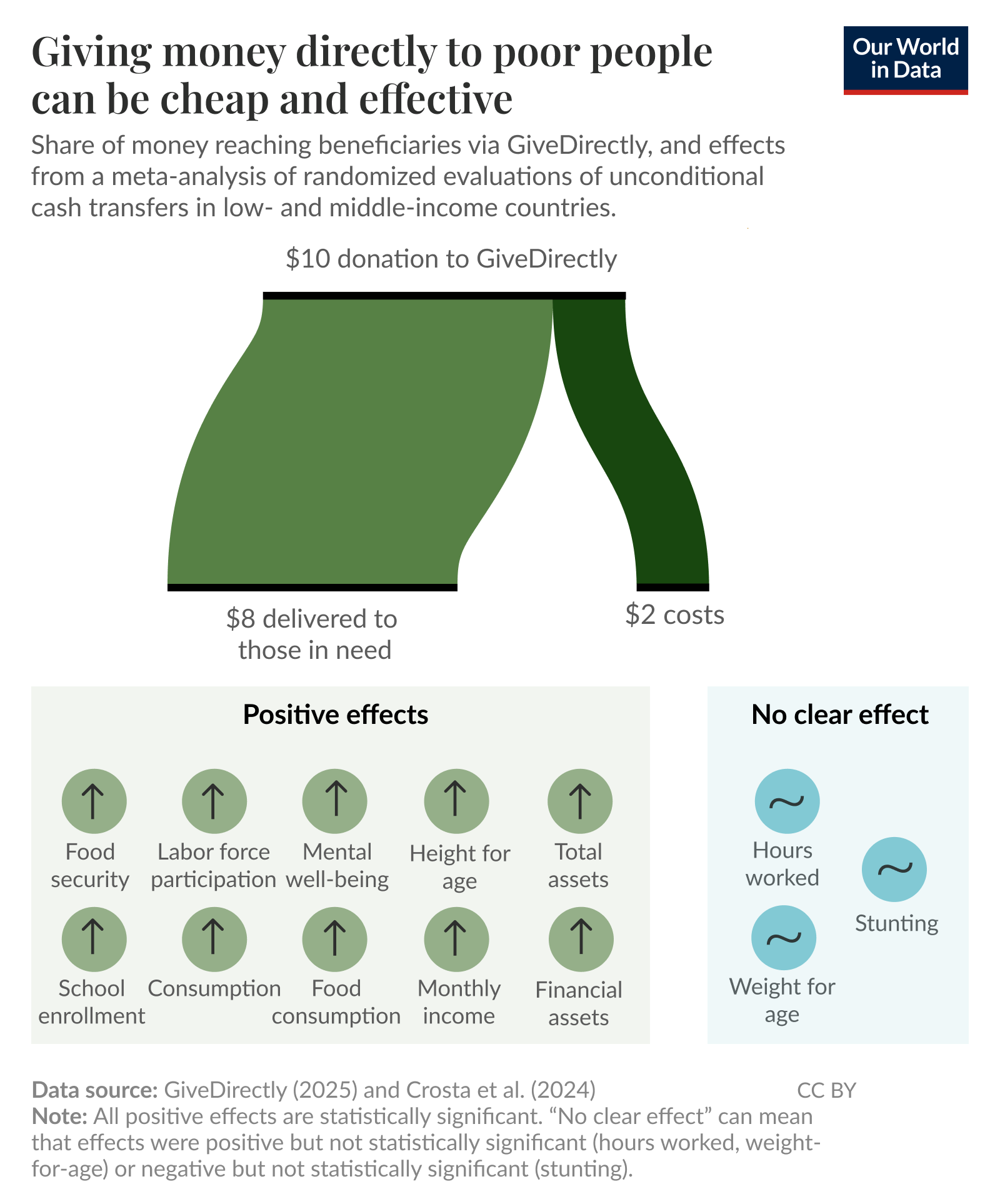
When it comes to addressing global inequality, one charity that stands out is GiveDirectly. While charities often face criticism for high administrative costs, this cash transfer organization gets donations directly to people with limited overhead. For every $10 donated, $8 goes directly to those in need.7 These direct cash transfers reach families in countries with particularly high poverty rates, like Malawi, Mozambique, Rwanda, Uganda, and Kenya.8
Giving money directly to poor households really does help. A meta-analysis of randomized controlled trials on such cash transfers to low- and middle-income countries shows a clear pattern: when poor people receive cash, they use it to improve their lives.9 They spend it on essentials like food, school fees, and healthcare. This improves their well-being, reduces stress, and leads to healthier and taller children.
The chart below shows the share of money reaching beneficiaries via GiveDirectly and the statistically significant effects identified in the meta-analysis. Additional studies have also shown that cash transfers increase recipients’ use of health services.10 There’s also extensive research examining potential negative consequences, and common concerns appear to lack solid empirical support.11
 3 – Raise awareness of global inequality
Let’s return to where we began: the gap between our expectations and the reality of global inequality. To this end, we want to share an insight from a paper by political economist Gautam Nair.12
Take a moment to consider: what do you think is the global median income? Make your best guess before checking the footnote.13
When people learned the actual global median income, their willingness to donate to international charities rose by 55%
In his paper, Nair asked a large, representative sample of Americans about the global median income. He discovered that they think the median income is much higher than it is. On average, they overestimated this figure by a factor of 10.
Because Americans think people globally earn far more than they really do, they underestimate their own relative income. In other words, they imagine they are only a little richer than the typical person worldwide, when they are vastly richer. American citizens are ten times richer than they believe, compared to the global median. This reminded us of seeing the 2% figure for the first time, challenging how we thought about global inequality.
This gap between perception and reality matters when it comes to foreign aid and charitable giving. Nair’s research revealed that correcting false beliefs can directly impact a person’s willingness to support people in poorer countries.
When participants learned the actual global median income, their generosity increased considerably. They not only expressed support for higher foreign aid spending, but also changed their behavior: their willingness to donate to international charities rose by 55% compared to those who remained unaware of the true global income disparity.14
Once they become aware of their relative position in the income distribution, many people want to help the poorest people more. If understanding these facts can spark generosity, even talking about the statistics in this article with someone could be a small but meaningful first step. Perhaps some people decide to act on this and use their opportunity to help those at the other end of the income distribution.
Acknowledgments
Many thanks to Ryan Briggs, Charles Kenny, Tyler Hall, Pablo Arriagada, Hannah Ritchie, Max Roser, Edouard Mathieu, Bastian Herre, and Saloni Dattani for their insights, feedback, and comments on this article.
Continue reading on Our World in DataCite this work
Our articles and data visualizations rely on work from many different people and organizations. When citing this article, please also cite the underlying data sources. This article can be cited as:
Simon van Teutem and Joe Hasell (2025) – “Global inequality is huge — but so is the opportunity for people in high-income countries to support poor people” Published online at OurWorldinData.org. Retrieved from: ‘https://ourworldindata.org/global-inequality-opportunity-to-give’ [Online Resource]
BibTeX citation
@article{owid-global-inequality-opportunity-to-give,
author = {Simon van Teutem and Joe Hasell},
title = {Global inequality is huge — but so is the opportunity for people in high-income countries to support poor people},
journal = {Our World in Data},
year = {2025},
note = {https://ourworldindata.org/global-inequality-opportunity-to-give}
} Reuse this work freely
All visualizations, data, and code produced by Our World in Data are completely open access under the Creative Commons BY license. You have the permission to use, distribute, and reproduce these in any medium, provided the source and authors are credited.
The data produced by third parties and made available by Our World in Data is subject to the license terms from the original third-party authors. We will always indicate the original source of the data in our documentation, so you should always check the license of any such third-party data before use and redistribution.
All of our charts can be embedded in any site.