

Data Cutoff: 2:00 PM ET
The Institute for the Study of War (ISW) and The Critical Threats Project (CTP) at the American Enterprise Institute are publishing updates Monday through Friday to provide analysis on the war with Iran and the broader Middle East. Weekday updates cover events from the past 24-hour period, whereas weekend updates are abbreviated and cover the Houthi-Saudi conflict and major breaking developments related to the war with Iran.
Key Takeaways:
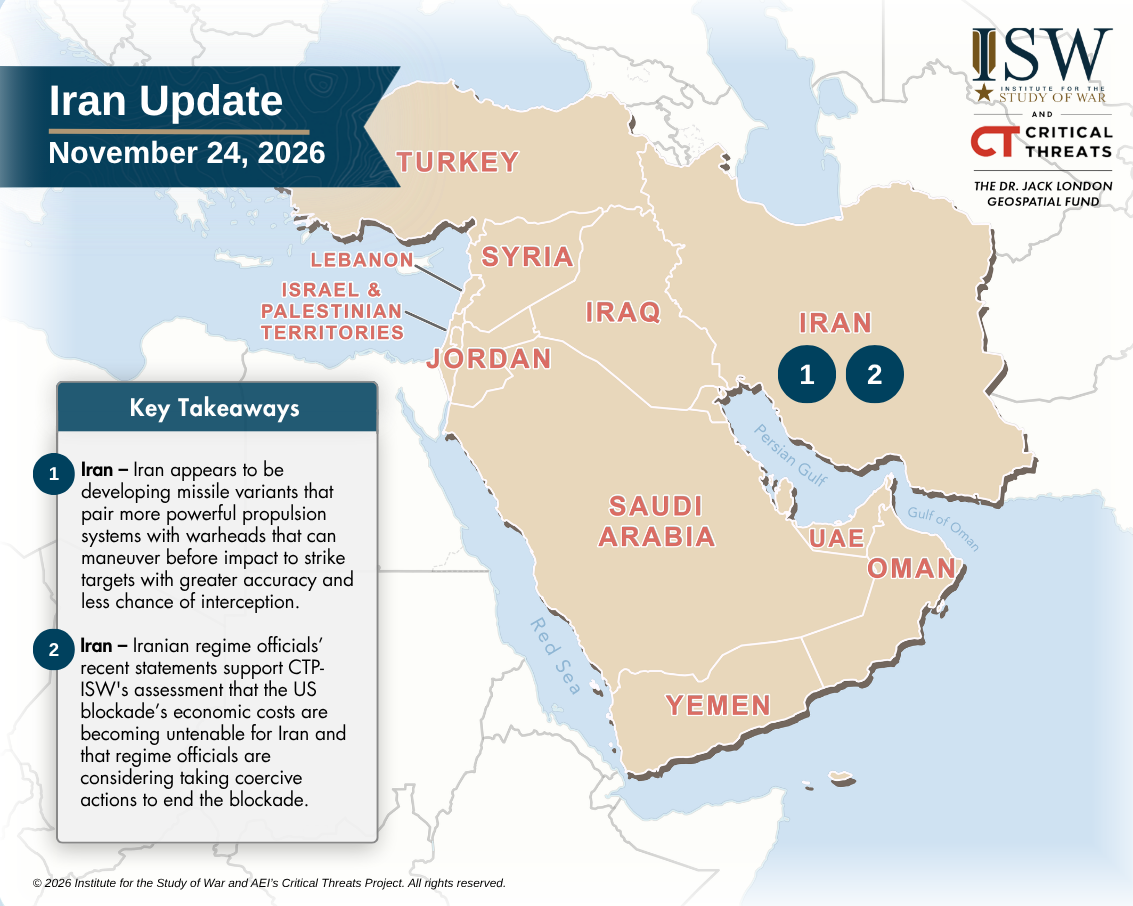
Iran appears to be developing missile variants that pair more powerful propulsion systems with warheads that can maneuver before impact to strike targets with greater accuracy and less chance of interception. Iran can likely produce these missile variants with minimal changes to its industrial supply chain because of their similar technologies, although the Iranian defense industrial base’s current capacity for mass missile production is unclear.
Iranian regime officials’ recent statements support CTP-ISW’s assessment that the US blockade’s economic costs are becoming untenable for Iran and that regime officials are considering taking coercive actions to end the blockade. These proposed actions include dispatching Iranian oil tankers as blockade runners to attempt to render the US blockade illegitimate and striking US and regional assets that support the United States’ enforcement of the blockade.
Toplines
Iran appears to be developing its missile capabilities by pairing more powerful missile propulsion systems with warheads that can maneuver just before impact in order to reduce the risk of interception and strike targets with greater accuracy. The Islamic Revolutionary Guards Corps (IRGC) has reportedly developed hybrid missile variants that combine the Haj Qassem medium-range ballistic missile’s (MRBM) propulsion system with Kheibar Shekan, Kheibar Shekan-2, and Fattah-1 warheads, which have maneuverable reentry vehicles (MaRV).[i] Iran has used all three of these solid-fuel MRBMs in attacks on Israel and US regional assets in previous conflicts.[ii] The Haj Qassem has a stronger propulsion system that enables the missile to attain a higher terminal velocity, according to Iranian media assessments.[iii] This enables the missile to travel at a higher speed as it approaches its target, leaving air defense systems with less time to react and increasing the missile’s force on impact. The Kheibar Shekan, Kheibar Shekan-2, and Fattah-1’s MaRV systems, meanwhile, alter the hybrid variant’s flight path during the terminal phase, helping it evade air defenses and improve targeting accuracy.[iv] Iran unveiled a separate Haj Qassem variant with a MaRV, called the Qassem Basir, in May 2025.[v] Iranian regime media has depicted the Kheibar Shekan-2-Haj Qassem and Fattah-1-Haj Qassem variants as distinct from the Qassem Basir, however.[vi] CTP-ISW cannot verify whether Iran has used these hybrid variants in attacks on US regional assets or only tested them.[vii]
IRGC-affiliated media suggested on November 23 that Iran could add cluster munitions, which scatter multiple submunitions before impact, to the Kheibar Shekan-2-Haj Qassem variant’s warhead, which would make the missile harder to intercept and more likely to cause impacts.[viii] Cluster munition warheads disperse submunitions over a wide area and are intended to maximize damage. Iran has used cluster munition warheads in previous missile attacks on Israel and US forces in the region, including in a September attack on Muwaffaq Salti Air Base in Jordan, for example.[ix]
Iran can likely produce these hybrid variants with minimal production and supply chain adjustments because the Haj Qassem, Kheibar Shekan-2, and Fattah-1 are all from the Fateh-110 missile family and share similar technology and supply chains.[x] The IRGC has recently displayed these hybrid variants in videos of IRGC “missile city” facilities, which suggests that the IRGC has continued to manufacture these variants.[xi] The status of Iran’s missile production capabilities and stockpiles remains unclear following extensive US and Israeli strikes on missile bases and missile production facilities in Spring 2026, however.

Recent statements from regime officials support CTP-ISW’s ongoing assessment that the economic costs of the US blockade are becoming intolerable for Iran and that Iranian officials are considering taking coercive actions to end the blockade.[xii] Iranian Supreme National Security Council Secretary Major General Mohsen Rezaei stated on X on November 24 that the Iranian regime and armed forces “remain firmly determined to break the blockade” and threatened that Iran would respond to any “aggression.”[xiii] Rezaei did not clarify how Iran would attempt to break the blockade, however. Rezaei’s statement follows statements from other senior Iranian officials in recent days calling for an end to the blockade.[xiv] Iranian Parliament Speaker Mohammad Bagher Ghalibaf’s adviser, Mahdi Mohammadi, claimed in an interview with state television on November 24 that there is a consensus among Iranian decisionmakers that the blockade is an “act of war.”[xv] Mohammadi argued that using military force to end the blockade would be “absolutely legitimate” and noted that the regime has made some preparations in recent months for such a scenario. Mohammadi noted that the preparations “remain incomplete” at this time, however.[xvi] Mohammadi suggested that Iran could target US and regional allies’ assets along the Persian Gulf that enable the blockade in order to degrade the United States’ ability to enforce the blockade.[xvii] Mohammadi was notably the first Iranian official whom CTP-ISW observed on November 10 express support for using military force to end the naval blockade.[xviii]
Some lower-level Iranian officials have separately advocated for sending oil tankers to run the blockade. Parliamentarian Hossein Ali Haji Deligani declared his support for dispatching oil tankers as blockade runners on November 24 and offered to personally accompany tanker crews, for example.[xix] Haji Deligani cited Supreme Leader Mojtaba Khamenei’s recent declaration to improve people’s livelihoods as justification for such a military operation, highlighting how deteriorating economic conditions are driving the regime to consider coercive measures to force the United States to lift the blockade.[xx]
US and Partner Military Operations
Nothing significant to report.
Iranian Strike Campaign
Assessed Iranian War Aims:
Secure international recognition of Iranian control over the Strait of Hormuz
Degrade the US ability and willingness to continue the war
Restore deterrence vis-à -vis the United States and its regional partners
Divide the United States and Israel from the Arab states
See topline section.
US-Iran Negotiations
Nothing significant to report.
Iranian Domestic Affairs
Nothing significant to report.
Lebanon
Nothing significant to report.
Iraq
Iraqi Prime Minister Ali al Zaydi is attempting to restrict Iranian-backed Iraqi militias’ ability to profit from oil theft and smuggling as part of a broader effort to combat smuggling and strengthen the Iraqi federal government. Iraqi media reported on November 24 that Zaydi dismissed numerous security and energy officials in Kirkuk Province and ordered Iraqi federal government authorities to assume control over oil fields and border crossings in the Kurdistan Region in order to combat smuggling efforts.[xxi] Iraqi Army and Popular Mobilization Forces (PMF) personnel also deployed near areas controlled by Harakat Hezbollah al Nujaba in Haydariya Subdistrict, Najaf Province, after an oil pipeline ruptured in the vicinity.[xxii] An Iraqi parliamentarian claimed that the rupture occurred within Harakat Hezbollah al Nujaba-controlled territory, suggesting that the group tapped the pipeline to steal and smuggle oil, although CTP-ISW cannot confirm this claim.[xxiii]
These developments come amid Zaydi’s efforts to strengthen the prime minister’s office and combat smuggling and sanctions evasion efforts, particularly by Iranian-backed Iraqi militias. Kataib Hezbollah’s (KH) involvement in oil theft and smuggling partly motivated Zaydi and the federal government to deploy forces to KH-controlled territory in Jurf al Sakhr on November 20.[xxiv] US-funded Arabic media also previously reported on November 14 that Iraqi intelligence concluded that unspecified oil smuggling networks, which are almost certainly linked to Iranian-backed Iraqi militias, are trafficking stolen oil from Kirkuk and the Kurdistan Region into Iran in order to evade sanctions.[xxv] Iraqi militias engage in oil smuggling and sanctions evasion at the expense of the Iraqi government in order to support Iran and finance the militias’ political and military activities, which Zaydi has sought to curtail with anti-corruption investigations and efforts to disarm Iraqi militias.[xxvi]
Arabian Peninsula
Commercially available satellite imagery shows that Houthi fighters have fortified advantageous terrain near Jabal Kharaz, which strongly suggests effective Houthi control of the area and ongoing Houthi efforts to consolidate positions against a potential government counterattack. The imagery confirmed reports from multiple anti-Houthi sources on November 24 that Houthi fighters dug a moat south of Jabal Kharaz, which is a mountain in southern Lahij Governorate, along the Mokha-Aden ground line of communication (GLOC).[xxvii] Houthi forces previously captured a Yemeni government defensive position south of Jabal Kharaz near the newly excavated moat on November 16.[xxviii] Houthi fighters’ ability to build defensive fortifications south of Jabal Kharaz without Yemeni government interference suggests that the Houthis may have seized Jabal Kharaz, as any remaining government-aligned forces on Jabal Kharaz would have presumably sought to fire on Houthi fighters during construction of the moat.
These Houthi fortifications likely reflect Houthi efforts to preserve and defend territorial gains along the Mokha-Aden GLOC against potential Yemeni government counteroffensives. Houthi control over elevated terrain on and near Jabal Kharaz, combined with the newly constructed moat, will likely complicate any Yemeni government effort to dislodge Houthi forces from the area. These defensive preparations likely indicate that the Houthis are prioritizing the consolidation of their recent territorial gains over further immediate advances along this portion of the front. Fortifying a highly defensible position at Jabal Kharaz insulates the Houthis’ more strategically significant territorial gains and supply lines on the Red Sea coastal plain from Yemeni ground forces’ fire.[xxix]
Yemeni government-aligned forces conducted multiple raids in Houthi-controlled al Misrakh District south of Taiz City on November 24, likely to disrupt Houthi advances that would optimize conditions for capturing Taiz City.[xxx] Yemeni government-aligned forces announced that they conducted a series of raids near al Aqroud, al Misrakh District, on November 24.[xxxi] The raids likely sought to disrupt the Houthis’ freedom of movement along the Taiz-Aden GLOC, given al Aqroud’s proximity to the key Houthi supply line. The Houthis, if permitted to advance north along remaining government-controlled sections of the Taiz-Aden GLOC, could tighten their encirclement of Taiz City, capture remaining Yemeni government rear areas, and facilitate Houthi efforts to capture the city. The raids came amid a series of Saudi airstrikes on Houthi positions on or near the Taiz-Aden GLOC, particularly in al Misrakh District and al Dhabab, which lies south of Taiz City, on November 23 and 24.[xxxii] Saudi forces previously conducted a series of airstrikes on Houthi forces in the area on November 22 and 23, likely to similarly disrupt Houthi preparations for a future offensive against Taiz City.[xxxiii]

The Houthi movement struck the Saudi Public Investment Fund headquarters in Riyadh for the second time in less than a week on November 24 as part of its ongoing campaign to compel Saudi Arabia to end military operations in Yemen and accept Houthi demands. Saudi authorities announced that the Houthis struck the headquarters for a second time on November 24 after a previous Houthi attack on November 19.[xxxiv] Saudi authorities and international media reported that the latest strike wounded 11 civilians and damaged the building.[xxxv] The Houthis have not claimed responsibility for the attack as of this writing. Saudi Joint Forces Command Spokesperson Major General Turki al Maliki separately announced on November 23 that Saudi air defenses intercepted a Houthi drone over southern Saudi Arabia.[xxxvi] The Houthis seek to impose economic and political costs on Saudi Arabia to compel the kingdom to submit to Houthi demands, which include ending Saudi support for Yemen’s legitimate government, lifting Saudi controls on Houthi-controlled ports and airports, and granting the Houthis control over Yemen’s oil and gas resources.[xxxvii]


View Citations