
August 25, 2025
by intelNews
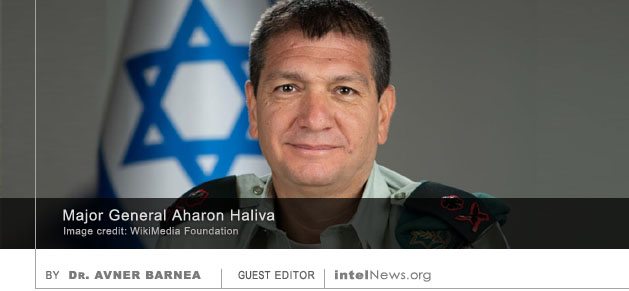 IN A SERIES OF leaked recordings, the former head of Israel’s Military Intelligence Directorate, Major General Aharon Haliva, has expressed strong views about Israel’s war in Gaza. General Haliva headed Israel’s Military Intelligence Directorate (known as Aman) on October 7, 2023, when Palestinian militants took Israel by surprise in a combined arms attack, killing over 1,200 and kidnapping 250. Since resigning a year ago, Haliva has not made any public statements.
It is unclear who Haliva was speaking to when he was recorded, or by whom he was recorded. Nor is it clear when or where the recordings occurred. They were leaked last week by Israeli television station Channel 12. There follows a summary of Haliva’s comments in the leaked recordings.
Personal Responsibility. Haliva admits that the disaster occurred during his watch; therefore, he bears ultimate responsibility. At the same time, he emphasizes that responsibility is systemic and broad—not only his, but also that of the entire Israel Defense Forces (IDF), the Israel Security Agency (ISA), and the country’s senior political leadership. He states: “Anyone who voluntarily assumes a leadership position knows that his decisions will bring both great successes and great failures”.
Systemic and Cultural Failures. Haliva argues that the failure originates from a long-standing organizational culture within the Aman, rooted in arrogance, overconfidence, and the belief that “the enemy is deterred”, as well as the idea that Israel’s intelligence is all-powerful. This mindset led to operational stand-downs during Sabbaths, holidays, and in the month of August, reflecting overconfidence. He warns: “This was not a one-time accident, but something that requires dismantling and rebuilding the system”.
Responsibility of Other Bodies. Haliva points to the ISA as the agency that should have provided human intelligence alerts on the evening of October 6 and the early hours of October 7, 2023, but did not. He criticizes the government and the cabinet for not holding serious, in-depth discussions on Gaza, while for years allowing Hamas to grow stronger with the help of Qatari money and by dividing Gaza from the West Bank.
The Political Leadership and Benjamin Netanyahu. Haliva describes Netanyahu as “a very attentive man, who reads, but is very cowardly—and in the test of results, he failed”. He emphasizes that Israel’s political leadership made decisions that strengthened Hamas and hindered proper preparedness. His conclusion: “In such a biblical-scale disaster, responsibility lies with everyone—they should all step down”.
The Conception of Intelligence. Haliva acknowledges that a widespread belief existed that “Hamas is deterred”—and that this appeared in official documents even days before the attack. He argues that even if a warning had been received, it would not have changed the overall understanding, as the system did not account for such a large-scale attack scenario. He points out that Israeli intelligence could monitor missiles in Iran in detail but still missed Hamas’s preparations in Gaza—thus revealing a systemic flaw.
The Night Before the Attack. Haliva argues that even if he had woken up on time that night, it would not have changed the decisions, as the ISA, the Gaza Division intelligence officer, and the Chief of Staff, all believed calm would be maintained. He denies “false rumors” about his whereabouts that night, saying he was at home with his family.
Strategic Concepts. Haliva explains that Hamas was considered an “asset” by some segments of Israel’s rightwing leadership, who aimed to weaken the Palestinian Authority. He criticizes the “conflict management” policy as flawed and directly responsible for the disaster.
The Price and the Future. He describes the war in Gaza as a “war of no choice” and says that the heavy toll is “necessary to prevent future conflicts for generations”. He acknowledges that Israel faces a profound cultural and moral crisis and warns that, without real accountability, such a disaster could happen again. He calls for a national commission of inquiry as the only way to properly examine the failures.
The attitude of Netanyahu. According to Haliva: “It was common for the Prime Minister to have a weekly working meeting with the head of Israeli Military Intelligence. Over time, this was reduced to once a month, then once every two months. Eventually, it was down to one meeting every six months, and even that was barely enough”. Haliva adds that it seems Netanyahu did not want to hear assessments that differed from his, especially those warning of an attack on Israel, particularly after he received a strategic warning.
► Author: Dr. Avner Barnea* | Date: 25 August 2025 | Permalink
* Dr. Avner Barnea is a research fellow at the National Security Studies Center of the University of Haifa in Israel. He served as a senior officer in the Israel Security Agency (ISA). He is the author of We Never Expected That: A Comparative Study of Failures in National and Business Intelligence (Lexington Books, 2021).