
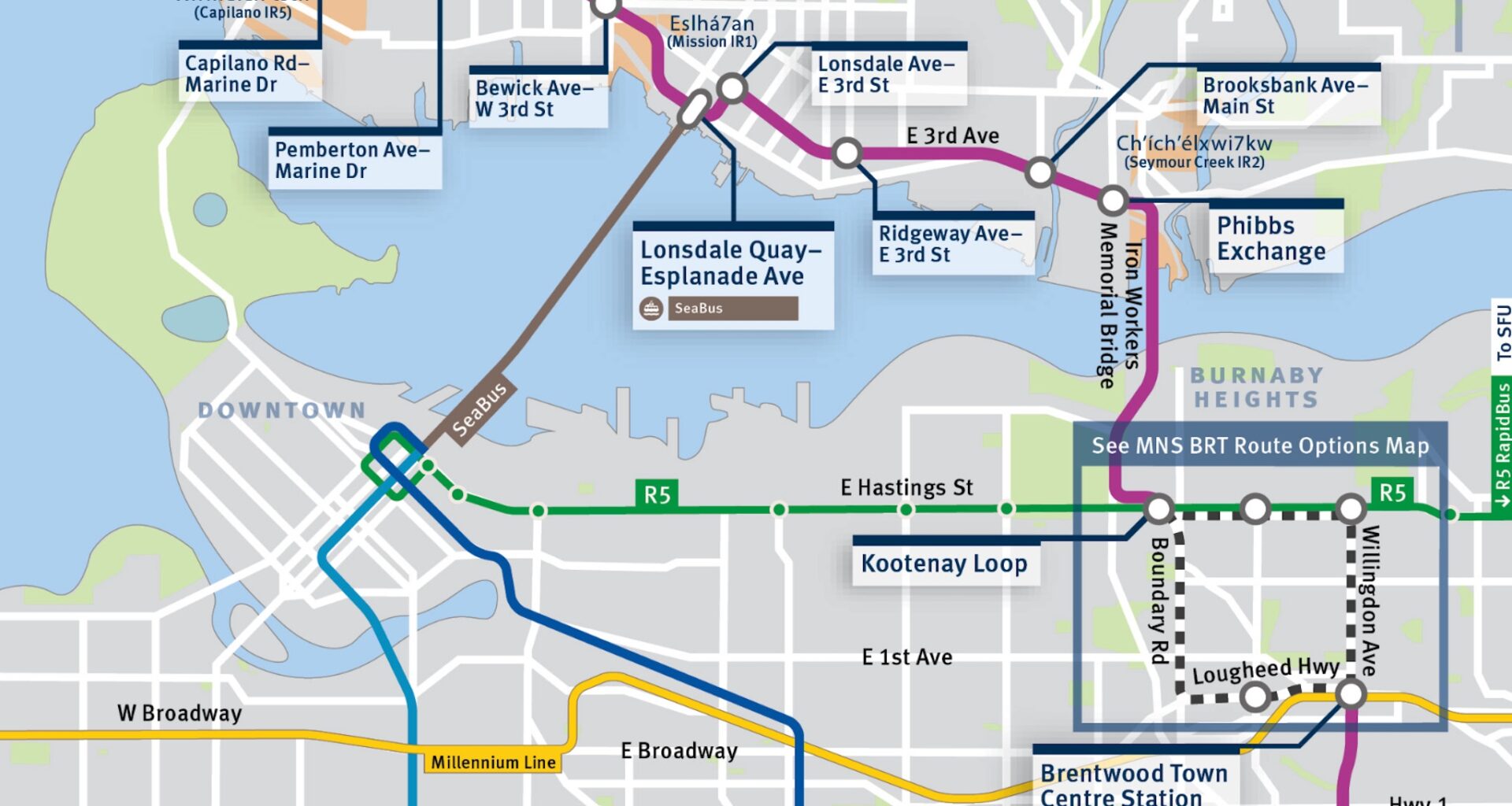
What route should the proposed Metrotown-North Shore Bus Rapid Transit (BRT) line take?
That is one of the focuses in TransLink’s new public consultation on the proposal to implement Metro Vancouver’s third BRT line, running between Park Royal in West Vancouver and Metrotown in Burnaby via Phibbs bus exchange and the Ironworkers Memorial Bridge.
This follows the public transit authority’s consultation earlier this year on the first two BRT lines of the King George Boulevard BRT in Surrey and the Langley-Haney Place BRT in Langley City, Langley Township, and Maple Ridge.
Metrotown-North Shore BRT would be an upgrade of the existing R2 Marine Drive RapidBus between Park Royal and Phibbs bus exchange, which is set to be extended south to reach Metrotown in 2027 — following the same future BRT route — as an interim service improvement measure made over the short term.
The Metrotown-North Shore BRT would span a length of 21 km, featuring 16 or 17 stations depending on the final route option selected in the North Burnaby/Brentwood area.
Up for public consultation are two route options for the BRT between the south end of the Ironworkers Memorial Bridge and Brentwood.
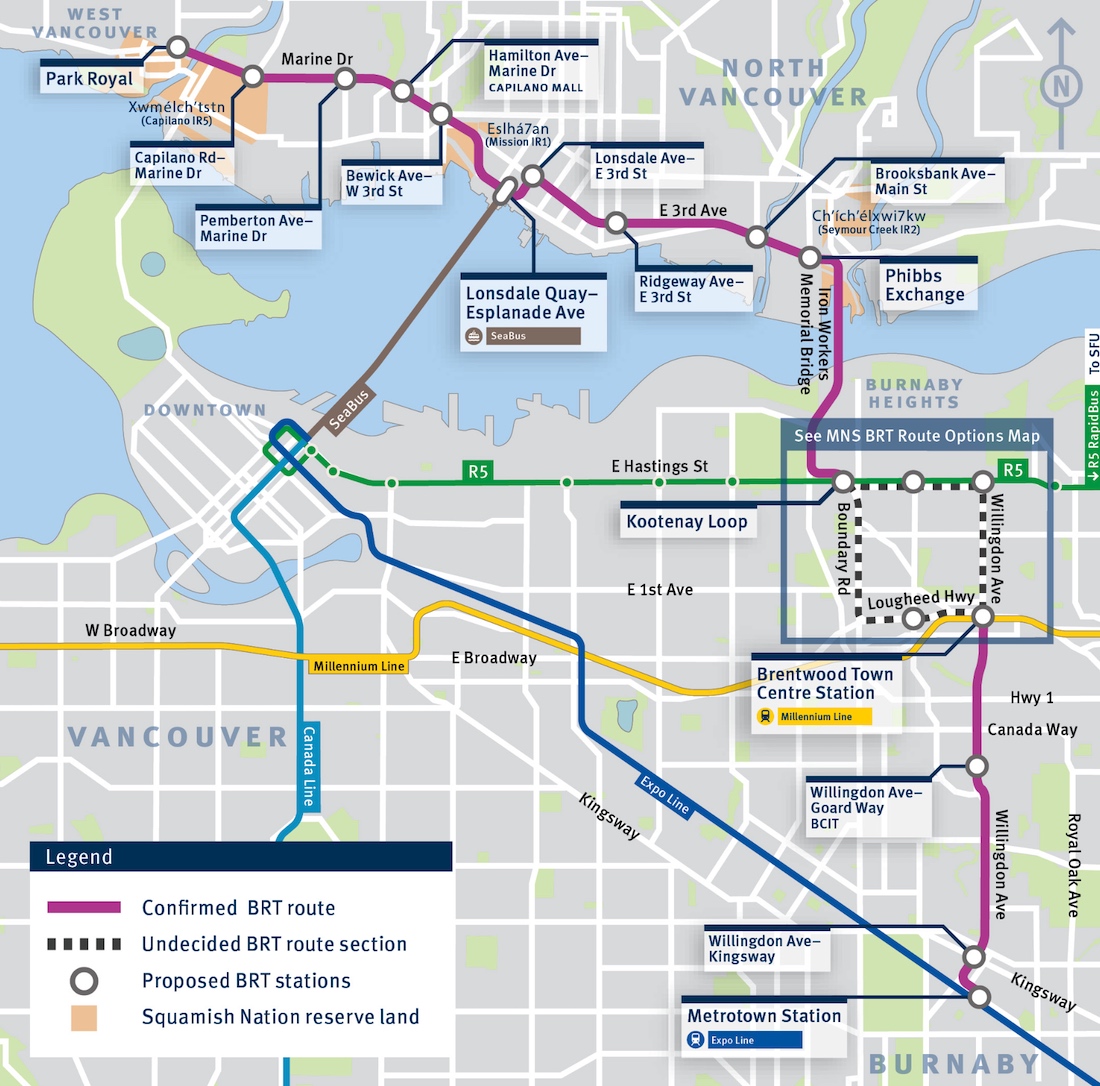
Option 1 and Option 2; proposed routes for Metrotown-North Shore BRT, August 2025. (TransLink)
Option 1 would run along Hastings Street (between Boundary Road and Willingdon Avenue) and Willingdon Avenue (between Hastings Street and Lougheed Highway), comprehensively serving the retail district along Hastings Street. However, this route has been highly contentious for local businesses, over concerns that it could conceivably reduce curbside vehicle parking along the route through Burnaby Heights. Over the past two years, businesses and residents have expressed opposition to Burnaby City Council over such a routing due to concerns that it would impact customers, commercial loading, and general traffic.
Option 2 would completely avoid the Hastings Street retail district in Burnaby Heights, as the route would run along Boundary Road (between Hastings Street and Lougheed Highway) and Lougheed Highway (between Boundary Road and Willingdon Avenue).
Option 1 would maintain two traffic lanes in each direction on Hastings Street, but reduce Willingdon Avenue to one lane in each direction. Option 2 would maintain two traffic lanes in each direction on Boundary Road, but reduce Lougheed Highway to two traffic lanes in each direction.
It is conceivable that Option 1, which directly serves the Burnaby Heights retail district, would carry a higher ridership potential, while Option 2 carries a lower ridership potential as it runs through low-density residential and light industrial uses.
Although Option 2 provides this BRT line with one fewer BRT station, it would provide an additional direct SkyTrain connection at Gilmore Station. The only BRT station serving the Hastings Street retail district would be at Kootenay bus loop, situated just to the west within Vancouver.
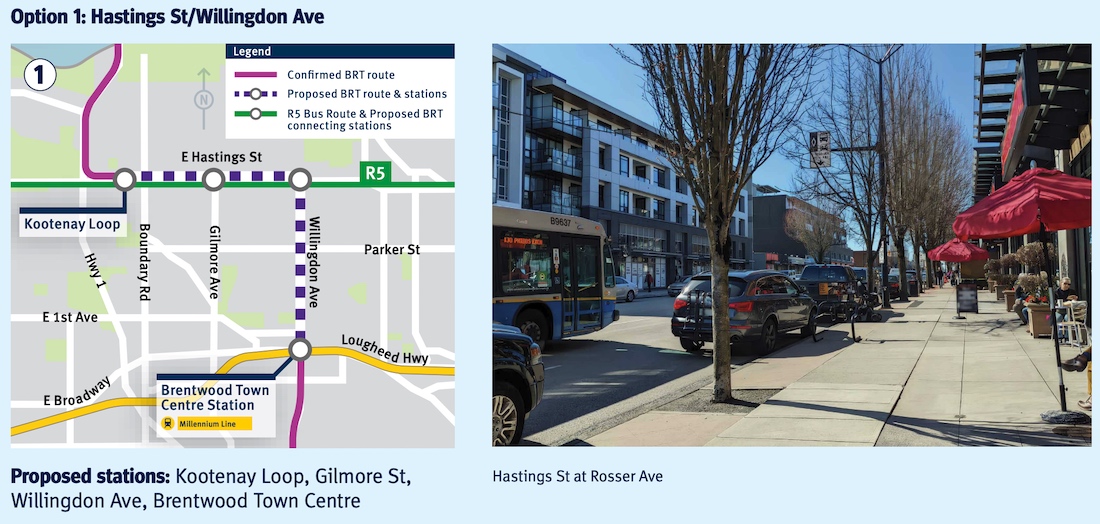
Option 1; proposed route for Metrotown-North Shore BRT, August 2025. (TransLink)
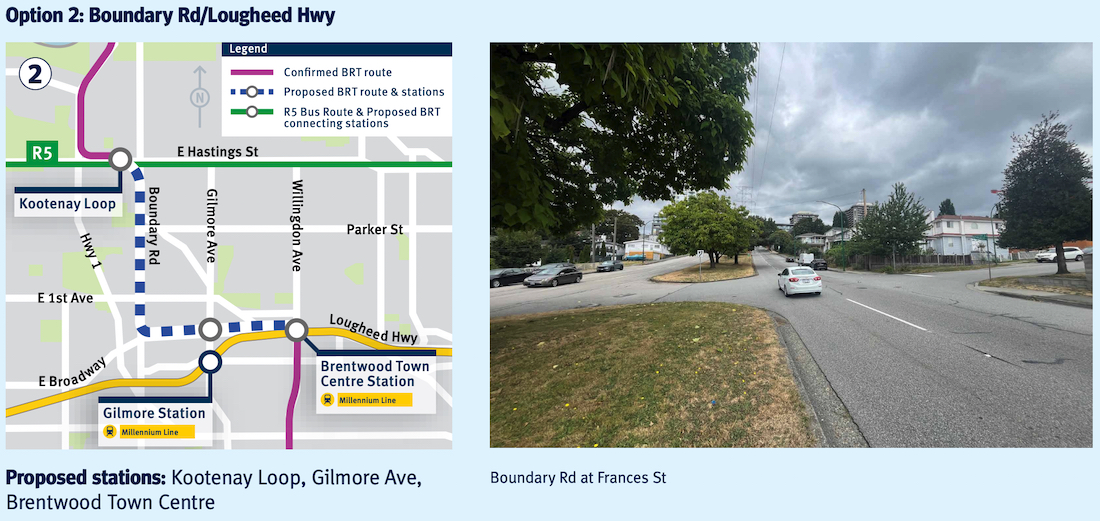
Option 2; proposed route for Metrotown-North Shore BRT, August 2025. (TransLink)
Both route options provide a connection to SkyTrain’s Brentwood Town Centre Station and Metrotown Station, and directly serve important points of interest such as the BCIT Burnaby campus, Lonsdale Quay bus exchange and SeaBus terminal in Lower Lonsdale, and the redevelopments of Capilano Mall and various Squamish Nation reserves.
Generally, all three BRT routes will feature extensive dedicated bus-only lanes from the removal of traffic lanes and/or curbside parking lanes. But TransLink notes an exception will be made for the Ironworkers Memorial Bridge, where no traffic lanes will be removed. Instead, improved bus access to/from the bridge on the Cassiar Connector is being considered.
Bus-only lanes and traffic signal priority will help speed up the buses and improve reliability. According to TransLink, the intention is to run a BRT standard of five-minute frequencies during peak periods and much of the day using high-capacity buses, such as articulated buses.
Additionally, the BRT stations will have a range of enhanced passenger amenities, including overhead cover for weather protection, real-time next bus digital displays, enhanced signage, free Wi-Fi, benches and leaning rails, accessibility ramps, tactile strips, railings, lighting, CCTV, and an emergency callbox for safety. Such BRT station designs are essentially intended to closely resemble Light Rail Transit (LRT) stations.
The current public consultation also seeks feedback on the types of passenger amenities and bus-priority measures that should be prioritized.
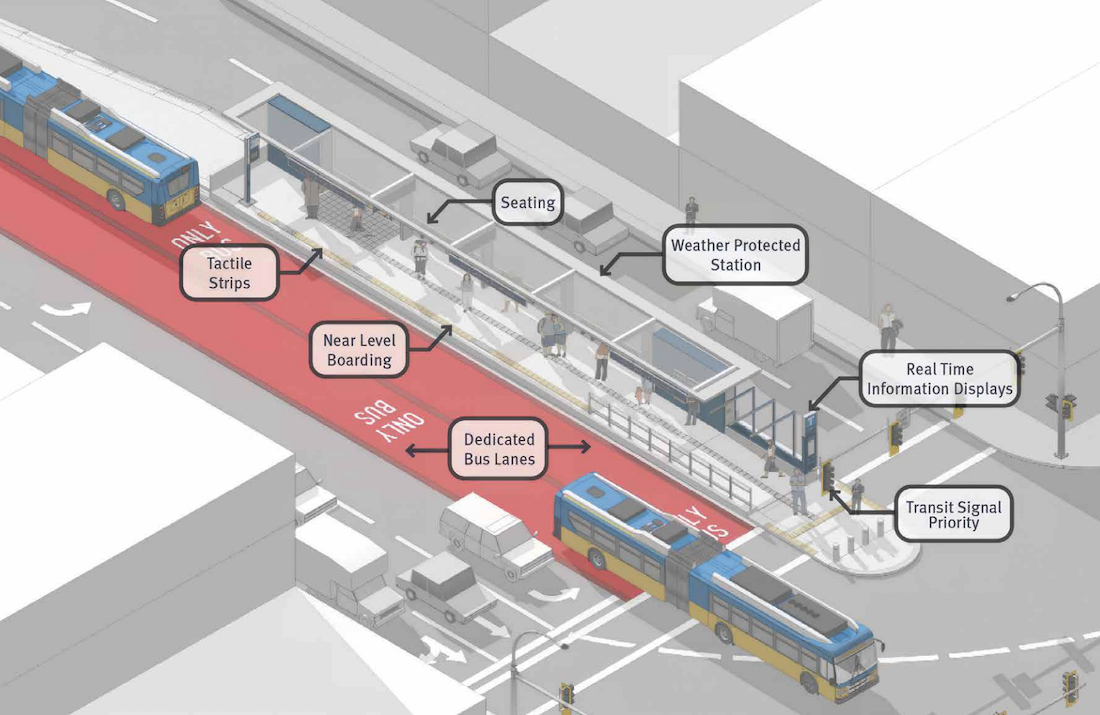
Proposed concept of Metrotown-North Shore BRT, August 2025. (TransLink)
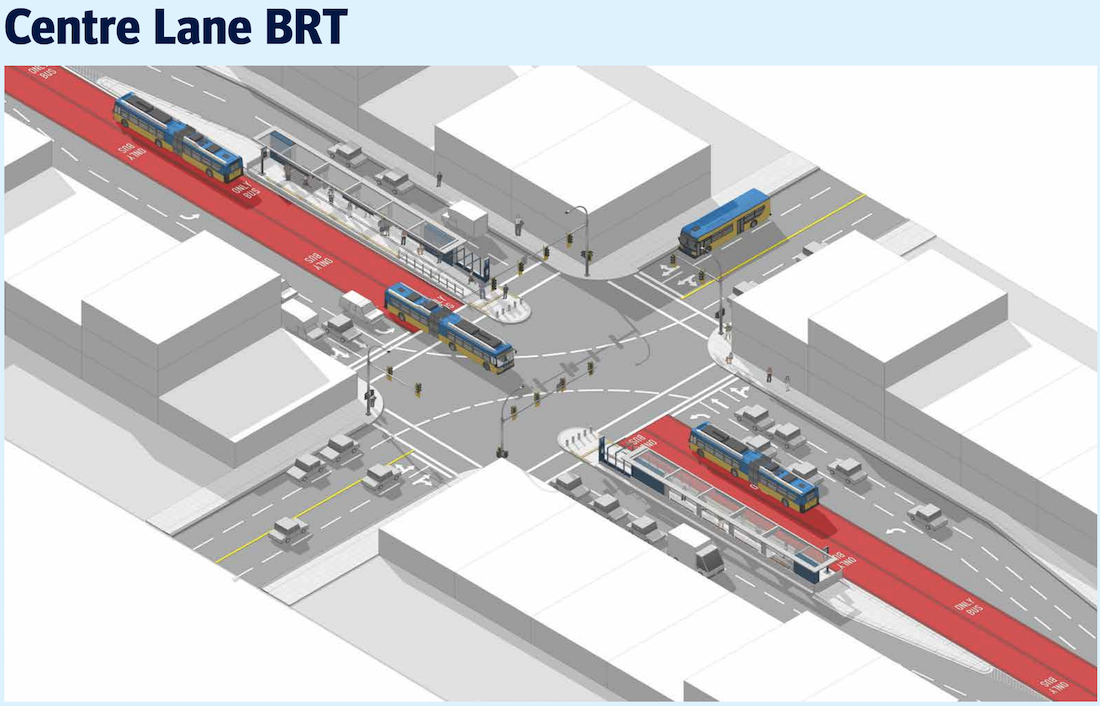
Proposed concept of Metrotown-North Shore BRT, August 2025. (TransLink)
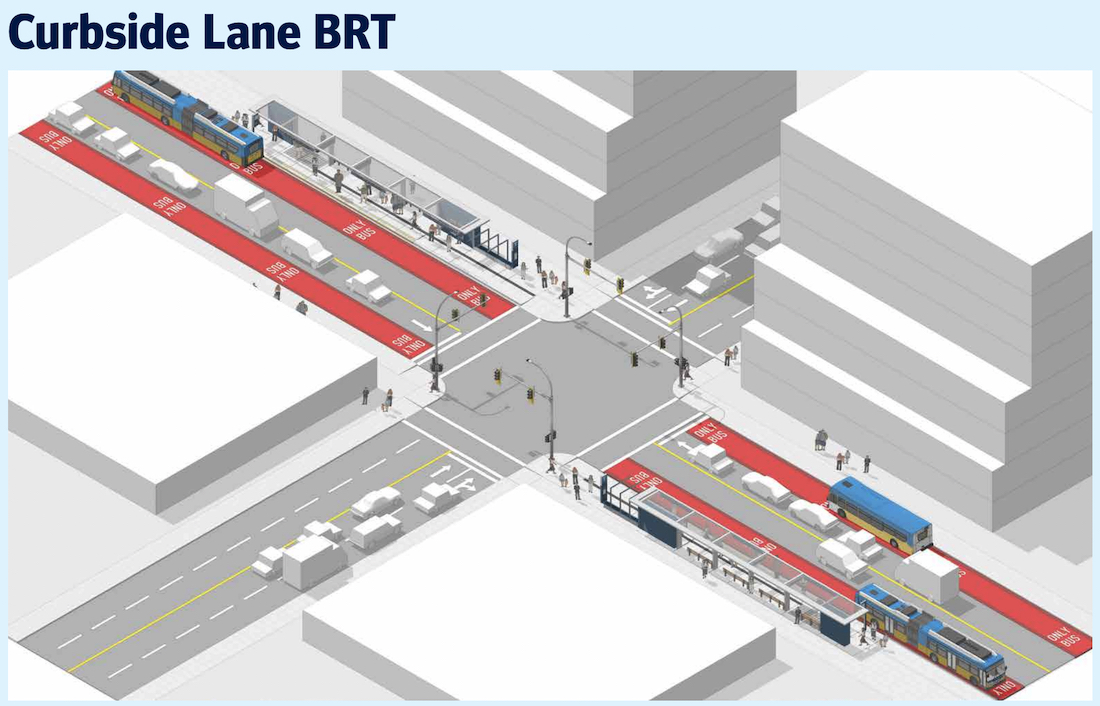
Proposed concept of Metrotown-North Shore BRT, August 2025. (TransLink)
TransLink estimates the Metrotown-North Shore BRT could attract a ridership of up to 60,000 daily riders by 2035. In 2024, according to TransLink statistics, the R2 RapidBus saw an average ridership of 5,700 boardings per weekday, 5,000 boardings per Saturday, and 4,000 per Sunday/holiday, and it ranked as Metro Vancouver’s 42nd busiest bus route and the fifth busiest RapidBus route.
The public transit authority believes that Metrotown-North Shore BRT will be able to achieve an end-to-end travel time of 60 minutes during peak periods. Currently, depending on traffic conditions, especially at the Ironworkers Memorial Bridge choke point, it can take between 40 minutes to over an hour by car on a similar route between Park Royal and Metrotown during peak periods.
TransLink now states that BRT’s street design changes and stations can be built within three years, after funding is secured. This is down from the stated five years during the previous public consultation earlier this year. No potential implementation timeline has been established.
It was also previously indicated that each of these first three BRT routes could carry a cost of between $250 million and $300 million for a total combined cost of nearly $1 billion.
“This investment is so welcomed and will have far-reaching generational impacts. For too long, people have simply not had a competitive alternative to travelling over the Ironworkers Memorial Bridge to their final destination, be it home, work, or leisure. With BRT, City of North Vancouver residents will have better, more frequent, and reliable transit connections within the North Shore and to the rest of the region reducing congestion, fostering economic growth and unlocking equitable opportunities to connect to jobs, post-secondary institutions and housing,” said Linda Buchanan, the Mayor of the City of North Vancouver, in a statement today.
Mike Hurley, Mayor of the City of Burnaby, added, “Creating a Bus Rapid Transit link between Metrotown and the North Shore is a huge win for Burnaby, the North Shore and the Metro Vancouver region. This north-south connection would provide excellent service to some of the fastest growing neighbourhoods in Burnaby, and help foster growth for businesses on both sides of the Burrard Inlet.”
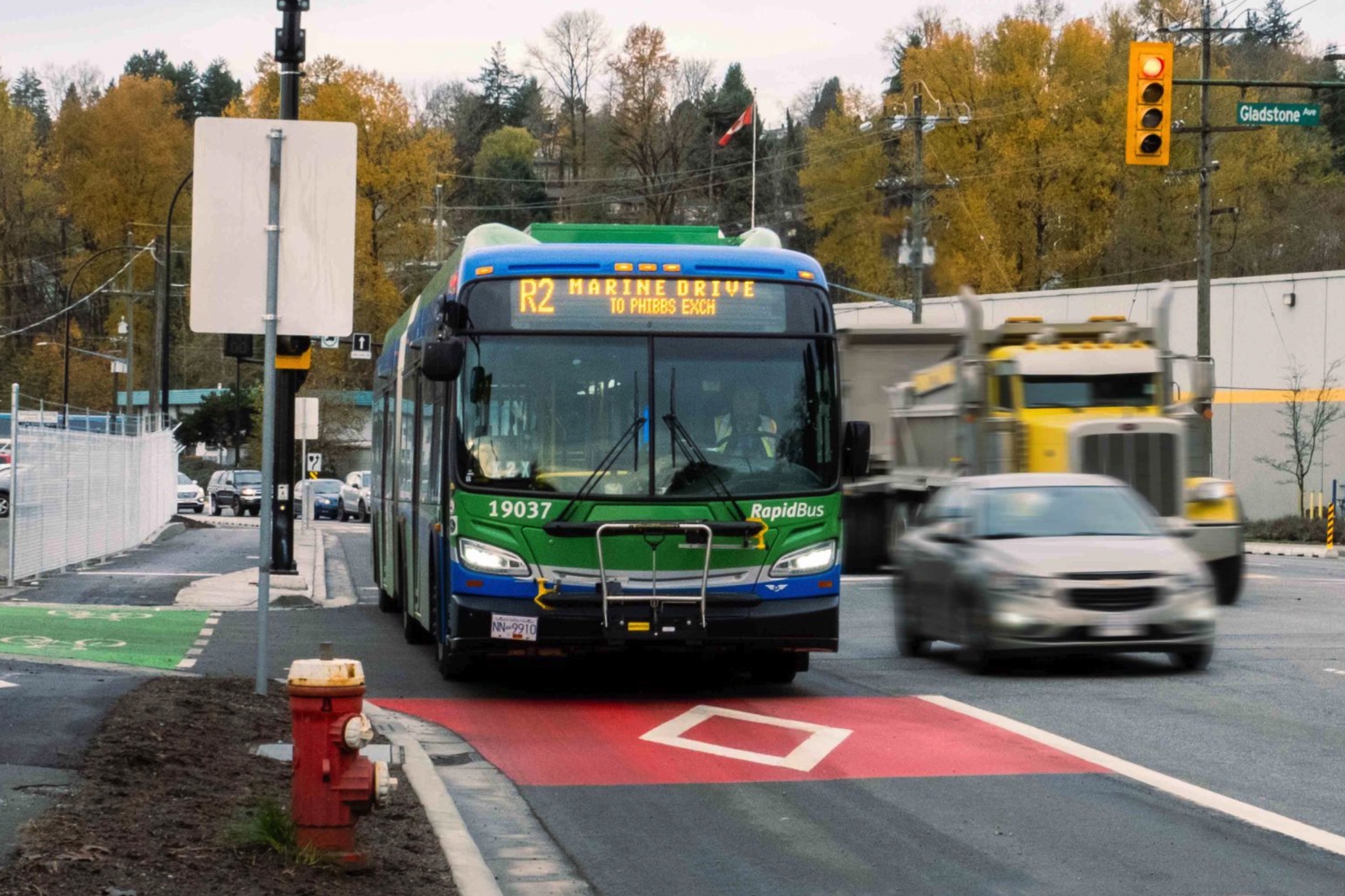
R2 RapidBus on Marine Drive in North Vancouver. (TransLink)
TransLink’s online survey for the public consultation for Metrotown-North Shore BRT will run through September 21, 2025.
The public transit authority is also in the process of planning a potential major upgrade of Metrotown Station’s bus exchange, which would conceivably also enable the station to better serve BRT.
BRT for the Metrotown-North Shore corridor is intended to be an interim medium-term solution, while more permanent, longer-term rapid transit solutions are considered, such as LRT or SkyTrain. Due to its growing age, the Ironworkers Memorial Bridge could also be replaced over the coming decades.
A recent preliminary study commissioned by the District of North Vancouver suggests a Metrotown-North Shore SkyTrain following the same route between Park Royal and Metrotown Station via the Second Narrows and Brentwood could achieve an end-to-end travel time of just 23 minutes and attract an average ridership of 120,000 boardings per day by 2050.