
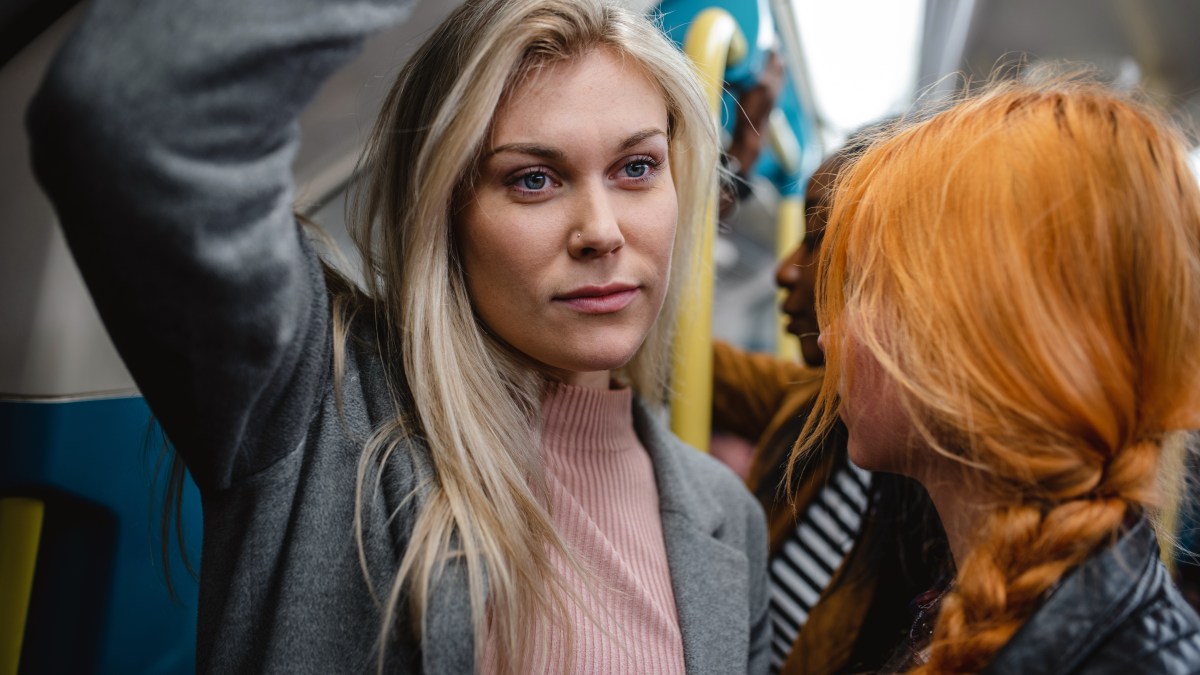
I sensed his heavy, hot breath on the back of my neck first. Not unusual on a London Underground train at rush hour but — hold on a second — my carriage wasn’t even busy. We didn’t need to be pressed up against one another like sardines. Then I felt it: his erection pushed firmly into my lower back and held there. And held there some more.
I froze. Turning round felt impossible and so I never saw his face. When we both got off at King’s Cross, the next stop, he slipped away into the crowd while I frantically felt the back of my dress to check that he hadn’t left a trace (thankfully not).
There’s a reason that the opening scene of Steven Moffat’s 2022 BBC drama Inside Man — in which a woman’s harassment by a man on the Tube is captured by female passengers and the police intercept the train to arrest him — went viral on social media.
Turns out a lot of us have been there.
A friend, sitting down on a train, noticed that the man standing next to her, holding the handrail, was masturbating under his jacket. Another was “dry humped and I didn’t know what to do about it”. Others recall teenage incidents — being pulled on to laps while wearing their school uniform.
I remember men on public transport sitting too close for comfort and edging ever nearer until their leg was practically on top of mine. It was deeply uncomfortable and mortifying but it wouldn’t have occurred to me — or my friends — to report it.

Claire Cohen: “For a while I didn’t count what had happened to me as sexual harassment”
GEMMA DAY
Sometimes you do need to intervene, though. A couple of years ago a wide-eyed woman, no more than 18 or 19, approached and asked if she could stand next to me because “that man over there keeps trying to touch me”. We chatted like old friends until he moved away. “I complained to a guard on the train from Newcastle because a man was verbally harassing a young woman,” a friend recalls. “She had already raised the alarm herself and the guard had moved him but he came back. Once she got off the train he started having a very explicit phone conversation, clearly designed to intimidate me. The guard, to be fair, kicked him off at the next station.”
• The problem I have with Love Island and what it says about men
How many stories like these are out there? According to the latest British Transport Police (BTP) figures, a lot. They show an alarming rise in violence against women and girls on our railways — up 59 per cent since 2021. The number of sexual offences has risen 10 per cent and sexual harassment 6 per cent year on year. Most take place during the evening rush hour, between 5pm and 7pm, on busy carriages.
Rail bosses are calling it an “epidemic” of offending and the Rail Delivery Group, a trade body for train operators, is introducing mandatory training for staff to help “recognise and safely respond to sexual harassment” and increasing the use of body-worn cameras to capture evidence.
It would be unfair to accuse the BTP of doing nothing. In recent years they have run campaigns to encourage women to report, and potential offenders to think twice (you’ve probably seen posters explaining that staring, pressing and catcalling won’t be “tolerated”) and urging bystanders to step in. There’s a free 61016 text service, which started in 2013, for passengers to report incidents in real time — the BTP tell me that the number works underground as many Tube stations have 4G or 5G connectivity and the BTP’s TikTok features several arrests of men, intercepted as they step off a train.
They also tell me that they received 20 per cent more texts in the year 2024-25 than the previous one, which they believe is “due to an increase in confidence among victims and bystanders, especially women and girls, to report crimes to us”. Although from 255,088 messages only 9,079 crimes were recorded — and presumably even fewer were prosecuted.
Campaigners say the rise in sexual offences can’t be attributed to increased reporting alone. “It’s not that simple,” says the barrister Charlotte Proudman, who specialises in women’s rights. “There is still a huge problem with underreporting because women and girls fear not being believed or taken seriously. Too often perpetrators act with impunity in crowded spaces, knowing that women will be blamed for overreacting or expected to move seats rather than the offender being challenged.”
Ellie Cosgrave from the urban design practice Publica, and a prominent campaigner for women’s safety, having been assaulted on the Tube herself, says more than 90 per cent of assault and harassment incidents on public transport are thought to go unreported “because of its normalisation”.
“What’s happening on trains is reflective of broader societal attitudes and behaviours — the very real rise in sexist attitudes stoked by the ‘manosphere’ and far-right groups, which perpetuate violent and aggressive behaviour towards women and girls,” she says.
• I’m fed up with ‘manslammers’ on the pavement
Both emphasise the need for better bystander training, along with investment in safeguarding on trains and a commitment from the criminal justice system “to treat these offences with the seriousness they deserve”, Proudman says. But it’s hard to know how realistic intervention is.
There was widespread horror when Ryan Johnston was jailed in 2023 for raping a sleeping woman on a Tube in front of other passengers — why hadn’t anyone stopped him? But this month, when commuters tackled a man exposing himself on a busy train they found themselves questioned by police. In that context, why would anyone step in?
Jamie Klingler, the co-founder of the social justice organisation Reclaim These Streets, calls it a “dereliction of duty by the people who are funded to protect us” that bystanders are being called upon to intervene at all.
Not to mention that it can be hard enough to know yourself whether you’ve experienced something or not, so subtle are some of the behaviours. For a while I didn’t count what had happened to me as sexual harassment. It felt as though I might have imagined the whole thing.
“I hate it when you’re on the train and the man next to you has a very wide sitting position, enough that they’re touching your leg,” a friend says. “It happens all the time but I don’t know if it’s harassment or not. But you’re the one that has to move to avoid being rubbed up against.”
“Just criminalising things isn’t making the trains any safer because the rates of infractions are still skyrocketing,” Klingler says. “These statistics just confirm what all women know: that it’s on us to keep ourselves safe.”