
Ofgem lifts the energy price cap – the details
The energy regulator for Britain, Ofgem, has said it will increase the cap on energy bills from October by 2%, the equivalent of a £35 rise in annual bills for the average home.
Here’s more details of the energy price cap just announced, from Ofgem.
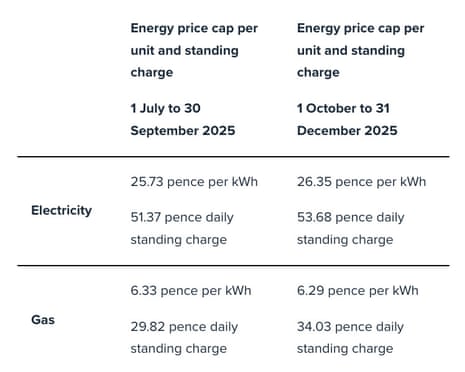 A table showing the latest energy price cap Photograph: OfgemElectricity rates
If you are on a standard variable tariff (default tariff) and pay for your electricity by Direct Debit, you will pay on average 26.35p pence per kilowatt hour (kWh). The daily standing charge is 53.68 pence per day. This is based on the average across England, Scotland and Wales and includes VAT.
Gas rates
If you are on a standard variable tariff (default tariff) and pay for your gas by Direct Debit, you will pay on average 6.29 pence per kilowatt hour (kWh). The daily standing charge is 34.03 pence per day. This is based on the average across England, Scotland and Wales and includes VAT.
Why energy prices have gone up
Volatile global wholesale prices for energy are partly behind the increase, as well as the cost of the government’s expansion of its warm home discount policy. Some people may see a reduction in their standing charges, but this will depend on the region in which they live.
Updated at 02.45 EDT
Key events
Show key events only
Please turn on JavaScript to use this feature
While another rise in energy bills will be unwelcome news for many, analysts at the consultancy Cornwall Insight have said that prices could fall under the next cap, which would start in January 2026.
Dr Craig Lowrey, of Cornwall Insight, said:
There is better news on the horizon with bills currently expected to ease in January, driven by a forecast fall in wholesale prices. Normally, that drop would have meant even lower bills, however, rising policy costs, such as funding for new nuclear projects are keeping bills a little higher.
These policy-driven costs are part of a broader shift in how we fund the energy transition. Nuclear will be one of the cornerstones of a more secure and sustainable energy system, yet some of the funding will ultimately need to come from billpayers.
This is a difficult trade off – after all, everyone wants to see bills come down. However, the challenge we face is clear: if we want to build a resilient, low-carbon energy future, we must be prepared to invest in it today.”
ShareOfgem lifts the energy price cap – the details
The energy regulator for Britain, Ofgem, has said it will increase the cap on energy bills from October by 2%, the equivalent of a £35 rise in annual bills for the average home.
Here’s more details of the energy price cap just announced, from Ofgem.
A table showing the latest energy price cap Photograph: OfgemElectricity rates
If you are on a standard variable tariff (default tariff) and pay for your electricity by Direct Debit, you will pay on average 26.35p pence per kilowatt hour (kWh). The daily standing charge is 53.68 pence per day. This is based on the average across England, Scotland and Wales and includes VAT.
Gas rates
If you are on a standard variable tariff (default tariff) and pay for your gas by Direct Debit, you will pay on average 6.29 pence per kilowatt hour (kWh). The daily standing charge is 34.03 pence per day. This is based on the average across England, Scotland and Wales and includes VAT.
Why energy prices have gone up
Volatile global wholesale prices for energy are partly behind the increase, as well as the cost of the government’s expansion of its warm home discount policy. Some people may see a reduction in their standing charges, but this will depend on the region in which they live.
Updated at 02.45 EDT
Ofgem statement
Tim Jarvis, director general for Markets at Ofgem, says:
While there is still more to do, we are seeing signs of a healthier market. There are more people on fixed tariffs saving themselves money, switching is rising as options for consumers increase, and we’ve seen increases in customer satisfaction, alongside a reduction in complaints.
While today’s change is below inflation, we know customers might not be feeling it in their pockets. There are things you can do though – consider a fixed tariff as this could save more than £200 against the new cap. Paying by direct debit or smart pay as you go could also save you money.
In the longer term, we will continue to see fluctuations in our energy prices until we are insulated from volatile international gas markets. That’s why we continue to work with government and the sector to diversify our energy mix to reduce the reliance on markets we do not control.
Jarvis, speaking to Radio 4’s Today programme, also noted that the cost of running the network and the expansion of the government’s warm home discount scheme had also driven the rise in the cap.
ShareFuel charity: Higher bills just as temperatures drop will put ‘even more pressure on households’
The rise in energy costs will hit people already struggling to pay their household bills, warns National Energy Action, the fuel poverty charity.
Michael Penhaligon, of the NEA, says:
Every day my colleagues and I speak to people in desperate circumstances. They can’t afford the very basics of heat and power. They are rationing their energy usage and they’re cutting back on food and other essentials. The individuals I speak to are left to rely on foodbanks, fuel vouchers and other charitable grants to help restore them to a basic standard of living. This shouldn’t be happening in the UK in 2025.
Some may say that the cap rising around £35 won’t have an impact but the people I speak to already can’t afford their bills and many of them are deep in debt. This can have a huge impact on their mental and physical wellbeing. A rise in bills just as temperatures start to drop will put even more pressure on households.
My colleagues and I achieve amazing outcomes for households to help them afford their energy; we get debt written off, we get them access to benefits they are entitled to, and we liaise with their suppliers on their behalf. But the scale and depth of fuel poverty is far beyond the remit of any charity.
ShareEnergy price cap to rise by 2%
Newsflash: The energy price cap on bills across Great Britain will rise by 2% in October, regulator Ofgem has announced.
This will lift the average annual cost of electricity and gas for a typical household to £1,755 per year.
This is the fourth consecutive hike in the cap on gas and electricity charges, and is slightly higher than analysts had just expected.
The cap limits the amount which a supplier can charge for a unit of electricity or gas.
ShareIntroduction: Energy price cap set to be set today
Good morning, and welcome to our rolling coverage of business, the financial markets and the world economy.
The cost of living could be about to get even tighter, as households find out whether their energy bills will rise again this autumn.
Ofgem, the energy regulator, is due to announce the latest price cap on the cost of a unit of energy at 7am.
Analysts expect the cap to rise due to recent increases in wholesale gas and electricity prices. Consultancy Cornwall Insight have predicted Ofgem will increase the cap by about 1% to £1,737 a year for a dual-fuel household, from the current level of £1,720.
A rise in energy prices would act as yet another driver for high inflation. Official figures showed last week that UK inflation rose in July to a higher-than-expected 3.8% amid higher food prices and travel costs. It marked the 10th consecutive month that inflation has sat above the Bank of England’s 2% target.
The new cap will come into effect in October and remain in place until the end of the year. The energy price cap sets the maximum that a supplier can charge for a unit of energy (there’s no cap on how high a bill can go).
Elsewhere, overnight Donald Trump has imposed 50% tariffs on most US imports from India, following through on his threat to punish one of the world’s largest economies over its purchases of discounted Russian oil.
The tariffs, which came into effect just after midnight on Wednesday in Washington, risk inflicting significant damage on the Indian economy and further disrupting global supply chains.
US tariffs of 25% on Indian goods went into force earlier this month, but Trump announced plans to double the rate, citing India’s purchases of Russian oil, which the White House has argued is indirectly funding Russia’s war against Ukraine.
The agenda
7:00AM BST: Energy regulator Ofgem announces UK energy price cap for October-December
10:00AM BST: UK 2028 gilt auction
After 9:00PM BST: Nvidia quarterly earnings report