
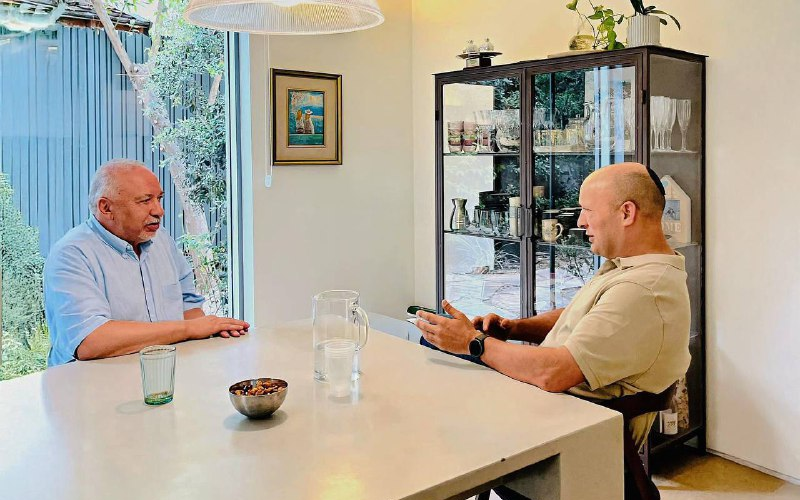
Yisrael Beytenu party chairman Avigdor Liberman met with former prime minister Naftali Bennett on Wednesday, as he sought to galvanize the “Zionist opposition party heads” to come up with a “basic outline” for the next government.
Bennett is not currently serving in the Knesset, but his eponymous new party consistently finishes at or near the top of opinion polls, alongside Prime Minister Benjamin Netanyahu’s Likud party.
In a statement about his meeting with Liberman reported by Hebrew media, Bennett said the two, both Netanyahu allies-turned-adversaries, spoke about a range of topics.
“The two discussed the continuation of the war in Gaza, discussions over a hostage deal, the issue of the draft, the Israeli economy, and likewise discussed different ways to replace the government as soon as possible in order to fix Israel,” Bennett’s statement said.
Liberman, meanwhile, said in a statement that the meeting “emphasized the need to advance underlying principles for the future coalition and maximal alignment between all the Zionist parties.”
Get The Times of Israel’s Daily Edition
by email and never miss our top stories
By signing up, you agree to the terms
The meeting came shortly after Liberman sent a letter to Opposition Leader Yair Lapid asking him to call a meeting of the “Zionist opposition party heads” — along with Bennett and former Knesset member Gadi Eisenkot — for a discussion on “formulating the basic outlines of the next government.”
Liberman told the opposition politicians that they will need to form a united alternative to the current government ahead of the next general elections, which are scheduled for October 2026.
Liberman’s move came after Blue and White-National Unity chief Benny Gantz last week called on Lapid and Liberman to form a “government of hostage redemption” and join Prime Minister Benjamin Netanyahu’s coalition to secure a hostage deal and set election dates. The two other opposition figures derided the idea as “pitiful,” saying there was “no reason” to join the government.
“I believe that especially during this period, we have a duty to show national responsibility and act together, for the sake of strengthening public trust and for a better future for the entire country,” Liberman reportedly wrote in the letter, a copy of which has circulated on social media.
In the letter, he said that Israel needs a “responsible, balanced, and united leadership” that will offer a “moral and practical alternative to the current government.”
“The basic guidelines that will be formulated should reflect broad agreements on the central issues on the national agenda, primarily security, the economy, the establishment of a constitution, the issue of conscription and relations between religion and state, while maintaining the fundamental values of the State of Israel as Jewish, Zionist, democratic and liberal,” he wrote.
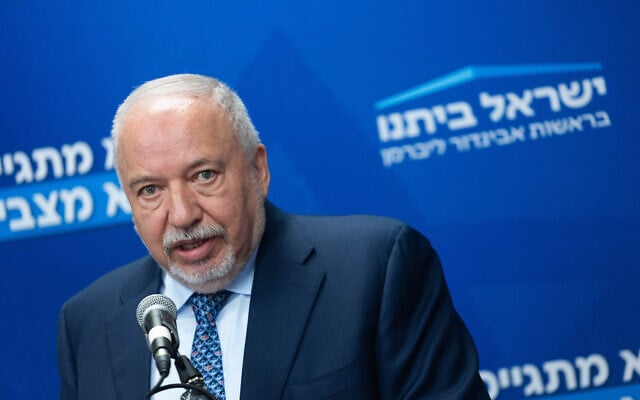
Yisrael Beytenu chair Avigdor Liberman leads a faction meeting at the Knesset on July 7, 2025. (Yonatan Sindel/Flash90)
“I believe that at this crucial hour, we have a duty to accept national responsibility and act together, for the sake of strengthening public trust and for a better future for the entire country,” Liberman concluded.
Notably not named in Liberman’s letter was Gantz, whom the Yisrael Beytenu chair previously called “tired, scared, panicked” for asking him to join forces with Netanyahu. The letter also did not name Yair Golan, chair of the left-wing Democrats party.
Liberman, who for years has been a vocal critical of Netanyahu, appears to be positioning his hawkish party as the linchpin of a future ideologically diverse coalition that would hope to unseat Netanyahu in the upcoming elections.
Speaking with The Times of Israel in his Knesset office last year, the former defense minister and foreign minister accused Netanyahu of politicizing wartime decision-making, claiming that he “has no strategy” and is actively “trying to waste time” and “continue the war until the next elections.”
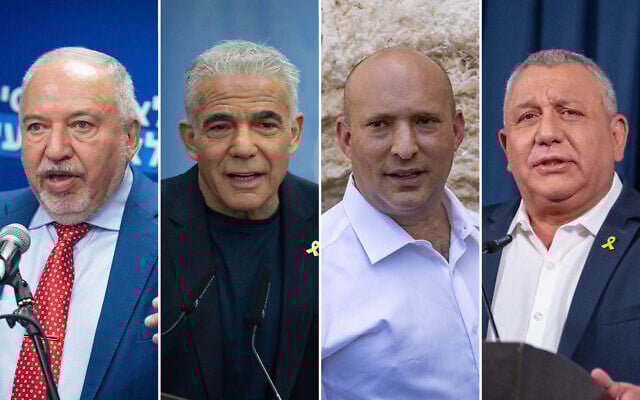
Left to right: Yisrael Beytenu chair Avigdor Liberman leads a faction meeting at the Knesset on July 14, 2025. (Yonatan Sindel/Flash90); Opposition Leader Yair Lapid leads a faction meeting at the Knesset, in Jerusalem, on August 4, 2025. (Yonatan Sindel/Flash90); Former prime minister Naftali Bennett visits at the Western Wall in Jerusalem’s Old City, May 26, 2025. (Yonatan Sindel/Flash90); Former MK Gadi Eisenkot holds a press conference after announcing his resignation from the Knesset and his departure from the National Unity party, in Tel Aviv, July 1, 2025. (Erik Marmor/Flash90)
Liberman started his political career in Likud, eventually serving as director-general of the party and, later, of the Prime Minister’s Office under Netanyahu in the 1990s. In 1999 he established Yisrael Beytenu after splitting from Likud, over what he said was Netanyahu’s weak stance on Palestinian affairs.
While he has since served in multiple Netanyahu governments, even running together with Likud in a unified slate in the 2013 elections, Liberman has been highly critical of the prime minister in recent years.
Liberman resigned as defense minister in November 2018, protesting a ceasefire between Israel and Palestinian terror groups in Gaza in the wake of a fierce two-day barrage of over 400 rockets fired by Hamas and other terror groups at Israel. He has since spent most of his time in the opposition, barring a stint as finance minister in the 2021-2022 Bennett-Lapid government.
His criticism has continued unabated following the October 7, 2023, attack, when thousands of Hamas-led terrorists from Gaza burst through the border fence and invaded southern Israel, killing some 1,200 people and taking 251 hostages, and starting the ongoing war.
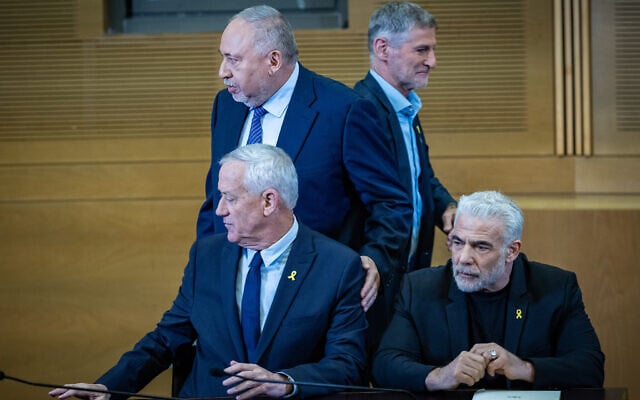
Head of The Democrats party Yair Golan, head of National Unity party Benny Gantz, head of Yesh Atid party Yair Lapid and head of Yisrael Beytenu party Avigdor Liberman hold a joint press conference at the Knesset in Jerusalem, November 6, 2024. (Yonatan Sindel/Flash90)
According to a poll conducted by Channel 12 earlier this month, if elections were held immediately, Liberman’s Yisrael Beytenu would win 11 seats, the fourth-most in the poll behind Likud, with 24 seats, an yet-unnamed party led by Bennett with 20 seats, and a theoretical party led by Eisenkot with 12.
The poll gave Lapid’s Yesh Atid seven seats and Golan’s Democrats 11 seats. It had Gantz’s Blue and White-National Unity party missing out entirely, falling short of the electoral threshold.
Sam Sokol contributed to this report.