
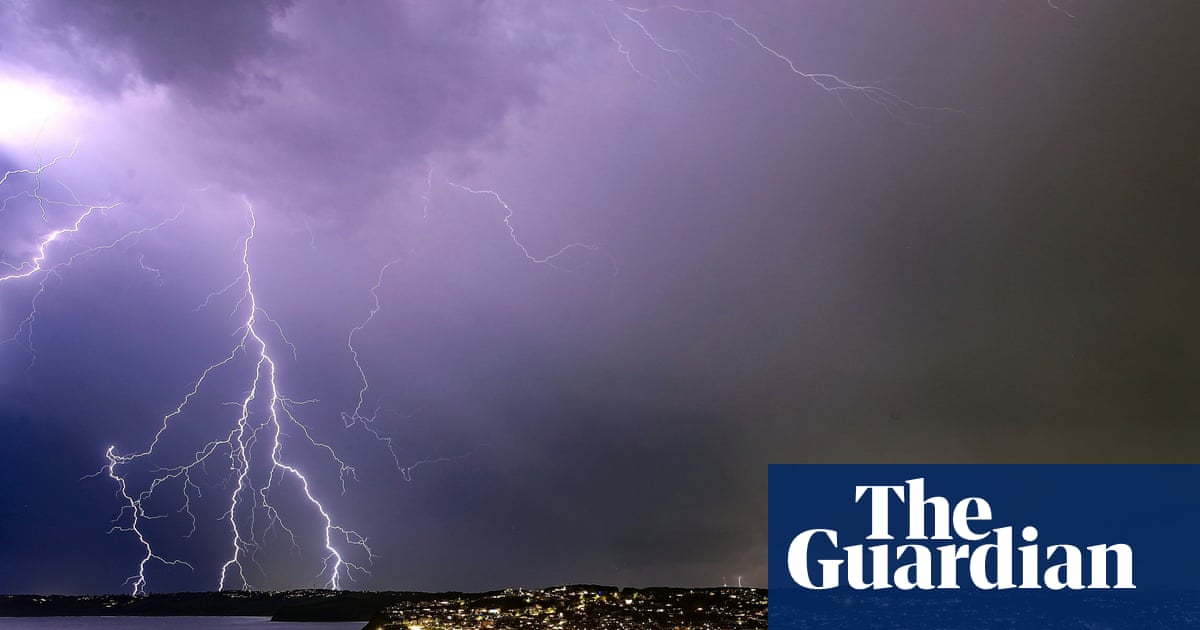
Spring looks set to be wetter than usual for Australia’s entire eastern half, according to the Bureau of Meteorology’s latest long-range forecast, after data showed record heat in the ocean around the continent in July.
The bureau’s forecast for spring also pointed to warmer than average night-time temperatures over almost the entire country.
Daytime temperatures were also likely to be above average across the north and south, with average conditions expected in south-east Queensland and northern New South Wales.
Tasmania is likely to see maximum temperatures in the top 20% on record, the forecast showed.
Global weather models suggested warmer waters in the eastern part of the Indian Ocean off Australia’s north-west were developing – a phenomenon known as a negative Indian Ocean Dipole, which can bring wetter conditions.
A Bureau of Meteorology map shows the eastern half of Australia is likely to have a wetter than average spring for 2025. Photograph: Bureau of Meteorology
Dr Simon Grainger, senior climatologist at the bureau, said: “It looks like we’re in the early stages of that negative IOD.
“Historically we have seen that [a negative IOD] tends to favour wetter than average springs, particularly inland from the dividing range in NSW and Victoria.”
Spring rainfall is between 60% and 80% more likely to be above average across most of the country’s east and September and October could be particularly wet, Grainger said.
The Bureau of Meteorology’s latest long-range forecast is suggesting a wet spring is likely for Australia’s east
The increased cloud cover that could bring the rain would also help keep night-time temperatures above average almost everywhere except the south-west corner of Western Australia.
Record ocean heat
In the ocean, the bureau expects warmer than average sea surface temperatures (SST) to the north, east and south-east which could “enhance the severity of storms and rain systems”.
Just like on land, global heating – caused mostly by burning fossil fuels – has been pushing up ocean temperatures around the globe.
SSTs in July were 0.56C above average for the Australian region – the warmest July on the bureau’s record that goes back to 1900.
skip past newsletter promotion
Sign up to Clear Air Australia
Adam Morton brings you incisive analysis about the politics and impact of the climate crisis
Privacy Notice: Newsletters may contain info about charities, online ads, and content funded by outside parties. For more information see our Privacy Policy. We use Google reCaptcha to protect our website and the Google Privacy Policy and Terms of Service apply.
after newsletter promotion
The region’s SSTs have been at record, or near-record levels, since July last year, the bureau said.
Australia’s hotter oceans were “part of a pattern we have seen globally,” said Grainger, where, since March 2023, temperatures have been at record highs.
“In a globally warming climate, about 90% of the extra heat goes into the oceans,” he said.
Increased bushfire riskA Bureau of Meteorology map shows the chances of areas having above-average night-time temperatures for the months of September, October and November 2025. Photograph: Bureau of Meteorology
Australia’s climate has warmed by 1.5C since the bureau’s official temperature data record started in 1910.
Spring 2024 was Australia’s warmest on record and since then, the country has broken a string of heat records.
The 12 months ending in March 2025 were 1.61C above average – the hottest of any 12-month period on record.
Earlier this week, fire chiefs said despite the expected wet conditions, they were expecting an increased risk of spring bushfires in parts of Victoria and northern and central WA.
There was a heightened risk of bushfire for the Dampier Peninsula, Derby Coast and the central Kimberley, Little Sandy Desert and south-eastern Pilbara in WA.
In the report, the fire chiefs said there was also increase bushfire risk for south-eastern agricultural areas of the Murraylands in South Australia and parts of Victoria, including south-west Gipplsland.