
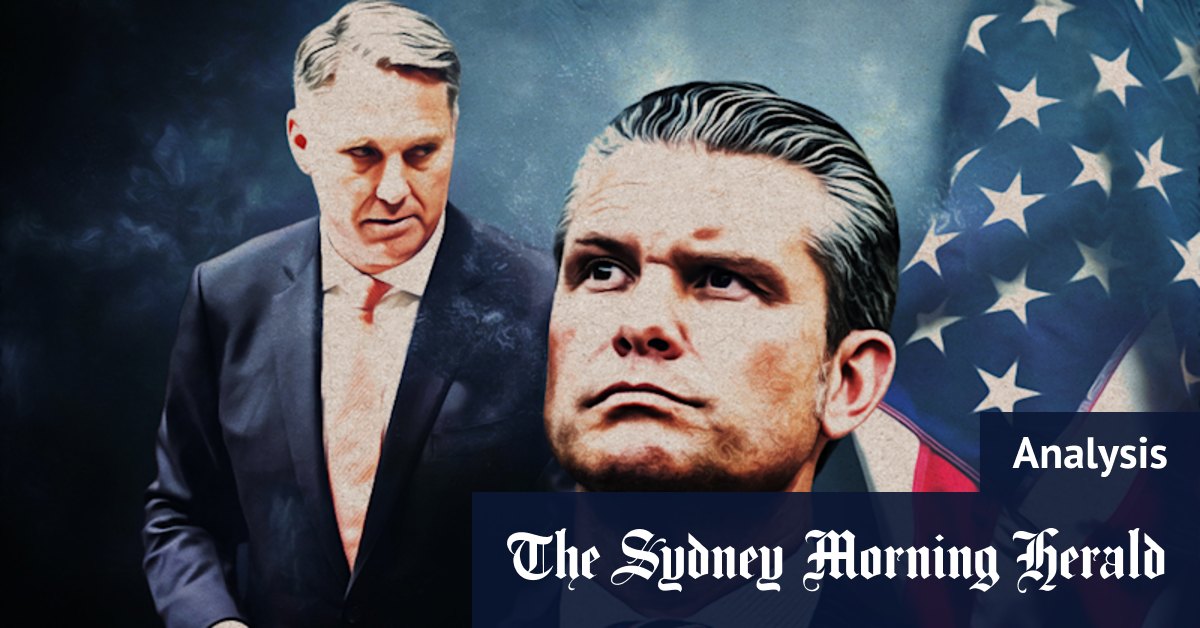
A few hours later, the Pentagon backflipped, saying in a subsequent statement that Hegseth had been happy to host Marles. “Their meeting at the White House on Tuesday was co-ordinated in advance,” the Pentagon’s chief spokesperson said, heightening the confusion. How can a meeting be both happenstance and organised in advance?
Whatever you call it, sources familiar with the encounter say Marles and Hegseth spoke for about 10 minutes, clearly not enough time for deep discussions about the future of the AUKUS pact, security in the Indo-Pacific or Australian defence spending.
Loading
Marles’ office typically stands out for being professional and highly organised in its operational matters, raising the likelihood that the ramshackle Trump administration was responsible for the stuff-up.
During Marles’ trip, Hegseth was occupied by a highly unusual three-hour live-streamed cabinet meeting in which Trump’s department secretaries were expected to fawn over him and explain how they were enacting his agenda. It was a high-stakes spectacle. “If I thought one of them did badly, I would call that person out,” Trump said, treating the event like an episode of The Apprentice.
Marles’ meetings with US Vice President JD Vance, Secretary of State Marco Rubio and deputy White House chief-of-staff Stephen Miller were far longer and more substantial. Regardless of any particular outcomes, this type of relationship building is critical and not to be dismissed. Opposition frontbencher James Paterson – hardly one to give the government an easy ride – took the high road by saying Marles had received “very senior access” in Washington and that this is “the kind of relationship we aspire to have with the United States”.
Looming over Marles’ visit was the more significant question of whether Prime Minister Anthony Albanese will secure a meeting with Trump when he visits the US next month for the United Nations General Assembly. Indeed, the main point of Marles’ visit may not have been defence but to grease the wheels inside the Trump administration for a leaders’ meeting.
Forget any notion that Albanese would be happy to steer clear of Trump; he has made clear that he wants to meet and will do so at short notice. It is crucial at any time for an Australian prime minister to have a productive relationship with their US counterpart. That’s true more so now, given the Trump administration is reviewing the future of the AUKUS pact. Trump may not be the US president most Australians would choose, but it’s in our national interest for him to have a positive view of Australia, and of Albanese.
While nothing is guaranteed with the chaotic Trump administration, the Albanese government is quietly confident a meeting will take place next month – if not in New York or the White House, then in a trilateral encounter in London with British Prime Minister Keir Starmer following his US visit. If a meeting doesn’t take place, that will be a major snub rather than just a snafu. As for the flap over the Marles-Hegseth encounter, it is significant only because it symbolises a deeper truth: the US may be our ally, but it is an increasingly unreliable and capricious one.
Cut through the noise of federal politics with news, views and expert analysis. Subscribers can sign up to our weekly Inside Politics newsletter.