
Nvidia beat Wall Street sales estimates for the second quarter as demand for its powerful artificial intelligence chips remained robust, despite uncertainty around the US chip producer’s China business.
The world’s most valuable company reported second-quarter revenue of $46.74 billion, up 56 per cent on the same period last year and beating analyst forecasts of $46.05 billion.
Despite the forecast-beating results and upbeat outlook, Nvidia shares were 3 per cent lower in after hours trading, after data centre revenue of $41.1 billion slightly missed estimates.
The shares are still 35 per cent higher since the start of the year. Nvidia has a market value of $4.4 trillion, compared with Microsoft at $3.8 trillion and Apple some way behind on $3.4 trillion.
David Wagner, head of equity at Aptus Capital Advisors, said: “The negative stock reaction feels like a bit of an incorrect knee-jerk reaction. The company is still growing over 50 per cent on their guidance at a $50 billion quarterly revenue run-rate — that’s remarkable, even for the current valuation.”
Net income for the second quarter rose 59 per cent year-on-year to $26.4 billion, ahead of forecasts of $24.7 billion.
Nvidia, the maker of graphics processing units first developed for video gaming, has recorded extraordinary results since the public launch of ChatGPT in late 2022, which broadened the use case for its chips and triggered a wave of investment in AI infrastructure.

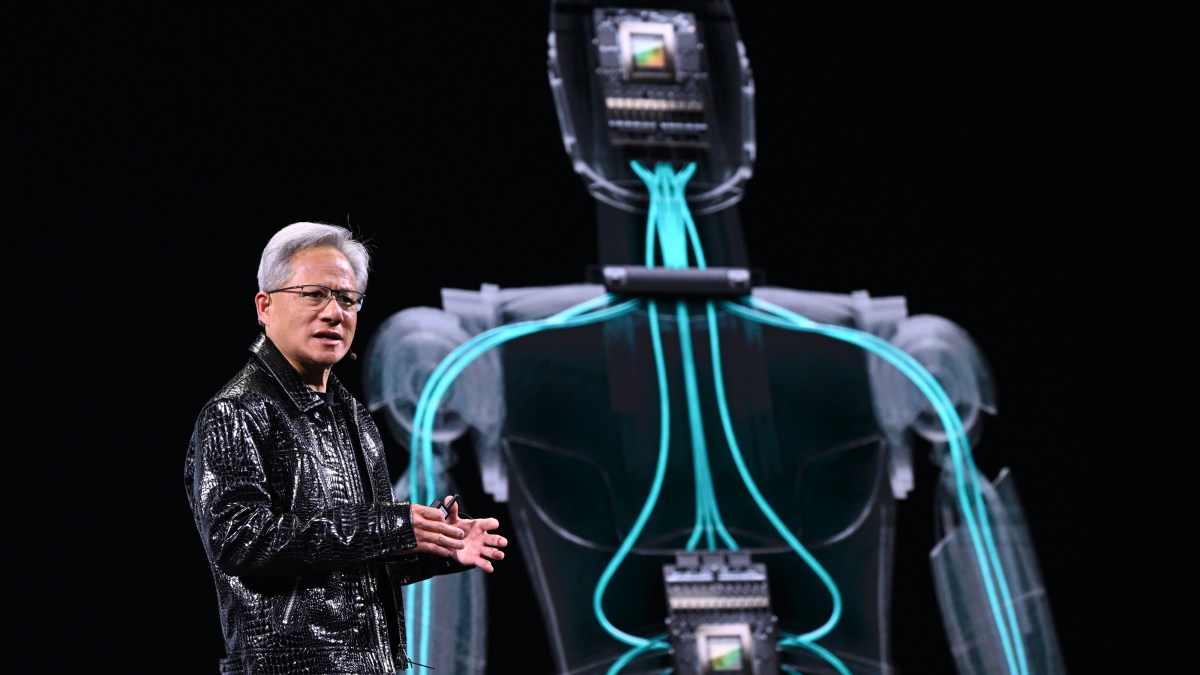
Huang in Beijing last month
ANDREA VERDELLI/BLOOMBERG/GETTY IMAGES
Nvidia is the first company to hit a $4 trillion market capitalisation. Its closest chip competitors are Broadcom, worth $1.4 trillion, and AMD, worth $265 billion, while Intel lags six places behind at $107 billion.
Investors have been piling into AI companies after a sell-off earlier in the year sparked by China’s DeepSeek and President Trump’s trade war. Traders’ confidence has been lifted by the huge AI infrastructure investment plans of cloud service providers such as Alphabet, Microsoft and Amazon.
Nvidia faces uncertainty around its China business amid rising friction between Washington and Beijing over access to its industry-leading AI chips. The company wrote off $4.5 billion in the first quarter related to inventory of H20, its less powerful chip developed for the China market, after Trump banned sales of the product in April over national security concerns.
In July, the White House reversed the ban. It later emerged that Nvidia had agreed to give 15 per cent of its chip sales in China to the US government in exchange for export licenses. However, the chip producer has asked some of its suppliers to stop work related to the H20 chip amid concerns in Beijing over the chip’s security risks.
China’s cyberspace regulator and state media have alleged that the company’s chips could pose security risks. Chinese authorities are understood to have summoned domestic companies including the internet giants Tencent and ByteDance over their purchases of Nvidia’s H20 chips. Nvidia says its chips have no backdoor risks.
• Five things investors should look out for in Nvidia’s results
Sales to China accounted for $17 billion, or 13 per cent, of company revenues last year. Colette Kress, Nvidia’s chief financial officer, said some of its H20 customers in China have received licenses over the past few weeks.
She added that the US government has not yet published a regulation codifying a requirement to receive 15 per cent of the revenue generated from licensed H20 sales.
If geopolitical issues ease, the chip producer would expect to shop between $2 billion and $5 billion of H20 chips in the third quarter.
Kress called for the US goverment to approve shipments of the more powerful Blackwell chip to China.
“Our products are designed and sold for beneficial commercial use and every licensed sale we make will benefit the US economy,” she said. “We want to win the support of every developer. America’s AI technology stack can be the world’s standard if we race and compete globally.”
Nvidia expects annual AI infrastructure investments to continue growing, driven by factors including physical AI and robotics, Kress added.
The company issued guidance for the present quarter, saying it expects sales of $54 billion, plus or minus 2 per cent, ahead of analyst estimates of $53.14 billion. It did not include any anticipated sales of H20 chips in the forecast.
Jensen Huang, Nvidia chief executive, said on Friday that the company was in talks with the US over offering China a chip that is more powerful than the H20 model.
“It’s up to, of course, the US government, and we are in dialogue with them, but it is too soon to know,” he said. He told reporters in Taipei that Nvidia had a significant number of H20 chips prepared and was now waiting for purchase orders from China customers.