Six months after Adrian Orr’s sudden departure as Governor of the Reserve Bank, the RBNZ has released a timeline of events leading up to what we now learn was a negotiated resignation.
The timeline was only released after the Chief Ombudsman requested that the RBNZ do so.
And we now know the negotiation over the Governor’s resignation included the RBNZ board agreeing to “withdraw” a letter it had sent to Orr raising several issues with him
In the original announcements on March 5 about Orr’s departure, the RBNZ had indicated the resignation was “just a personal decision” Orr had made, and there weren’t any policy, conduct, or performance issues driving it.
However, further details were released in June in response to Official Information Act requests that gave a rather different picture.
And now the released timeline includes some more and new details of what were clearly acrimonious events leading up to the departure, (in which Orr “agreed to resign”) including reference to the “tenor of dialogue” at meetings with officials and the Finance Minister Nicola Willis.
The timeline also includes some detail of a letter the RBNZ chair sent to Orr, raising issues with him – the letter that was apparently later ‘withdrawn’.
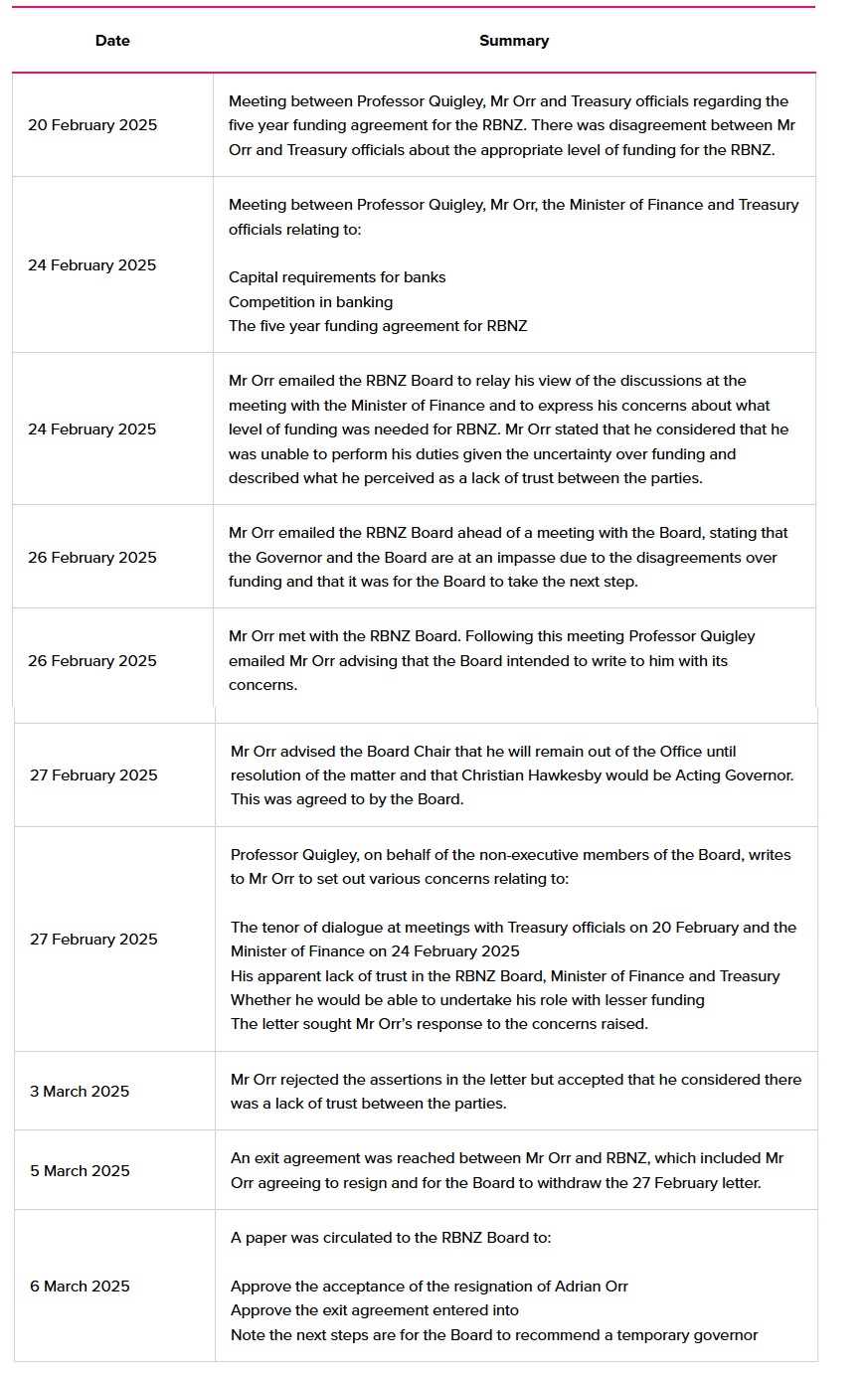
The timeline says: “An exit agreement was reached between Mr Orr and RBNZ, which included Mr Orr agreeing to resign and for the Board to withdraw the 27 February letter”.
The release of the timeline by the RBNZ on Thursday was only after an inquiry by the Chief Ombudsman John Allen into complaints received on the RBNZ’s handling of Official Information Act (OIA) requests regarding Orr’s departure.
RBNZ Board Chair, Neil Quigley said in a statement that “following his review of information withheld by the RBNZ from requests under the OIA for information relating to Adrian Orr’s departure, the Chief Ombudsman has asked us to release a timeline of events covered by this information but has not required any additional documents or other information to be released. The Chief Ombudsman has also provided guidance on the different grounds that applied to withhold information and where the public interest lies”.
“We therefore conclude that apart from being late with our OIA responses, the approach we took in responding to OIA requests was a reasonable one to the requests and met the overall public interest by balancing transparency with privacy and other legitimate concerns.”
The timeline gives detail on how Quigley, on behalf of the non-executive members of the Board, had written to Orr on February 27 to “set out various concerns” relating to:
“The tenor of dialogue at meetings with Treasury officials on 20 February and the Minister of Finance on 24 February 2025, [Orr’s] apparent lack of trust in the RBNZ Board, Minister of Finance and Treasury, whether he would be able to undertake his role with lesser funding.”
The letter had sought Orr’s response to the concerns raised.
The timeline said that Orr, who was already now on leave, had responded on March 3 that he “rejected the assertions in the letter but accepted that he considered there was a lack of trust between the parties”.
On March 5, according to the timeline, an “exit agreement was reached between Mr Orr and RBNZ, which included Mr Orr agreeing to resign and for the Board to withdraw the 27 February letter”.
This earlier story gives detailed information around the RBNZ’s handling of the issue.
Additionally, Finance Minister Nicola Willis had warned RBNZ leadership to be more transparent.
This is the timeline provided by RBNZ: