
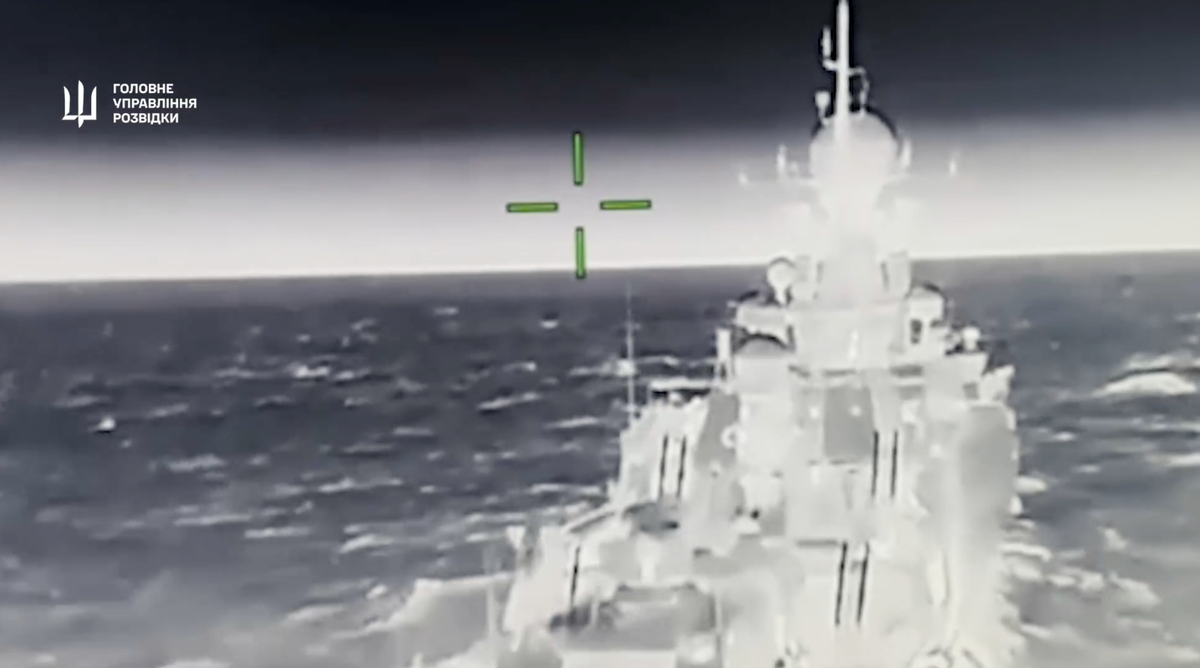
The fighters of the Defense Intelligence of Ukraine (HUR) on Thursday, Aug. 28, damaged a Russian small missile ship of Project 21631 “Buyan-M” — a carrier of Kalibr cruise missiles, according to an official statement from the agency.
HUR reported that the operation was carried out jointly by the Department of Active Measures and the special unit “Prymary.”
JOIN US ON TELEGRAM
Follow our coverage of the war on the @Kyivpost_official.
First, the “Prymary” fighters attacked the vessel with a strike drone, damaging its radar system. Afterwards, special forces from the Department of Active Measures hit the ship’s hull.
HUR published corresponding video footage of the strike in Azov Sea near Crimea.
“As a result of the attacks, the Russian missile ship, which was in the potential launch zone for Kalibrs in the Temryuk Bay, sustained damage and was forced to leave its combat duty area,” the intelligence service said.
Russia’s Project 21631 Buyan-M small missile ship is designed for operations in coastal areas and inland seas.
The vessel is 73 metres (240 feet) long, with a displacement of around 949 tons, and a draught of roughly 2.5 meters (8.2 feet). It can reach speeds of up to 25 knots (29 mph / 46 km/h) and has an endurance of about 15 days at sea.
Its armament includes Kalibr cruise missiles, Redut surface-to-air missile systems, a 76 mm naval gun (3-inch), as well as several machine-gun mounts for close-range defence.

Other Topics of Interest
Putin ‘Mocking’ Peace Efforts: Sikorski After EU HQ Damaged in Missile Attack on Kyiv
The British Council’s offices in Kyiv were also hit in one of the largest aerial bombardments of Russia’s three-and-a-half-year-long invasion.
The crew consists of approximately 52 sailors, and the ship is fitted with modern communications and radar systems to conduct combat missions in coastal zones.
The Kalibr missiles — Russia’s sea-launched cruise weapons — are widely used against Ukraine. They can be launched from both surface ships and submarines operating in the Black Sea and the Sea of Azov.
These missiles have a range of over 1,500 km (930 miles), with flight profiles that allow them to evade air defence systems, making them difficult to intercept.
Typically, Kalibrs are employed during large-scale, combined attacks, launched alongside ballistic missiles or kamikaze drones.