
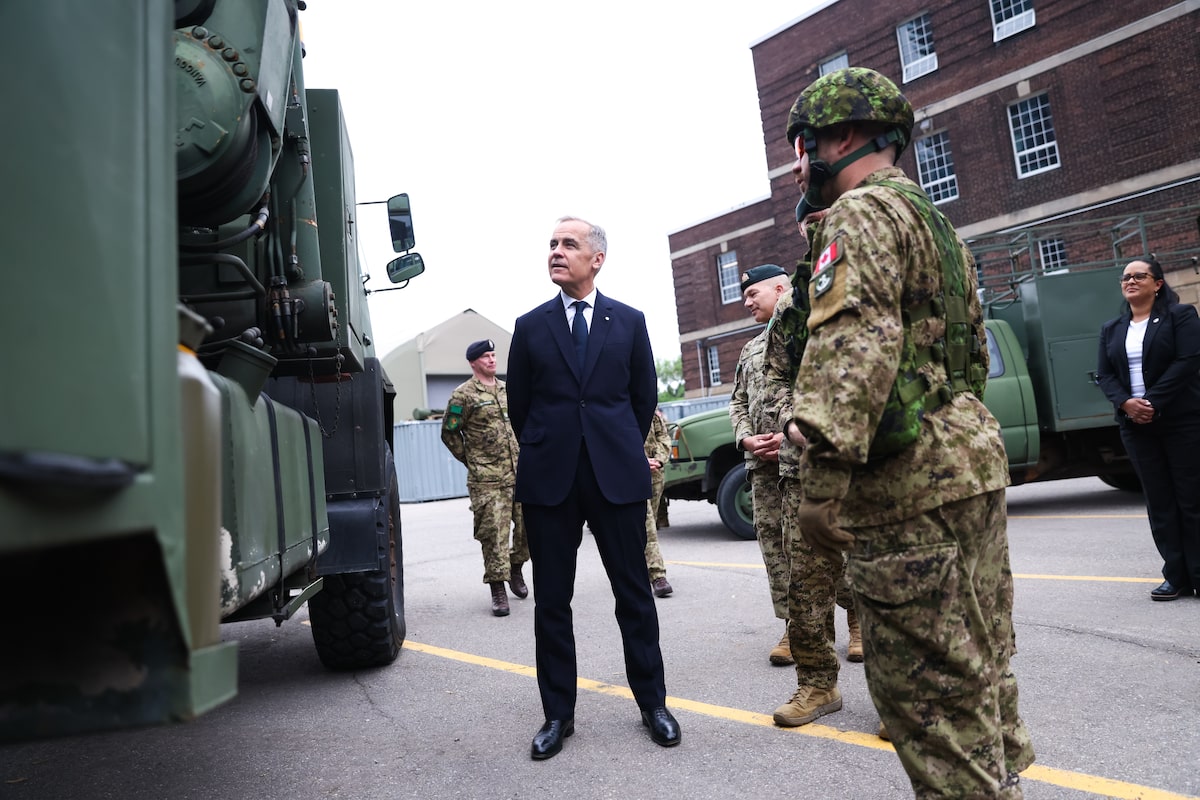
Prime Minister Carney has pledged to hike the defence budget to equal 5 per cent of GDP − up from this year’s 2 per cent.Cole Burston/Getty Images
Submarines to prowl Canada’s coasts, surface-to-air missiles to protect its cities and billions of dollars for aging military-base infrastructure that in many cases dates back to the Second World War.
For years, the Canadian military has drawn up lists of what it needs to bolster its readiness and capabilities. Now, it may have the cash to change how Canada defends itself.
For the past decade, the country has lagged much of NATO in meeting an alliance military spending target. But the Armed Forces are now in line to receive a cash infusion of historic proportions.
In what would be the biggest increase in military spending in more than 70 years, Prime Minister Mark Carney agreed at a June North Atlantic Treaty Organization leaders’ summit to hike the defence budget to equal 5 per cent of gross domestic product − up from 2 per cent this year.
New NATO target will require Canada to spend $150-billion annually on defence, Carney says
In terms of military-related spending, that means upward of $50-billion in additional annual funds by 2035. (A significant part of the NATO target is for security-related infrastructure investments that could have a dual civilian and military purpose, such as ports or airports. Mr. Carney has said that Canada can easily meet this part of the target by claiming infrastructure expenditures that would happen anyway.)
How should Canada spend the money? Many military experts have ideas.
Retired general Wayne Eyre, formerly Canada’s top soldier as chief of the defence staff, said submarines are among key priorities. Not four submarines, as Canada has now, but 12.
“Submarines provide the stealth, the lethality, the persistence, that really gives the country unilateral options it wouldn’t otherwise have – especially as the Arctic opens up,” he said in a recent interview.
Canada currently has four submarines bought from Britain in 1998.DARRYL DYCK/The Canadian Press
The four used subs Canada bought from Britain in 1998 were a means of keeping a sub capability alive, whereas 12 submarines would give the Canadian military a robust capacity.
Twelve submarines would give Canada three submarines in a state of high readiness: able to deploy or patrol.
“For every four submarines, one is going to be in long-term maintenance, one is going to be in short-term maintenance, one will be in training and one is in high readiness,” Mr. Eyre said. It has been estimated that the full cost of acquiring 12 submarines would be up to $120-billion, or $10-billion apiece.
Back in 2024, a defence-policy update laid out top priorities, many of which will remain so.
These include sustaining military equipment with sufficient spare parts and upgrades, enabling more domestic ammunition production, installing maritime sensors to surveil ocean traffic, building out a string of northern supply hubs to support Arctic operations, ground-based air defences, long-range precision strike missiles, as well as more light armoured vehicles and a new focus on drones.
Mr. Eyre said a maintenance deficit has built up in the Forces over the years because of underfunding. Investing in readiness will mean significant additional funding for maintenance.
He said he thinks Canada needs to significantly increase the Department of National Defence’s research and development spending to perhaps 15 to 20 per cent of its budget. The former soldier said the accelerated pace of technological innovation in the battle between Ukraine and Russia demonstrates how fast the battlefield is changing and Canada needs to keep up.
“In the ‘adaptation battle’ we need to work much closer with tech companies and dramatically shorten the path from innovation to acquisition,” he said. “We’re going to have to prepare for the next war and rapid changes during it, and not the last one, so we’re going to have to crack that code.”
Opinion: Canada’s age-old stigma against defence spending will cost us dearly
Canadians prefer more debt over higher taxes to finance increased military spending, poll finds
DND was unable to immediately say exactly how much of its budget is spent on research and development but noted that its Defence Research and Development Canada unit represents about 1.76 per cent of its budget.
About 25 per cent of existing DND infrastructure is greater than 50 years old and “requires significant maintenance, repair and recapitalization to ensure it remains serviceable and compliant with health, safety and environmental regulations,” an audit revealed in 2024.
Airfields, jetties, ports, training areas, housing − all these areas are ripe for upgrades, Mr. Eyre said.
Military procurement has long been plagued by delays and rising costs. Mr. Eyre said fixing purchasing must include buying more “off-the-shelf” equipment rather than adding pricey customizations for the Canadian Armed Forces.
“We need a willingness to accept an 80-per-cent solution so we don’t have to Canadianize the heck out of it.”
Canada has already arranged to buy new F-35 fighter jets and Mr. Eyre said he thinks these should be the last generation of crewed fighters. He said the Canadian military should take an interim step toward this by tethering drones to fighter jets so they operate in tandem.
Canada has made a deal to buy new F-35 fighter jets and retired general Wayne Eyre believes these should be the last generation of crewed fighters.Justin Tang/The Canadian Press
Andrea Charron, director of the Centre for Defence and Security Studies at the University of Manitoba, said earlier this month that Canada needs to seriously consider beefing up security at military bases – both information-technology protection and physical infrastructure.
“You look at a lot of bases in Canada, and they are extraordinarily easy to access,” she said. “There’s a chain link and a commissionaire [guard] and maybe we need to look at hardening them.”
Prof. Charron said Canada needs ground-based air defence systems to defend critical infrastructure. “We have no short-range or long-range systems for use in Canada,” Prof. Charron said. “So whenever we have big events like the G7, we have to have them brought up from the United States.”
Most importantly, she notes, Canada needs to have a funded operation for the defence of the country, so that the Armed Forces stops dipping into maintenance funds when it needs to scramble jets. Right now, the Forces are “stealing from Peter to pay Paul,” she said.
Mr. Carney has confirmed that Canada is in talks with the United States about potentially joining U.S. President Donald Trump’s “Golden Dome” missile shield to expand continental defences against missile and drone attack.
Those negotiations are continuing but Prof. Charron said improved domain awareness and ground-based air defences will be essential parts of any increased protective systems − also to catch any stray hostile missiles that aren’t intercepted by the rest of the shield.
Campbell Clark says: The golden maybe for Golden Dome
Opinion: Canada should firmly reject Trump’s ludicrous Golden Dome plan
Canada relies heavily on the U.S.-owned Global Positioning System, a satellite-based navigation technology that is increasingly vulnerable to manipulation or jamming by rival states such as Russia or China.
Prof. Charron said she anticipates that one day the United States will ask countries that benefit from GPS to help underwrite the cost of strengthening the system against attacks.
A bigger military will also need more people. The Canadian Armed Forces, which has repeatedly fallen short of its goal of 71,500 regular forces, was at 65,154 as of April 30.
David Perry, president of the Canadian Global Affairs Institute, said Canada should plan on expanding its regular forces by another 20,000 to 91,500. He said that would be necessary in his opinion just to operate all the new equipment that Ottawa has ordered to date: for instance, the new over-the-horizon radar system that will surveil Canada’s northern approaches.
“As far as I understand it,” he said, “there’s not actually any positions within the military that have been funded to operate that piece of equipment − never mind having gone out in the process of recruiting and training those people.”
Mr. Perry said the military would have to further expand to accommodate further gear purchases, including a new submarine fleet.
He said Ottawa must devote more resources to expediting medical and security screening of new recruits, saying he’s heard of delays of two or three months to undergo checks.
Mr. Perry said Canada also needs new coastal patrol vessels to replace the aging Kingston-class ships and perhaps more armaments in a specialized area such as anti-submarine warfare, or anti-drone defences, to complement the rest of the fleet.
Finally, he said Canada will likely need more strategic lift aircraft to carry civilians, or troops or equipment − not only to support the needs of a larger military but also the government’s growing role in evacuating Canadians from harm’s way both abroad and at home.