
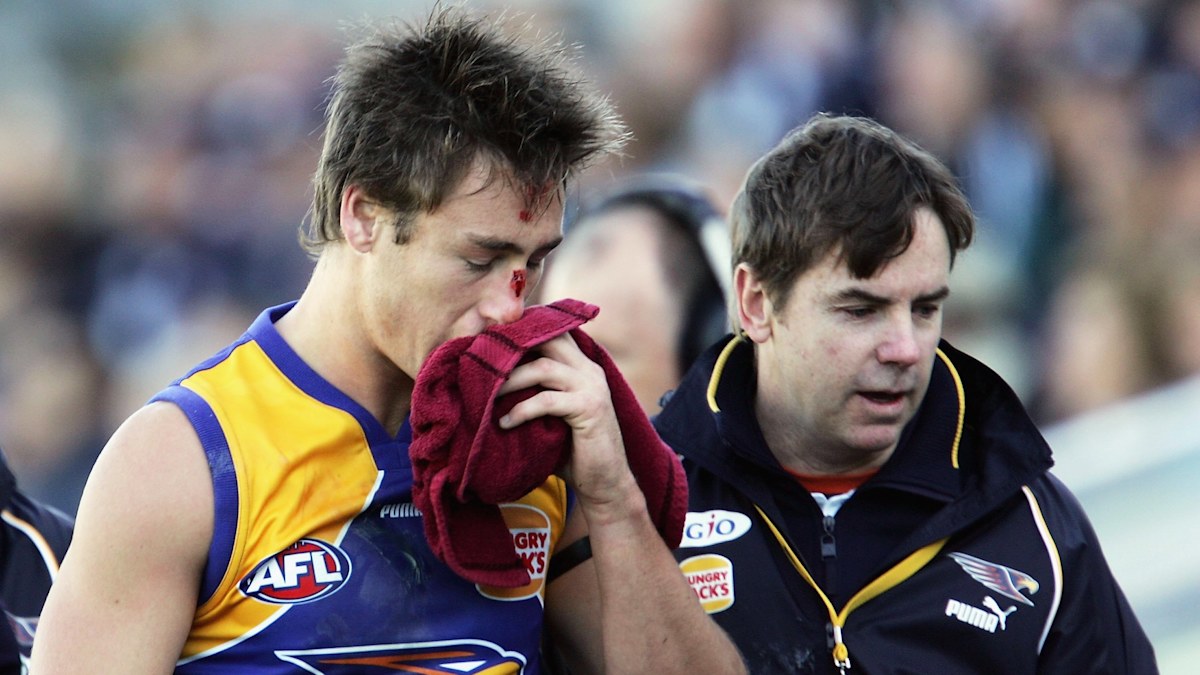
Late West Coast Eagles premiership player Adam Hunter has been posthumously diagnosed with chronic traumatic encephalopathy (CTE), his family has confirmed.
CTE is a progressive brain disease linked to a history of repetitive concussions, particularly from contact sports.
The condition can currently only be diagnosed after death. Many former athletes have committed to donating their brains for posthumous research.
READ MORE: ‘Dark time’: Smith reveals he spent time in psych ward
READ MORE: Top contender ‘primed’ for Knights job after key endorsement
READ MORE: JT, Smith urge ‘one-dimensional’ Dogs to ditch line-up experiment
Adam Hunter of the Eagles leaves the field under the blood rule in 2006. Ryan Pierse via Getty Images
Hunter died suddenly in February at the age of 43.
He played 151 AFL games for the Eagles between 2000 and 2009, winning the 2006 premiership with the famous team.
Hunter suffered serious knee and shoulder injuries throughout his career and was forced to medically retire in 2009. He continued playing local football up until his death.
In the wake of his death, Hunter’s parents decided to donate his brain to the Australian Sports Brain Bank (ASBB) for research.
The ASBB’s examination of Hunter’s brain found several lesions consistent with stage two CTE.
Hunter’s mum, Joanne Brown, told the ABC that her son had suffered countless sub-concussive blows (also referred to as head knocks) and concussions over his life.
Joanne and Hunter’s step-dad, Rod Brown, said Hunter had mentioned on several occasions that he believed he had CTE.
According to Joanne, Hunter thought it was too late for him, so he might as well keep playing.
“We just hope that something can come out of the [brain] donations … [and] it can help young players in the future to find a cure before it kills them,” she said.
Research, including studies from the ASBB, has shown a strong link between the number of years a person plays a contact sport and their risk of developing CTE, as opposed to the number of concussions they have sustained.
The odds of developing the disease and its severity increase the longer an athlete’s career lasts, more so than the number of concussions they have suffered.
Initial coronial findings suggest that Hunter’s death was caused by heart failure related to methylamphetamine use.

Adam Hunter in action for the Eagles during the 2005 AFL season. Getty
The investigation into the circumstances of his death is still ongoing.
His body was discovered at a home located south of Perth.
Hunt’s partner, Latisha Yacoub, previously said his drug addiction had become consuming.
Early-onset CTE symptoms commonly include behavioural and mood-related changes like depression, anxiety, aggression, substance abuse and poor impulse control.
CTE has been posthumously diagnosed in several other former professional players in recent years, including Graham ‘Polly’ Farmer, Danny Frawley, Shane Tuck, and Heather Anderson.
If you or anyone you know needs immediate support, contact Lifeline on 13 11 14 or via lifeline.org.au. In an emergency, call 000.