
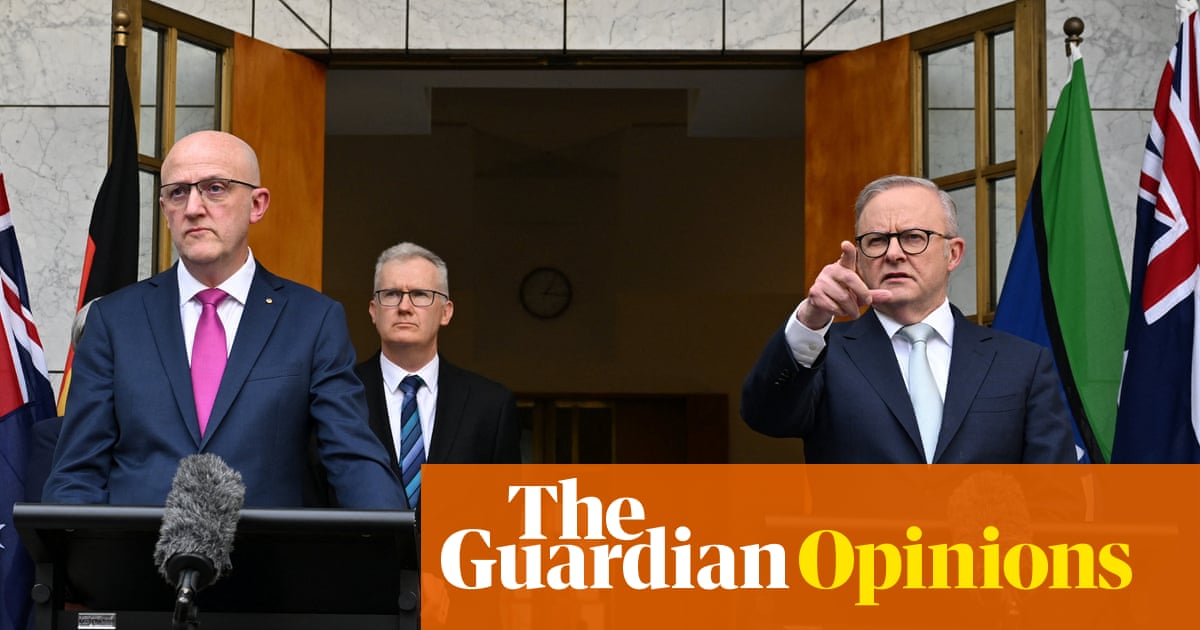
Anthony Albanese was cryptic in a meeting of the Labor caucus on Tuesday morning, telling government MPs he was preparing to make a big announcement in Canberra later that day.
Without any detail, the unusual statement quickly started a guessing game throughout Parliament House – especially in the press gallery.
Reporters soon learned that anyone who knew what was going on wasn’t talking. Those who didn’t know speculated anyway, suggesting more sanctions could be on the way for Israel’s government over its brutal war in Gaza and the killing of yet more journalists covering the starvation and suffering this week.
But when he fronted the media around lunchtime, Albanese announced one of the most decisive foreign policy moves of his three-and-a-half years in power.
Sign up: AU Breaking News email
Standing alongside the Asio director-general, Mike Burgess, and the foreign affairs minister, Penny Wong, Albanese announced the government was expelling Iran’s ambassador to Canberra, Ahmad Sadeghi, over intelligence showing the regime had paid criminals to whip up antisemitic sentiment in Australia. Tehran’s thugs had attacked Melbourne’s Adass Israel Synagogue and Lewis’ Continental Kitchen in Sydney.
It was the first time since the second world war a foreign ambassador had been declared “persona non grata” in Australia. The government has already taken steps towards listing Iran’s Islamic Revolutionary Guard Corps (IRGC) as a prescribed terror group.
The night before, Burgess had told the cabinet’s national security committee that the evidence linking the crimes to Tehran was overwhelming, and the regime’s proxies were suspected of involvement in more attacks still under investigation.
IRGC operatives had used encrypted messages, cryptocurrency and a stolen Volkswagen Golf to terrorise Jews; an unacceptable situation Albanese described as a state-directed attack on Australia. A handful of Australian diplomats were quickly extracted from Iran, with the decision made public only once their safety was secured.
Albanese and Wong have resisted calls for other foreign envoys to be kicked out of Canberra, and weathered significant political and media criticism over the government’s response to antisemitic violence and vandalism in the two years since the 7 October 2023 terrorist attacks by Hamas. The decision to draw a line in the sand on Iran and formally call out the IRGC as terrorists follows a Coalition-led Senate committee recommending such a move two years ago, forcing Labor to explain why it had not acted sooner.
Israel’s prime minister, Benjamin Netanyahu, tried to claim credit for the ambassador’s expulsion, suggesting Australia had been shamed into action. Soon after, Israeli media asked whether Israel’s spy agency, Mossad, had contributed intelligence to uncover the plot.
Netanyahu’s fury, including lashing out at Albanese directly, follows Australia’s decision to recognise Palestinian statehood and its criticism Israel is prolonging the war and blocking desperately needed aid deliveries. Netanyahu has adopted a similar playbook following moves on recognition by countries including France, Britain and Canada, even as he looks increasingly isolated ahead of next month’s UN general assembly in New York.
Albanese’s increased confidence in foreign affairs is evident. The prime minister has stuck closely to like-minded world leaders, notably Keir Starmer and Mark Carney, and sounds serious about committing Australian troops to a coalition of the willing in Ukraine, if and when a peace agreement can be secured with Russia’s Vladimir Putin. He relies on Wong and other senior ministers, including Don Farrell and Richard Marles, to lead on spot fires in their portfolios.
Wong and the Pacific Island affairs minister, Pat Conroy, established Labor’s foreign policy footing in the government’s first term through dogged engagement with the region, most importantly on the issue of climate change, reestablishing relationships that had been downgraded during the final years of the former Coalition government.
But Albanese’s most pressing foreign policy challenges are considerable. They include stewardship of the US-alliance under Donald Trump and Australia’s unresolved bid to host the COP31 climate talks in association with Pacific nations.
skip past newsletter promotion
Sign up to Breaking News Australia
Get the most important news as it breaks
Privacy Notice: Newsletters may contain info about charities, online ads, and content funded by outside parties. For more information see our Privacy Policy. We use Google reCaptcha to protect our website and the Google Privacy Policy and Terms of Service apply.
after newsletter promotion
Trump has so far not agreed to hold a first meeting with the prime minister, a political irritant for the government, and something Albanese is frequently asked about. Albanese said on Friday that he hoped the Quad leaders’ summit, planned for India later in the year, would go ahead, but wouldn’t be drawn on the possibility of a visit to the White House being added to his travel to the US in late September.
The prime minister gave a strong signal the government would meet Trump’s demands to spend more on defence. After a scramble to bring forward some planned spending, Albanese said on Friday Labor would spend what was required to keep the country safe, hinting that political considerations would be front of mind. “We’ll continue to provide whatever investment is required to make sure that we lift our capability and we lift our relationships as well,” he told Nine.
Another pressing concern is resolving the standoff with Turkey over hosting rights for COP31, due to take place in late 2026 in Adelaide. Labor sees climate advocacy as a serious extension of foreign policy and wants to deliver for vulnerable partners in the region.
The decision on the host country is made through consensus among member states, and so far, at least, the government of Recep Tayyip Erdoğan has refused to drop out despite Australia having overwhelming support. There is speculation first lady Emine Erdoğan, a climate activist, wants Turkey to stay in the race, and even that China is involved in the negotiations to frustrate Australia’s ambitions. Albanese and Wong have assisted the climate and energy minister, Chris Bowen, but so far have not found the right price to persuade Turkey to withdraw.
Labor doesn’t need the extra complication, as it has more than enough to worry about ahead of announcing Australia’s 2035 emissions reduction target.
Labor’s decisive election result suggests Albanese will represent the country on the world stage for some time beyond the next election, and his outlook on the world will increasingly help determine Australia’s place in it.