
Negotiations between Alberta teachers and the provincial government have broken down days before most kindergarten-to-Grade 12 students return to the classroom.
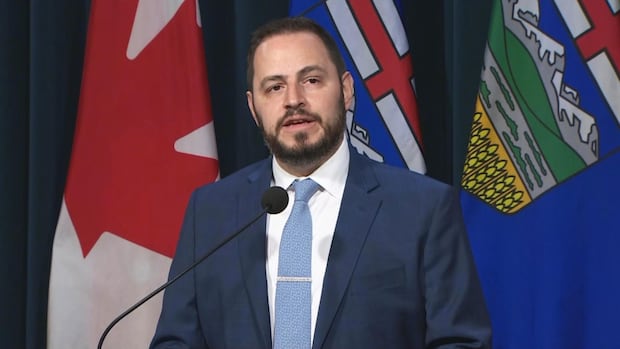
In a joint news conference Friday, Education Minister Demetrios Nicolaides and Minister of Finance Nate Horner said mediated contract negotiations with the Alberta Teachers’ Association have reached an impasse.
The province has pinned the failed talks on the association, characterizing the union’s negotiation tactics as manipulative.
Nicolaides said it has become increasingly clear the union is only interested in “playing politics” with Alberta students by threatening to strike.
“Parents should be furious that union leaders are gambling with their kids’ future and their learning,” he said.
The ATA, meanwhile, blamed the provincial government for failing to make the changes needed to fairly compensate and support teachers in increasingly overburdened classrooms.
In a news conference Friday, association president Jason Schilling said the government needs to focus on fixing an education system in crisis, not attacking its educators.
“The workload has increased, the expectations have grown, class sizes continue to soar, and the pay has barely moved,” he said.
“[That] is not politicizing. It’s telling the truth about what we see in our schools.”
Teachers and administrators at public, Catholic and francophone schools are in a legal strike position, with 51,000 teachers prepared to walk off the job if the union and school board representatives are unable to reach a deal.
During Friday morning’s news conference, Horner said the province is facing a ballooning deficit of $6.5 billion, $1.3 billion more than initially projected.
He said hiring the additional teachers would have $750 million over the life of the contract and he is disappointed that the union walked away from talks.
He said public sector agreements must be financially sustainable and strike a balance between fair wages and easing the current pressures on taxpayers but Alberta has been committed to striking a fair deal. The cost of the deal, over the full term, is over $2.3 billion, the province said.
“The bargaining team walked away from this offer,” he said.
“That’s why I’m disappointed to be here today.”
Horner said the deal is in line with wages seen in other regions and reflects market demands.
“Depending on where this goes, I don’t see that offer changing,” he said.
A 12-per-cent salary increase for teachers was offered along with a pledge to hire 3,000 more teachers across the province, he said.
Teachers had already voted down the 12 per cent figure earlier this summer.
Nicolaides said the promise to hire new teachers was the primary change from Alberta’s original offer, but the deal should still have been acceptable.
He said the union has altered its position during the course of negotiations and is asking for “higher wages and fewer teachers,” a statement the union said was inaccurate.
“There seem to be some changing requests here,” Nicolaides said.
He said he can’t understand why Alberta’s “generous and competitive” proposal was declined. He said no counter offer was made by the union before talks broke down.
When asked about a lockout after school resumes Tuesday, Nicolaides said government officials are hopeful they can avoid labour disruption.
“I think we’re very, very close,” he said. “I would encourage union leadership to come back to the table.”
He said the union is not being transparent about what they want from negotiations.
“I’m quite baffled, to be completely honest,” Nicolaides said. “We are giving union leaders exactly what they asked for and now they have walked away.”
It’s the latest in increasingly tense contract negotiations, which have put parents on edge as students prepare for a return to the classroom next week.
In a June strike vote, almost 95 per cent of teachers who voted said they were in favour of taking strike action. Nearly 39,000 teachers cast ballots online and in person between June 5 and 8.
That followed teachers’ rejection of a mediator’s proposal that would give teachers at least 12 per cent in wage increases over four years.
‘Telling the truth’
During Friday’s news conference, Schilling said new government policies, including a pending ban on books with sensitive content and new policies on the use of students’ preferred pronouns, have added to the anxiety and anger among members as they prepare for a new school year.
Schilling said the bargaining team is acting on the direction of teachers across the province who have been “loud and clear” about what they need to best serve their students.
He said the offer to add 3,000 new teachers to the system over three years would be a “drop in the bucket.”
He said the union had called for student-teacher classroom formulas to be adopted to alleviate overcrowding, but they went unaddressed by government negotiators.
Members can not accept a deal that will undermine staff retention and fails to keep pace with inflation, Schilling said.
“The education system in Alberta is unsustainable,” he said.
Teachers have received a 5.75 per cent increase in the past decade, he said. A fair wage is not just about money, it’s about showing respect for the value teachers bring to the Alberta’s education system, he said.
He said it’s hypocritical for Alberta to claim it values education while vilifying teachers and refusing to address systemic issues within provincial classrooms.
Schilling said no strike notice has been invoked and teachers are eager to return to their students as planned, but that will depend on negotiations.