
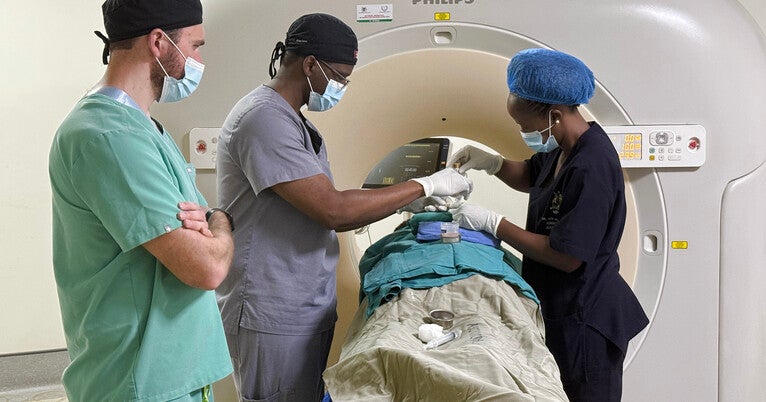
Before the Road2IR program in Uganda, image-guided biopsies were the only IR-related procedures available to patients in public hospitals, and patients would either wait to get surgery, travel abroad for care, or visit private hospitals where treatments are more expensive.
Now, interventional radiologists like Nabawanuka can perform many other procedures, from abscess drain placements, in which a doctor uses imaging guidance like an ultrasound to remove pus and infected fluid using a catheter, to central venous catheter placement, in which a doctor to use imaging guidance to insert a catheter into a large vein for medication administration, fluid delivery, or blood draws. Within the first year of the program, 1,890 patients were seen at Mulago Hospital’s IR clinic.
“I work for a public hospital where the average Ugandan seeks care,” Nabawanuka said. “For me to be able to offer services to that person is very, very, very impactful.”
Nabawanuka’s cohort, the first to graduate from the Road2IR program in Uganda, won’t be the last. Next year, three junior fellows — who just wrapped up their first year in the program — will graduate.
The Road2IR program has not only benefited Nabawanuka, her colleagues, and her patients in Uganda, said Laage Gaupp. It’s also had a big impact on the volunteer teams of IR physicians, nurses, and technologists from the U.S., including YSM faculty.
“For many people, this will be their first trip to Africa or even out of the country,” Laage Gaupp said. “They go to Tanzania or Uganda and see a completely different part of the world. So many people after that [trip] reach out to me and say this was really one of the best things they’ve ever done. For many people, it’s a life-changing experience, and they want to go back every year.”