
STEVE INSKEEP, HOST:
Today, nearly 200 news outlets are calling for the protection of journalists covering the war in Gaza. NPR joined that call by Reporters Without Borders.
LEILA FADEL, HOST:
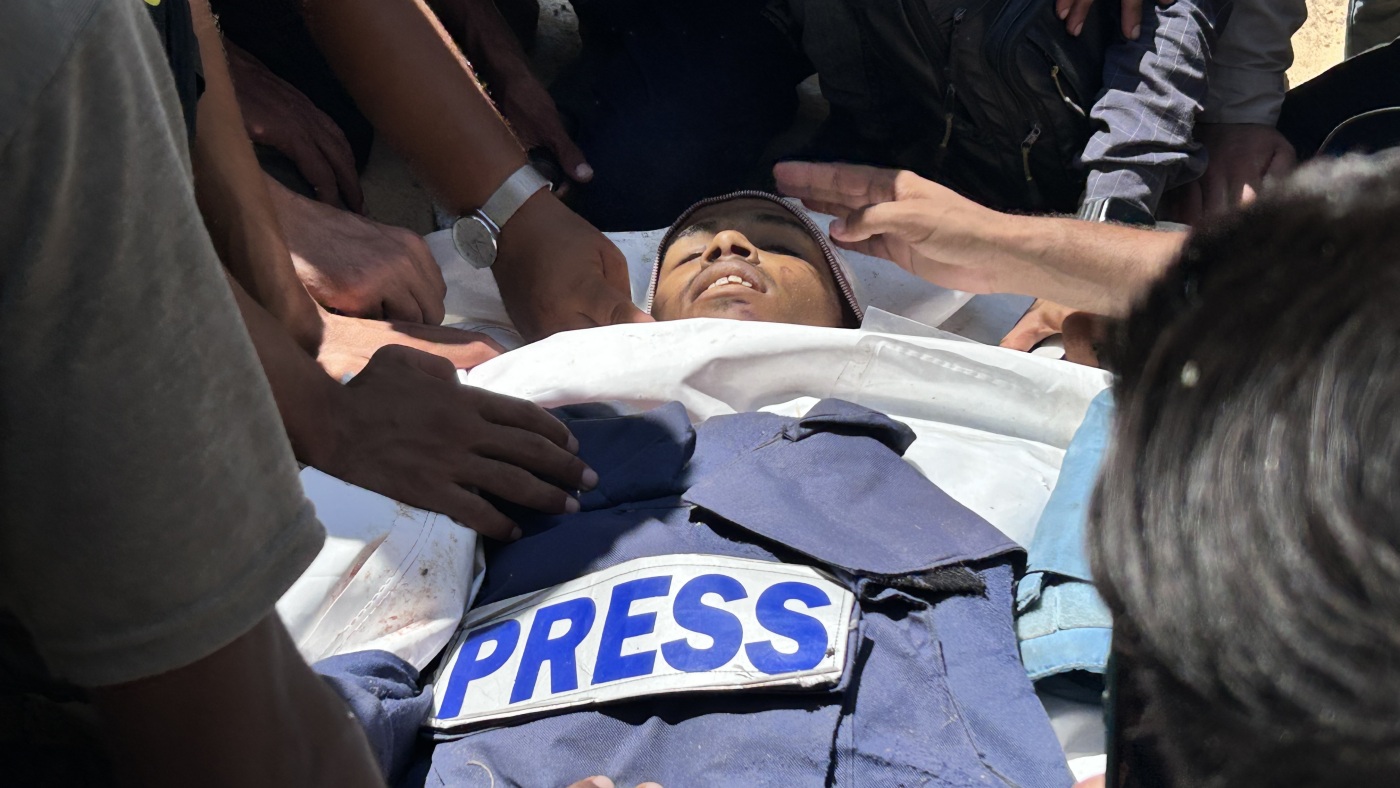
Israel has barred international journalists from independently entering Gaza for the entirety of this war and has killed Palestinian journalists reporting there.
INSKEEP: Israel confirmed killing journalists from Reuters, The Associated Press and Al Jazeera in strikes on a Gaza hospital last week. Israel’s military said soldiers believed they were targeting a Hamas surveillance camera, but gave no evidence, and the prime minister has since called it a tragic mishap. Jonathan Dagher from Reporters Without Borders says Israeli forces have killed 220 journalists since the October 7 attacks.
Is there a way that you define who is a journalist and who is not?
JONATHAN DAGHER: Anyone who does a journalistic activity following the ethics and the values of this job, anyone who does a job of transmitting information. But we’re very clear on that they should be doing a job that is considered journalistic. For example, excluded from this list are people who would fall under freedom of expression, for example, poets or comedians or artists.
INSKEEP: As you very well know, Israel will insist they’re not deliberately targeting legitimate journalists that people are in the way. In some cases, they’ve explicitly said, we targeted this person because we believe they are Hamas. What do you think Israel’s doing here?
DAGHER: Well, you know, for at least 56 of these cases, we were able to collect testimonies, elements, images, evidence in some cases that show that there was actually targeting of journalists who were clearly identified as journalists. In some specific cases, the Israeli army has itself admitted to targeting them, giving the justification that, well, they were not really journalists, that they were also members of Hamas, that they were terrorists. We’ve also investigated these claims and the very meager evidence that was provided by the Israeli army. These documents are often riddled by contradictions. Their media outlets confirm that they work with them. Anyone can go on their social media, on their pages and see the work that they do. So the evidence and the justification given by the Israeli forces, we consider it defamatory, and it is certainly not a license to kill.
INSKEEP: Does it appear to you that Hamas also pressures, threatens or kills journalists?
DAGHER: We’ve received reports of threats and pressures by Hamas on journalists. Hamas never respected press freedoms. It was never democratic in that sense, obviously. And we denounced that. We have, according to our information, all of the journalists were killed by Israeli strikes. The journalists on the ground, they tell us that is the primary danger.
INSKEEP: What does it matter to the rest of the world if journalists are being killed at such a rate?
DAGHER: It’s very dangerous. Every time a journalist is killed, it’s an attack against our right to be informed everywhere in the world. Democracies are founded on public opinion and what it chooses, and public opinion is largely formed by information. And therefore, a media blackout such as the one that Israel is imposing on Gaza is very dangerous for democracies everywhere in the world, not just for Gaza’s journalists and for Gaza’s population.
INSKEEP: Jonathan Dagher of Reporters Without Borders, thanks so much.
DAGHER: Thank you very much.
LADEL: We’re joined now by NPR’s Daniel Estrin for more. He’s in Tel Aviv. Good morning, Daniel.
DANIEL ESTRIN, BYLINE: Good morning, Leila.
LADEL: With all the dangers journalists in Gaza face today, what does it take for them to do their jobs?
ESTRIN: You know, a typical day for a journalist in Gaza might be they’ll go to the hospital Morgue to count bodies and report how many people were killed in an Israeli strike, and then they’ll go collect food and drinking water for their families. And then they’ll rush to the scene of another Israeli airstrike, fearing that there might be an additional strike on that same spot that could injure or kill them. My NPR colleague, Ahmed Abuhamda, spoke with a journalist in Gaza, Salem al-Rayes. He reports for Arabic language news sites, and he said he spends his days covering his neighbors’ daily struggles under war. And then those same people will turn around and tell him and his colleagues, don’t get in my car. Don’t get in my cab, wearing your press vest. Don’t park your car marked TV near me. Because people in Gaza today are afraid journalists are a target and will endanger them.
LADEL: Wow. I mean, we heard there from Reporters Without Borders the dangers of having an information blackout. A war of weapons is also an information war, and we heard there also that both sides are playing. But Israel’s actually killing Palestinian journalists. How does the Israeli government defend that?
ESTRIN: Israeli government spokesman David Mencer last week summed up how Israel perceives Palestinian journalists in Gaza.
(SOUNDBITE OF ARCHIVED RECORDING)
DAVID MERCER: Many journalists who have reported from Gaza, so-called journalists, are simply terrorists with a press vest on.
ESTRIN: When Israel admits to targeting journalists, it says it’s doing so because they are alleged Hamas terrorists. Even when the evidence Israel presents is thin, most Israeli media report that as a fact. And so therefore, many Israelis view Palestinian journalists’ deaths with indifference. When Prime Minister Benjamin Netanyahu expressed regret for the killing of AP and Reuters journalists last week, he only expressed it in English for an international audience. That regret was not issued in Hebrew to Israelis. I’ve spoken to independent Israeli analysts who believe Israel does not have a policy of deliberately targeting journalists in Gaza, but they also argue the military has repeatedly shown a disregard for the lives of journalists there.
When the army identifies what they believe is yet another Hamas terrorist, they do not consider the bigger picture of, well, wait, there are journalists nearby who will be killed. This is, according to the Israeli analysts I’ve spoken to, that the military does not consider the bigger picture of the global outrage that would come because of that.
LADEL: NPR’s Daniel Estrin, talking to us from Tel Aviv. Thank you for your time, Daniel.
ESTRIN: You’re welcome, Leila.
Copyright © 2025 NPR. All rights reserved. Visit our website terms of use and permissions pages at www.npr.org for further information.
Accuracy and availability of NPR transcripts may vary. Transcript text may be revised to correct errors or match updates to audio. Audio on npr.org may be edited after its original broadcast or publication. The authoritative record of NPR’s programming is the audio record.