
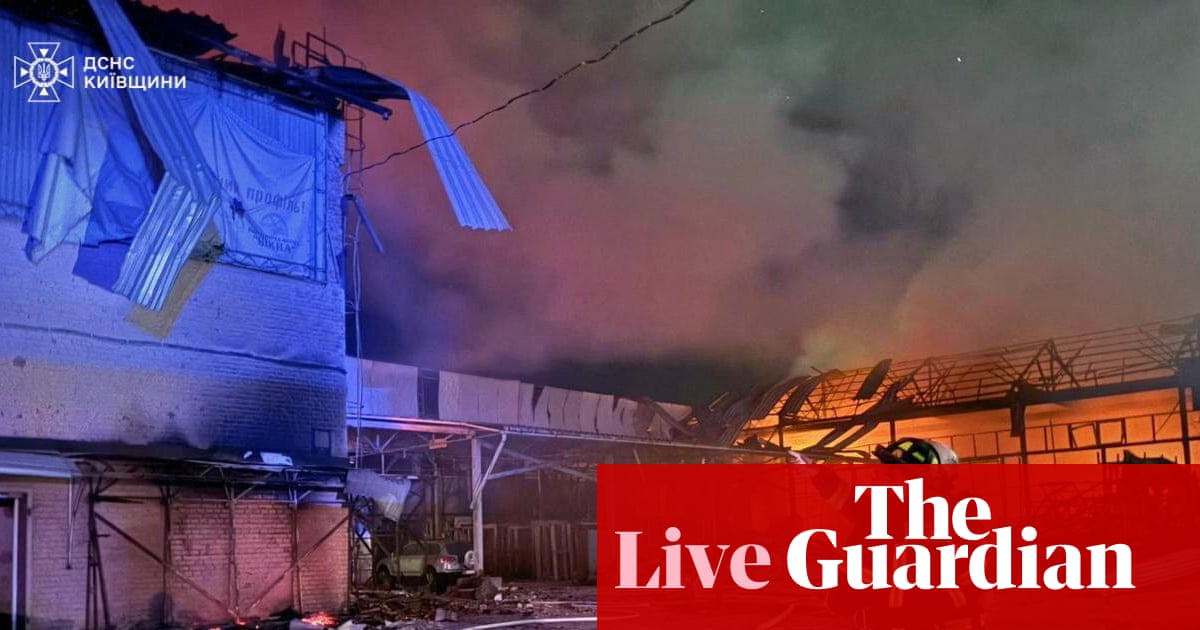
Morning opening: Growing frustration over Putin’s refusal to move on Ukraine Jakub Krupa
Europe looks on with growing frustration as the US-led peace efforts in Ukraine show little tangible progress amid continuing attacks, even as Russia – the aggressor – receives a warm and increasingly public embrace from China.
Europe ministers of EU countries are meeting in Copenhagen this morning, so we should get the latest EU line on this.
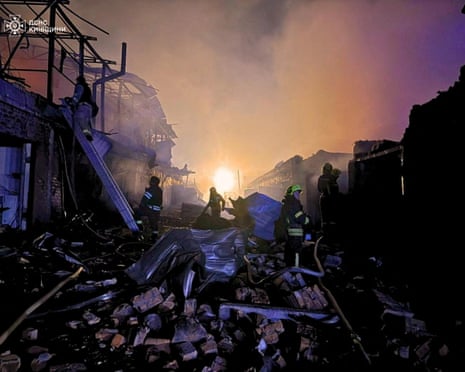 Firefighters work at the site of car garages hit by a Russian drone strike, amid Russia’s attack on Ukraine, in the city of Bila Tserkva, Kyiv region, Ukraine. Photograph: State Emergency Service Of Ukraine/Reuters
The US treasury secretary, Scott Bessent, said last night that “all options are on the table” as Russia’s Vladimir Putin “has done the opposite of following through on what he indicated he wanted to do” in the weeks since his summit with the US president, Donald Trump.
“As a matter of fact, he has in a despicable, despicable manner increased the bombing campaign,” he told Fox News.
His comments indicate growing frustration within the US administration with the lack of progress on Ukraine. But we are yet to hear from Trump himself.
Meanwhile, Russia’s Putin is diplomatically active in China, meeting Xi and India’s Modi for closed talks.
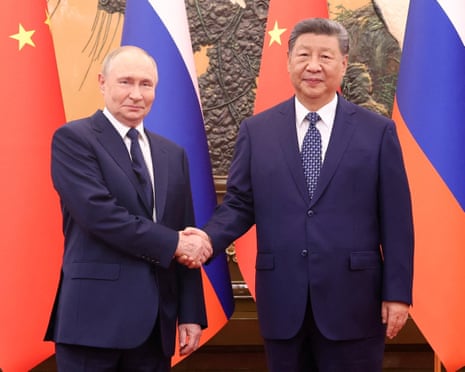 The Chinese president, Xi Jinping, shakes hands with the Russian president, Vladimir Putin, at the Great Hall of the People in Beijing, China. Photograph: China Daily/Reuters
On Tuesday, Putin hailed the “unprecedented level” of Russian-Chinese friendship to Xi, and socialised with Modi, who went above and beyond by posting on his social media a picture of the pair sitting in a limousine together and praising the Russian leader for “always insightful” conversation.
They discussed “the peaceful resolution of the conflict in Ukraine,” Modi said, but it remains unlikely, if unclear, whether their way of getting to the outcome is anywhere near Europe’s preferred scenario.
Let’s see what the day brings us. I will bring you all the key updates here.
It’s Tuesday, 2 September 2025, it’s Jakub Krupa here, and this is Europe Live.
Good morning.
Updated at 04.03 EDT
Key events
Show key events only
Please turn on JavaScript to use this feature
EU’s Europe ministers to discuss Ukraine, Moldova’s accession plans amid Hungarian block
One of the topics of today’s informal meeting of Europe ministers in Copenhagen is the EU’s enlargement process, including a discussion on Ukraine and Moldova.
French minister Benjamin Haddad nailed the issue in his doorstep comments, saying:
“We’ll have to talk very frankly, very openly about the fact that … when it comes to Ukraine 26 countries around the table that are ready to move forward with the opening of the cluster for Ukraine, but you have one country, Hungary, that is still holding up, for domestic reasons [or] for bilateral reasons, this process, and this is something that we’ll have to address here today.”
Poland’s Ignacy Niemczycki said “the time is absolutely right” to open the first cluster of negotiations with Ukraine and Moldova.
“We really feel that we want to send positive signals to the Ukrainian people, not negative. So it’s obviously a difficult situation, but the easiest way forward would be for Hungary not to block Ukraine any more,” he said.
But Hungary’s János Bóka insisted the EU should be focused on the western Balkans instead.
He said:
“When it comes to enlargement, I will make the case of maintaining our focus on the western Balkans. We have promised membership to countries in the region more than 20 years ago. It is time to deliver on our promise. Otherwise, we will lose our credibility there.”
On Ukraine specifically, he added:
“I think this is a very political issue where governments need to be aware of what the electorate in the member states actually wants.”
ShareBelgium to recognise Palestinian state at UN general assembly Jennifer Rankin
in Brussels
Belgium will recognise a Palestinian state at the UN general assembly, adding to the growing number of countries seeking to put pressure on Israel and keep alive a two-state solution to end the conflict.
The Belgian deputy prime minister and foreign minister Maxime Prévot talks to the press as he arrives for a meeting last month. Photograph: Shutterstock
Belgium’s deputy prime minister, Maxime Prévot, announced the move during the night after complex negotiations within the governing five-party coalition.
He also announced 12 sanctions measures against Israel, including a ban on the import of products from occupied territories and restrictions on consular aid to Belgians living in those areas.
The Belgian government will also declare persona non grata (not welcome on Belgian soil) two far-right Israeli ministers, Itamar Ben Gvir and Bezalel Smotrich, as well as several violent Israeli settlers and Hamas leaders.
In a statement on X, Prévot wrote:
“In view of the humanitarian tragedy playing out in Palestine and particularly in Gaza, and in the face of the violence perpetrated by Israel in violation of international law, given its international obligations, including the duty to prevent any risk of genocide, Belgium had to take strong decisions to increase pressure on the Israeli government and the Hamas terrorists.”
He indicated that Belgium would recognise Palestine at this month’s UN general assembly, after France announced such an intention in July in the hope of creating momentum for peace.
But the Belgian royal decree on recognition would not be issued until the last hostage is released.
The compromise averts a political crisis within the relatively new Belgian government. Prévot, a centrist who is also foreign minister, had threatened to block government business if there was no agreement on recognition, or taking a stricter tone towards Israel.
Only last week the prime minister, Bart de Wever, a Flemish nationalist, described recognition as “counterproductive” and “pointless” without the full disarmament of Hamas.
More updates on our Middle East crisis liveblog:
Updated at 04.29 EDT
Morning opening: Growing frustration over Putin’s refusal to move on UkraineJakub Krupa
Europe looks on with growing frustration as the US-led peace efforts in Ukraine show little tangible progress amid continuing attacks, even as Russia – the aggressor – receives a warm and increasingly public embrace from China.
Europe ministers of EU countries are meeting in Copenhagen this morning, so we should get the latest EU line on this.
Firefighters work at the site of car garages hit by a Russian drone strike, amid Russia’s attack on Ukraine, in the city of Bila Tserkva, Kyiv region, Ukraine. Photograph: State Emergency Service Of Ukraine/Reuters
The US treasury secretary, Scott Bessent, said last night that “all options are on the table” as Russia’s Vladimir Putin “has done the opposite of following through on what he indicated he wanted to do” in the weeks since his summit with the US president, Donald Trump.
“As a matter of fact, he has in a despicable, despicable manner increased the bombing campaign,” he told Fox News.
His comments indicate growing frustration within the US administration with the lack of progress on Ukraine. But we are yet to hear from Trump himself.
Meanwhile, Russia’s Putin is diplomatically active in China, meeting Xi and India’s Modi for closed talks.
The Chinese president, Xi Jinping, shakes hands with the Russian president, Vladimir Putin, at the Great Hall of the People in Beijing, China. Photograph: China Daily/Reuters
On Tuesday, Putin hailed the “unprecedented level” of Russian-Chinese friendship to Xi, and socialised with Modi, who went above and beyond by posting on his social media a picture of the pair sitting in a limousine together and praising the Russian leader for “always insightful” conversation.
They discussed “the peaceful resolution of the conflict in Ukraine,” Modi said, but it remains unlikely, if unclear, whether their way of getting to the outcome is anywhere near Europe’s preferred scenario.
Let’s see what the day brings us. I will bring you all the key updates here.
It’s Tuesday, 2 September 2025, it’s Jakub Krupa here, and this is Europe Live.
Good morning.
Updated at 04.03 EDT