
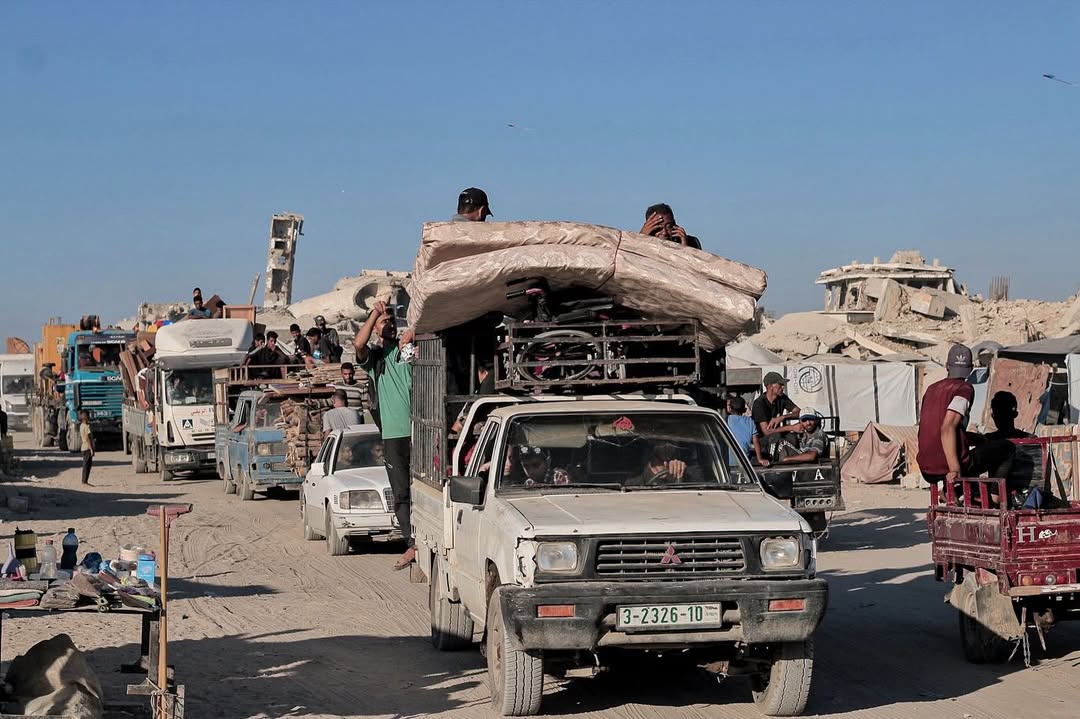
Displaced families moving south from northern Gaza via Rashid Street. Courtesy of Ibrahim Abu Gazaleh.
Israeli missiles are striking crowded areas in west and central Gaza City while its ground forces are grinding forward on three fronts, forcing people living in frontier neighborhoods to flee the advance.
Even so, taking the road southward to areas of the strip is a challenging decision for most households.
Mada Masr spoke to ten families who managed to make the journey south. All described paying extreme prices for transport, rental accommodation, or a tent and land to pitch it on, while some also noted weak or absent infrastructural support for their new shelters.
The obstacles have pushed the thousands facing displacement in Gaza City to crowd instead into packed camps along the city’s western coastline, where many feel they are awaiting death at the hands of advancing Israeli forces.
Abu Mohamed Qassem and his family were among those who decided to flee to the south, heading to Mawasi, Khan Younis, a coastal area designated as a “humanitarian zone” by the Israeli military but nevertheless subjected to regular shelling.
“Displacement was exhausting and difficult,” Qassem said. “We barely managed to find a place to set up our tent in Mawasi.”
Qassem also had to bid farewell to many of his extended family. “Many of our relatives stayed in Gaza City and refused to move with us to the south,” he told Mada Masr.
Many of those who managed to relocate their families and most of their belongings had access to areas of south or central Gaza to support their move; either a plot of family land, a second home or relatives willing to host them.
This was the case for Magdy Elian, who left his home in western Gaza City for a small plot of land that belongs to him and his relatives in Deir al-Balah in central Gaza.
Another, Ali al-Shorbajy, was displaced along with his family by Israel’s oncoming advance from the city’s southeast. After artillery fire reached his home in Tal al-Hawa, they all moved instead to a small apartment they own in Nuseirat camp, also in central Gaza. He too described the move as costly and exhausting. “But better safe than sorry,” he told Mada Masr.
People who had moved south or were coordinating moving in the coming days described high costs, sometimes upward of 4,000 shekels for a tent, or over US$1,000, with the cost of land to pitch it on ranging from 500 shekels, or $180, to much higher rates.
Transportation to the south could cost around 2,000 shekels, $600, they said, or more to load belongings onto a larger truck.
Meanwhile, apartment rentals start at around $1,000.
Most of the families who made the move were fleeing the southeastern neighborhoods of Zeitoun, Sabra or Sheikh Radwan, where Israeli vehicles are operating, or the Abu Eskandar and Saftawy neighborhoods in the north.
Those in western areas of Gaza City, however, are not only deterred by the costs, but the dire humanitarian conditions in south Gaza.
Displacement orders issued in recent weeks for the Sheikh Radwan and Daraj neighborhoods are expected to affect around 200,000 people, though non-governmental monitoring has recorded much lower numbers, in the tens of thousands, as displaced from their Gaza City homes so far.
The Israeli military announced on Tuesday that “the Mawasi area will witness the provision of better humanitarian services,” warning people against approaching or returning to dangerous combat zones, which have now expanded to include the entirety of Gaza City.
But after reaching Mawasi, Qassem said a lot is still missing to make the place livable due to the lack of basic infrastructure in the area.
A desalinated water pipeline was recently announced to link the Emirati-built desalination plant in Egypt to displacement areas in Khan Younis. Sherif al-Nayrab, head of the Fares al-Shahm initiative overseeing the project, told Mada Masr that the line reaches western Khan Younis through the coastal Mawasi. It is expected to serve 600,000 people, providing each with an estimated 15 liters of drinking water per day.
In the meantime, many in Khan Younis depend on charitable initiatives to supply them with water.
Tents are also in short supply. Nehad Shehaibar, head of Gaza’s Private Transport Association, said that Israel has not let in tents or temporary shelters for months while it continues to block all other materials and equipment needed to build such shelters.
Operation to ‘capture’ Gaza City continues
Meanwhile, heavy airstrikes have targeted crowded areas increasingly close to the center of Gaza City since Monday night, killing at least 43 people, according to Al Jazeera, which cited hospital sources.
An eyewitness described Israel’s attack on Monday night as one of the most brutal Gaza City has endured, with artillery fire pounding continuously throughout the night.
An airstrike on a residential building in Tal al-Hawa neighborhood killed at least 14 people and injured dozens. Simultaneously, two separate strikes hit a tent sheltering displaced people and a home in Sheikh Radwan in the northwest, killing 12.
A strike on Tuesday hit a three-story building belonging to the Hoor and Aff families in the Daraj neighborhood in central Gaza City. Eleven bodies have been recovered so far. Several more are trapped under the rubble, mostly children, according to Fares Afanah, head of Gaza’s Ambulance and Emergency Services.
Over five remotely detonated explosions took place in central Sheikh Radwan overnight, shaking the entire city. The Israeli military had advanced into the neighborhood on Sunday night, detonating explosives remotely in the northern and eastern reaches of the neighborhood and wiping out entire residential areas, before its ground forces pushed into the detonated areas.
Residents were ordered to evacuate southward, either through leaflets dropped from aircraft or loudspeaker announcements broadcast by quadcopter drones.