
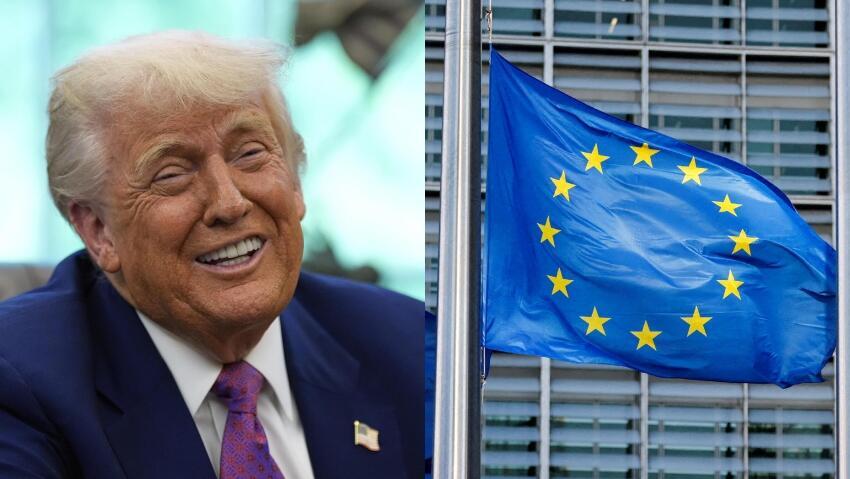
European Union member states, whose foreign ministers met over the weekend in Copenhagen, are furious with the United States. The American administration issued an official statement announcing the cancellation of visas for 80 senior Palestinian Authority officials, including President Mahmoud Abbas.
“You will not be allowed to attend the UN General Assembly,” Secretary of State Marco Rubio declared, “unless you meet a series of preconditions”: consistent condemnation of terrorism; halting incitement in textbooks; ending attempts to bypass negotiations through international campaigns, including appeals to international courts in The Hague; and stopping efforts for unilateral recognition of a Palestinian state.
2 View gallery
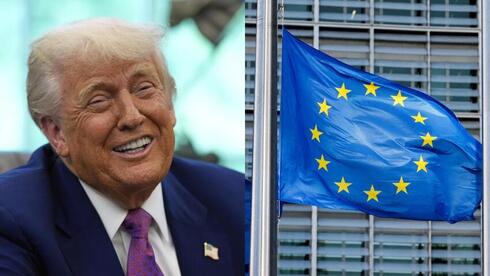
U.S. President Donald Trump
(Photo: Reuters/Johanna Geron ,AP/Alex Brandon)
Each of the American conditions is rooted in agreements the Palestinian Authority has violated. And not only the U.S. The EU itself has repeatedly passed resolutions against incitement in textbooks, only to ignore them. The most recent case was less than three months ago, on May 6, when the European Parliament voted to suspend funding to the PA as long as textbooks encourage terror. Two years earlier, on May 10, 2023, the parliament passed a similar resolution. Within three days, the EU’s then–foreign policy chief, Josep Borrell, decided to disregard the decision and keep the money flowing to prevent the PA’s financial collapse.
Other requirements, such as blocking international campaigns and forbidding appeals to The Hague, are anchored in the Oslo Accords. Europe often criticizes Israel over settlement construction — it’s right, though the Oslo Accords include no prohibition on such building. Yet the same Europe systematically permits the Palestinians to violate binding agreements. What is the point of signing accords when Europe makes clear in advance that violations only benefit the Palestinian Authority? How, exactly, can anyone expect Palestinians to embrace peace when Europe funds incitement and education for terror?
This is not the first time Washington has set preconditions for participation in the UN General Assembly. In the mid-1970s, Henry Kissinger crafted terms for dialogue between the U.S. and the PLO: an explicit denunciation of terrorism, recognition of UN Resolutions 242 and 338, and recognition of Israel. Only toward the late 1980s, after the PLO leadership relocated to Tunisia and the first intifada erupted, did the PLO seek dialogue with Washington.
In November 1988, the Palestinian National Council in Algiers — remembered mainly for its declaration of independence — recognized UN Resolutions 181, 242, and 338 for the first time. The move seemed positive. But it was not enough for the U.S., Sweden’s foreign minister at the time, Sten Andersson, stepped in to mediate and persuaded Yasser Arafat to issue a statement condemning terrorism.
American pressure at the time created an illusion of Palestinian moderation. In every test, however, they reverted to rejectionism. There are many reasons peace initiatives have failed over the decades. Chief among them is the Palestinian refusal to accept a two-state solution, rooted in nurturing the “right of return” fantasy, incitement in textbooks, and insistence on funding terror. Europe has played a negative role by conditioning Palestinians to believe they can break agreements, fund killers, continue incitement, and still receive generous funding and recognition of a Palestinian state.
It is not certain that the current U.S. policy will deliver peace. What is certain is that Europe’s appeasement and weakness are pushing peace even further away.