
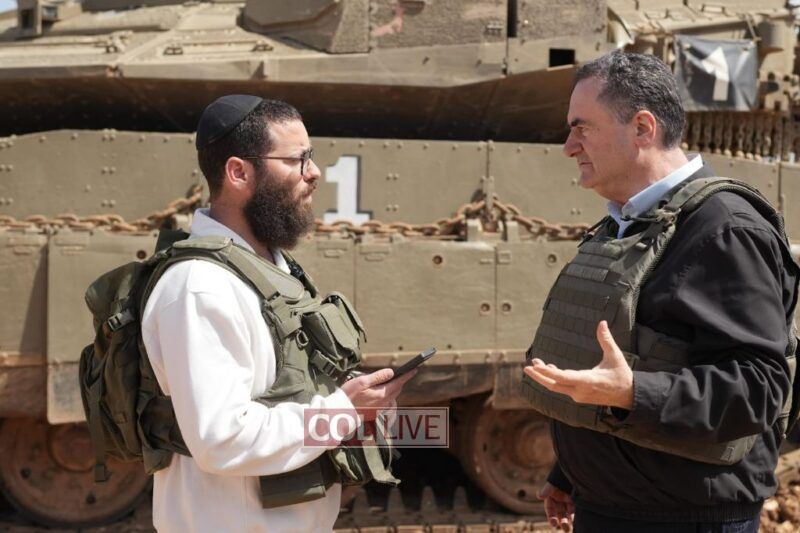
Military commentator Mendy Rizel attended a security briefing with Israel’s Defense Minister Israel Katz, who recalled how Israeli jets were 90 seconds from bombing Tehran before President Donald Trump called off the final wave. Full Story
By Mendy Rizel, military commentator for the Kol Barama radio station and Channel 14
This week, I participated in a briefing at the Kirya in Tel Aviv, the Israel Defense Forces’ main headquarters. It was attended by Israel’s Defense Minister Israel Katz and the outgoing Head of Operations Directorate, Maj. Gen. Oded Basiuk. It was an in-depth conversation with the military correspondents’ pool, focusing primarily on the summary of Operation “Am K’Lavi” (“A Nation Like a Lion”).
The operation included several deceptions, which cannot yet be revealed to the public, and also involved significant concerns.
After Pesach, the IDF realized that the time had come to strike Iran’s nuclear and missile programs. Two key conditions had matured: Iran’s weakening influence through its proxies, as evidenced by the blows dealt to Hezbollah and the deterrence achieved against the Lebanese terror group; the collapse of the Assad regime and the rise of a Sunni figure, Ahmed al-Sharaa, to the presidency; and the blow to Hamas.
The second decisive factor was the presence of President Donald Trump in the White House, who recognized the danger posed by Iran and supplied Israel with massive quantities of weapons. At the same time, intelligence emerged indicating that Iran was secretly accelerating its nuclear program.
On May 15, the first order for an attack on Iran was issued—Operation “P+14,” meaning preparation for action (“P”) within 14 days.
Five days later, a classified document titled “Hila Readiness, P+7” was signed.
On May 27, an in-depth discussion was held between the Defense Minister and representatives of the Air Force and the Intelligence. They delved into the details of various plans and scenarios. “I asked them two questions,” Katz recalled. “Are you confident in our capabilities, and are you willing to act?” The answer to both was yes. “That was significant—it showed me not only that they had confidence, but that the operational echelon understood we had reached the moment of truth and needed to act.”
On June 9—three days before the operation began—the final order was issued: “Activate readiness and define D-Day: Thursday, June 12, 2025.”
Interestingly, Katz revealed that “most of the General Staff was informed only hours before the operation began. In contrast, Home Front Command chief Maj. Gen. Rafi Milo was briefed months earlier to prepare the home front for an unprecedented challenge. ‘The home front has never faced a war like this before.’”
One of the primary concerns in the decision-making process was the potential leak of the planned operation. “There were no leaks from the Cabinet meetings because all ministers agreed the move was correct. Cabinet leaks usually happen when there are disputes, and some ministers want to air disagreements in the media to derail plans or elevate their importance in the public discourse.”
As the operation progressed, more individuals were brought into the loop. “When an aircraft technician is asked to load a specific number and type of bombs, he realizes this isn’t routine. When an intelligence officer is called up from reserve duty and asked to handle something regarding Iran, he knows something’s brewing. The concern over information leaks was very real.”
In the end, there were no leaks from Israel, but a senior, highly suspicious Iranian (later killed in the opening strike) grew wary and nearly thwarted the entire plan at the last moment. “To his credit,” said a senior military official this week, “he was a true professional in that sense.”
Eventually, Israel employed a clever deception that lured him into a trap, leading to his elimination and the success of the entire operation, without him realizing the Israeli strike was imminent.
Meanwhile, Iranian intelligence had picked up on signs that Israel was preparing to strike—but by then, it was too late.
Defense Minister Katz revealed: “There was never any intention to act against the wishes of the U.S., but they did provide support, including air defense. President Trump pulled the ‘handbrake’ on a joint battle protocol,” meaning a coordinated U.S.-Israel attack.
It wasn’t easy for Israel to convince Trump to let them proceed with what Katz called a “blue-and-white operation.” In the end, Trump agreed—though not before warning Prime Minister Benjamin Netanyahu of the consequences if the operation were to fail. “What ultimately convinced Trump to give the green light,” Katz explained, “was Israel’s declaration that we were ready to act alone. He saw that we had the determination—and the capability.”
In fact, Trump carried out two diversionary moves that “lulled” the Iranians.
The main problem in terms of timing was the U.S. readiness to protect its forces. “For years, there had been claims that Iran would kill thousands of Americans if its nuclear sites were attacked. It took time to evacuate their personnel. In the end, we—a small country—helped the U.S. defend its bases in the region.”
Israel defined the operation’s objectives based on the nuclear sites. “From the outset,” Katz said, “we aimed to inflict heavy damage on the uranium enrichment facility at Natanz,” the most central of Iran’s nuclear sites. “Destroying the conversion facility there was critical to the success of the operation.”
Regarding the fortified facility in Fordow, “the goal was, at the very least, to delay it. Israel didn’t have the capability to strike Fordow alone.”
I asked: If the Americans hadn’t intervened and struck Fordow, would that have diminished the overall success of the operation?
“The operation would still have been a success if we hit the other targets, even without Fordow,” Katz answered. “We had some capability to partially damage it, but not like the Americans could with their bunker-buster bombs and B-2 bombers.”
Before deploying their stealth bombers to Iran, the Americans asked Israel to help destroy Iran’s air defenses. Israeli Air Force jets did just that in several parts of Iran. But ultimately, the U.S. military chose a flight path already cleared by Israeli jets earlier in the war. “A superpower was afraid to send its most advanced and expensive aircraft without Israel paving the way,” the Defense Minister said proudly.
Few understand the critical role Katz played in this war. He asked tough questions, set targets, and made decisions that even seasoned commanders praised.
Among other things, about a month before the strike, Katz initiated a project codenamed “Tornado.” It aimed to deliver a heavy blow to regime targets—like the Basij HQ, IRGC command centers, a major oil reservoir, and even the regime’s main media outlet—and also provide an endgame scenario. “‘Tornado’ was a major tool we prepared to wrap up the campaign.”
When the Air Force commander briefed the pilots, he said: “Look up the definition of ‘Tornado’—that’s what we’re going to do there.”
The campaign ended once Israel felt it had reached its objectives. Interestingly, the Chief of Staff had initially planned for an even shorter campaign. “After seven days, we had achieved our main goals. We understood continuing would just provoke more missile fire without additional strategic gain.”
After the ceasefire announcement, Iran violated it by launching ballistic missiles that triggered alarms in many northern communities. Dozens of fighter jets were en route to attack targets deep in Iran—but President Trump halted them at the very last second. It can now be revealed that this “last second” was just 90 seconds before Israeli pilots were to unleash dozens of bombs on central Tehran.
Katz shared the dramatic moment: “The Chief of Staff was on the line with me, and I was on another line with the Prime Minister’s Military Secretary, Maj. Gen. Roman Gofman, who was next to the Prime Minister. At that moment, the pilots were already close to the target. The first formation reported: ‘Four minutes to target.’ A minute later: ‘Three minutes.’ Then: ‘Two minutes.’ Ninety seconds before the strike, we ordered them to abort—at Trump’s request—and instructed them to strike only a radar site near Tehran.”
Behind the scenes, Israel had ensured that Trump would wake up early, be briefed on the imminent Israeli strike, and have time to block it.
Today, Israelis are less concerned about their capabilities. “Iran lost its nuclear scientists. They’re still in shock and won’t rush to develop a bomb—but we remain vigilant,” said Katz.
The primary concern now is the production of ballistic missiles.
“Besides their ambition to develop ‘a thousand times stronger’ missiles, they have unused missiles and are retrieving missiles stored in underground facilities. We can’t strike in Iran as we do daily in Gaza and Lebanon—but we will maintain our capabilities and achievements. We have red lines—we will not allow them to pose another existential threat through ballistic missiles. The IDF is aligned with that. Bottom line: Israeli citizens can breathe easier—the existential threat has been lifted.”
And what about Iran’s Supreme Leader Ali Khamenei?
It turns out that during the operation, Israel failed to “put him in its crosshairs. Had we succeeded, we would have taken him out—not to destabilize the regime, but because he is marked for death.”
Kul kalb biji yomo – Every dog has its day.
