
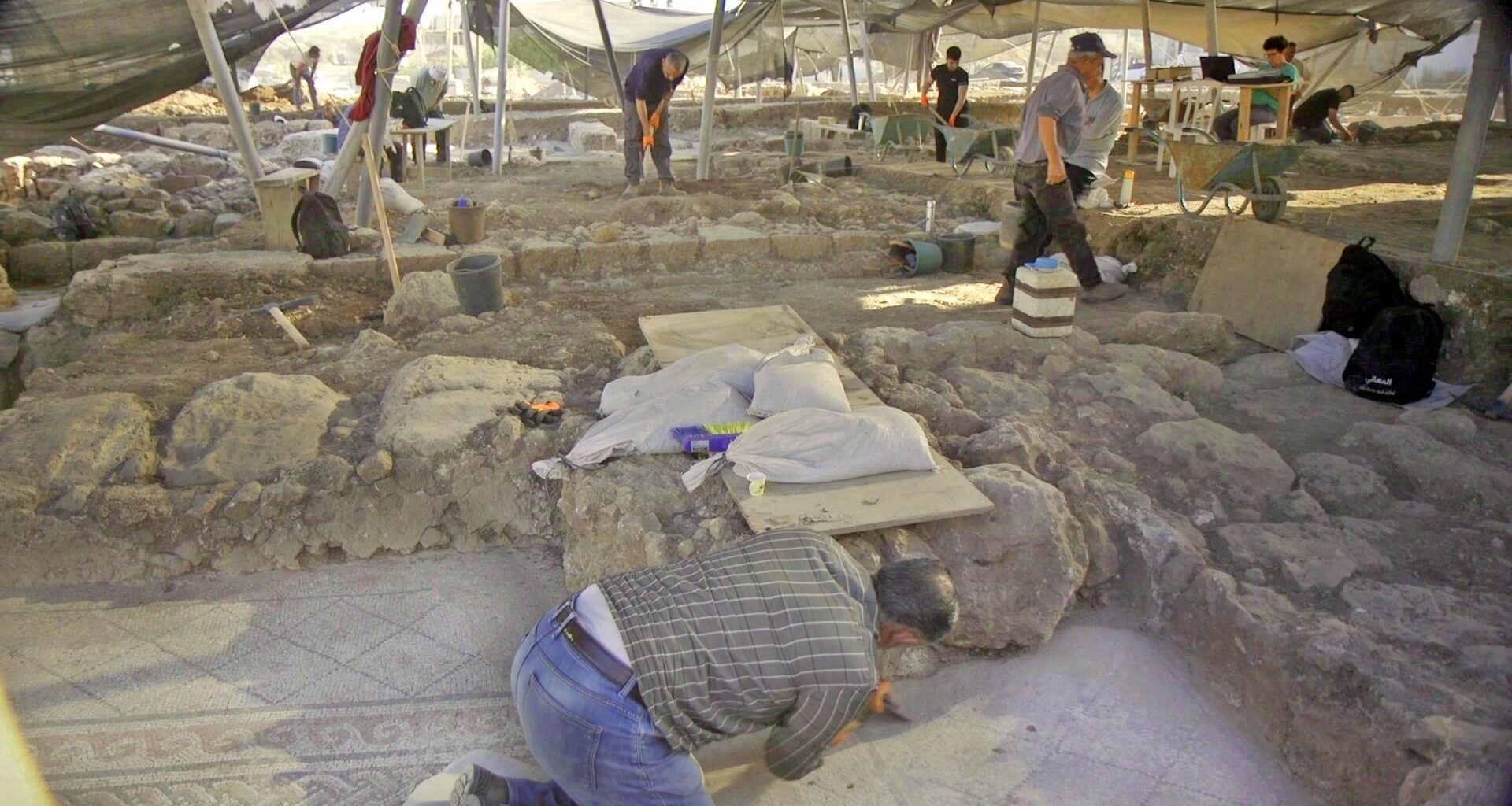
A magnificent agricultural estate, active between the 4th and 7th centuries CE, has recently been uncovered in Kafr Qasim, central Israel, the Israel Antiquities Authority (IAA) announced on Tuesday.
The site offers striking evidence of its ties to the ancient Samaritan community. Yet, many mysteries surrounding its inhabitants and their lives remain, one of the archaeologists excavating the site told The Times of Israel.
The estate was first unearthed during a salvage excavation carried out ahead of the construction of a new neighborhood in Kafr Qasim, an Arab town of 28,000 residents located some 20 kilometers east of Tel Aviv.
Archaeologists uncovered the remains of several buildings, an olive press, two ritual baths and colorful mosaics — including one decorated with a partial Greek inscription reading “Congratulations to.” A large number of coins and pottery, among them several oil lamps characteristic of Samaritan design, helped both date the estate and confirm its identification, explained Dr. Daniel Leahy Griswold, who co-directed the excavation with Alla Nagorsky on behalf of the IAA.
“About three years ago, we carried out a small test excavation in Kafr Qasim and identified the remains of some buildings,” Leahy Griswold told The Times of Israel in a phone interview.
Get The Times of Israel’s Daily Edition
by email and never miss our top stories
By signing up, you agree to the terms
When the team returned in February of this year for a larger dig, he said, they expected to uncover some Roman remains — perhaps a village — but never anticipated a site of such scale and importance.
“As we excavated, we realized we were on the verge of something major,” Leahy Griswold recalled. “At first we thought it might be a monastery, but gradually we noticed distinctive features that pointed us instead to a Samaritan site.”
“We are talking about the largest Samaritan site outside of the Samaritan homeland,” he added.
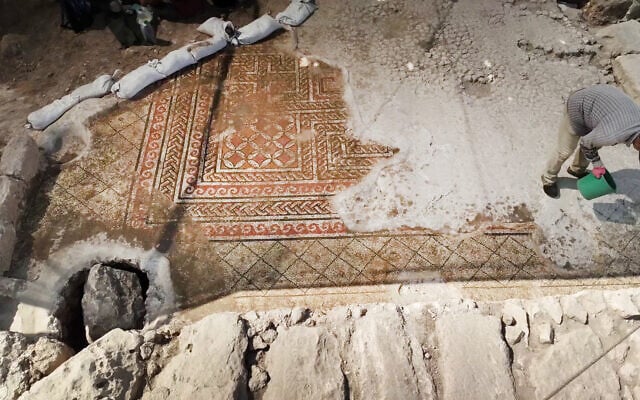
A mosaic in a 4th-century Samaritan estate recently uncovered in Kafr Qasim, central Israel, during an excavation by the Israel Antiquities Authority, in a discovery announced on September 2, 2025. (Emil Aladjem/Israel Antiquities Authority)
Samaritans are a community that considers itself descended from the northern tribes of biblical Israel, specifically Ephraim, Manasseh and Levi, but who split from the rest of the people as early as the time of the biblical kings, approximately 3,000 years ago. They trace their roots back 127 generations in the land and view the Pentateuch as their sole holy text (as opposed to Jews, whose canon includes also the books of Prophets and Writings, as well as the vast corpus of the so-called Oral Torah — that is, Mishna, Talmud and the commentaries that came after).
Today, there are approximately 900 Samaritans in the region, primarily residing in Holon and Nablus in the West Bank, near Mount Gerizim, which they consider a holy site.
“The estate shows several features that point to its Samaritan identity,” Leahy Griswold said.
“All the decorations we uncovered follow the Samaritan rule prohibiting depictions of people, animals or religious symbols, relying instead on geometric and vegetal motifs,” he explained.
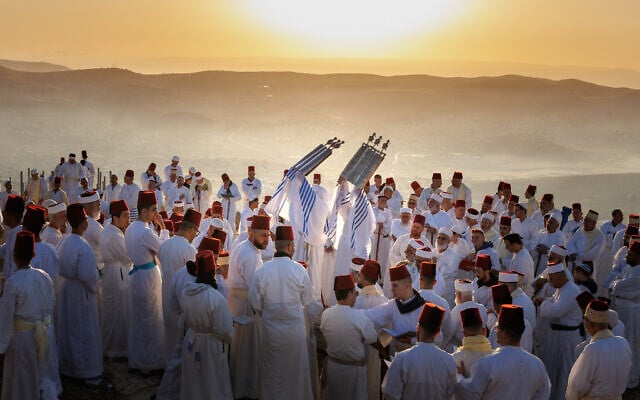
Samaritan worshipers gather in Mount Gerizim, near the West Bank city of Nablus on June 1, 2025, during celebrations of the holiday of Shavuot. (Edi Israel/Flash90)
One mosaic unearthed at the entrance of a building features a central medallion with acanthus leaves surrounded by fruits and vegetables, including grapes, dates, watermelons, artichokes and asparagus, while the rest of the floor is covered with a dense geometric design.
“The most important clue to the site’s identity is the discovery of dozens of Samaritan oil lamps,” Leahy Griswold said.
These lamps are characterized by knob handles and densely packed geometric designs, but notably avoid any depictions of people or religious symbols such as menorahs or crosses.
“This is in sharp contrast to both Christian and Jewish lamps of the period,” he added.
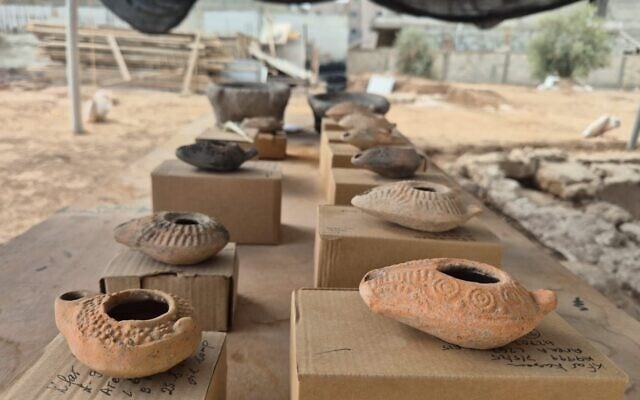
Samaritan oil lamps discovered in a 4th-century Samaritan estate uncovered in Kafr Qasim, central Israel, during an excavation by the Israel Antiquities Authority, in a discovery announced on September 2, 2025. (Yoli Schwartz/Israel Antiquities Authority)
According to Leahy Griswold, the Samaritan community flourished in the Land of Israel during the 4th century. But in the 5th and 6th centuries, the group launched several uprisings against the Byzantine Empire, which were brutally suppressed — particularly under Emperor Justinian I. These events are believed to have decimated the Samaritan population, marking the beginning of the community’s decline.
The Israel Antiquities Authority team believes that the estate, to some degree, reflects this turbulent history. Still, while its luxurious buildings were later repurposed for agricultural use, the site remained active.
“The official story is that after the revolts, Samaritans were expelled from this area,” Leahy Griswold said. “But apparently, some remained. We can see that after the revolts, the estate changed — rooms were subdivided, and an oven complex was added on the western side of the compound. Yet the cultural identity of the site stayed distinctly Samaritan.”
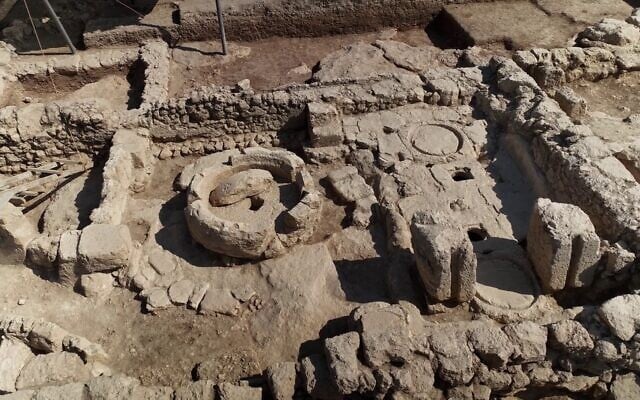
An olive press in a 4th-century Samaritan estate uncovered in Kafr Qasim, central Israel, during an excavation by the Israel Antiquities Authority, in a discovery announced on September 2, 2025. (Emil Aladjem/Israel Antiquities Authority)
The estate lies near another archaeological site: the ancient village of Kafr Ḥatta, also known as Capparetaea, which historical sources identify as the birthplace of Menander, a 1st-century Samaritan magician and successor to Simon Magus, a figure mentioned in the New Testament and one of Christianity’s earliest converts.
“Information about this settlement comes from historical texts and surveys carried out in the area,” Leahy Griswold explained. “Capparetaea is first mentioned by Eusebius and the Christian apologist Justin Martyr as the birthplace of Menander, a Samaritan magician who followed Simon Magus, regarded as the father of the Gnostic sects.”
A trove of open questions
The estate’s fate during the Samaritan revolts — and its apparent resilience in their aftermath — is only one of the puzzles raised by the site.
Among the most intriguing finds is a fragmentary Greek mosaic inscription reading “Congratulations to,” followed by a name of which only a few letters remain.
“Samaritans typically wrote in Aramaic,” Leahy Griswold noted. “The use of Greek here is highly unusual.”
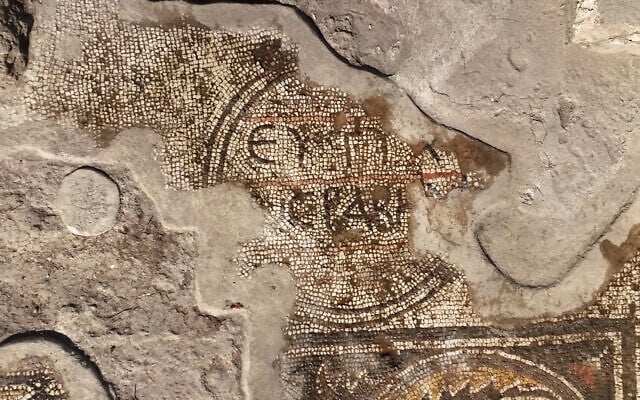
A mosaic featuring a partial Greek inscription reading “Congratulations to” in a 4th-century Samaritan estate uncovered in Kafr Qasim, central Israel, in a discovery announced by the Israel Antiquities Authority on September 2, 2025. (Emil Aladjem/Israel Antiquities Authority)
Another surprise emerged with the discovery of one of the ritual baths at the estate, which features an architectural design not previously known from this period.
“This type of ritual bath is called a ‘peripheral mikveh,’” Leahy Griswold explained. “Instead of having steps descending into the pool on just one side, the steps run along the entire perimeter. These mikvehs were common in the Second Temple period [586 BCE–70 CE], but none have been documented from the Byzantine era. That makes this example especially unique.”
While it is technically possible that the bath was built earlier and later reused, the archaeologists doubt this, since the structure appears to have been erected together with the rest of the complex, which was securely dated through coins and pottery.
The mikveh was situated along the road next to the olive press, enabling workers to purify themselves before beginning their labor.
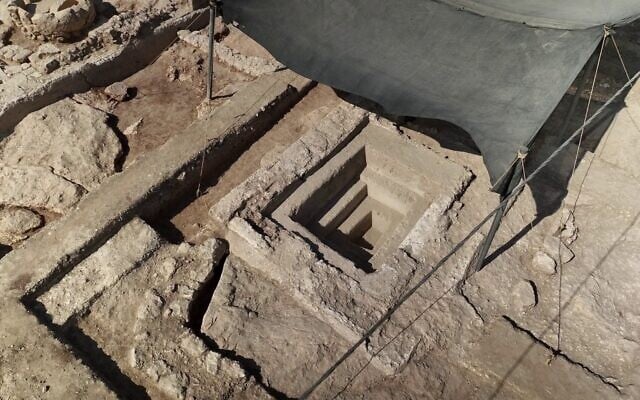
A mikveh (ritual bath) in a 4th-century Samaritan estate uncovered in Kafr Qasim, central Israel, during an excavation by the Israel Antiquities Authority, in a discovery announced on September 2, 2025. (Emil Aladjem/Israel Antiquities Authority)
A second, smaller mikveh was discovered in the courtyard of one of the buildings, which the archaeologists believe may have been a private one. The team also uncovered what appear to be the remains of two distinct pools.
“We’re not certain whether one was a ritual bath and the other a water reservoir, or if both were mikvehs, with the latter one built atop the former,” Leahy Griswold said. “Either way, this structure is remarkable because the steps of the mikveh are covered with mosaics — highly unusual, since mikvehs typically require materials that prevent water from escaping.”
The archaeologists also uncovered a rare glass spoon.
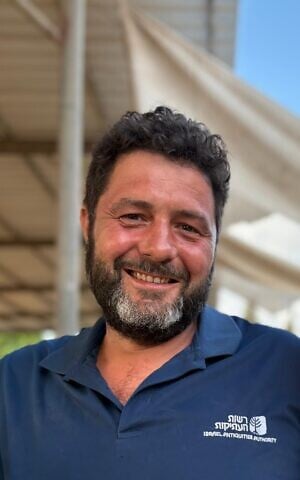
Israel Antiquities Authority archaeologist Dr. Daniel Leahy Griswold. (Courtesy)
Leahy Griswold said further study of the estate’s artifacts and structures may help clarify some of the enigmas.
“We just finished excavating yesterday [Monday],” he noted. “Now comes the process of analyzing everything we uncovered.”
The archaeologists hope to remove and relocate the mikvehs and mosaics, both to preserve them and to allow excavation of the older layers beneath. Ultimately, the area — which is privately owned — will need to be covered and developed, as is customary following salvage excavations.
The team plans to continue their work in Kafr Qasim with a new project, aiming to uncover the remains of an ancient settlement west of the estate, near the path of the Roman road.
“The main entrance of the estate was on its western side, so it makes sense that the settlement would have been located there,” Leahy Griswold said.
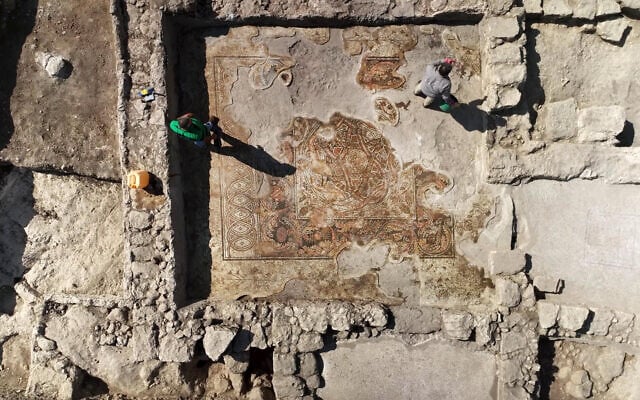
A mosaic in a 4th-century Samaritan estate uncovered in Kafr Qasim, central Israel, during an excavation by the Israel Antiquities Authority, in a discovery announced on September 2, 2025. (Emil Aladjem/Israel Antiquities Authority)
The settlement appears to have been active during the later phase of the estate’s use, a period when the olive press may have been opened for the public to press their own olives.
“The area is currently covered by Kafr Qasim’s main road, but there are plans to relocate it,” Leahy Griswold added. “Hopefully, that will allow us to excavate the site.”