
Poland is invoking Article 4 of the NATO treaty after a number of drones were shot down over its territory during an overnight Russian attack on western Ukraine, marking the first time NATO has responded to an incursion.
Prime Minister Donald Tusk told parliament Wednesday that the military recorded about 19 drone incursions overnight. He added that three or four were shot down and that a significant number had flown into Polish airspace from Belarus.
“This is not a war only for Ukrainians, this is a war, this is a confrontation that Russia has declared against the entire free world, and this must finally reach everyone without exception,” Mr. Tusk said.
Article 4 of the NATO treaty calls for member states to consult whenever “the territorial integrity, political independence or security” of a member is threatened. It has been invoked only seven previous times in the 76-year history of the alliance, most recently in 2022, when Bulgaria, the Czech Republic, Estonia, Latvia, Lithuania, Poland, Romania and Slovakia called for consultations after the start of Russia’s full-scale invasion of Ukraine.
Earlier Wednesday, the military said about a dozen drones had entered the country’s airspace. The Dutch Defence Ministry confirmed that its F-35 fighter jets based in Poland had “helped ensure safety in Polish skies tonight.”
Poland says it shot down drones that entered its airspace on Wednesday, with the NATO member calling the incursion ‘an act of aggression.’ It marks the first time a member of the alliance has fired shots in the war.
Reuters
Mr. Tusk held an emergency cabinet meeting Wednesday morning. “The first test has been passed. Procedures and plans for such incidents have been implemented. There is no reason to panic,” he told reporters after the meeting.
NATO Secretary-General Mark Rutte said Italian AWACS radar planes – as well as German Patriot anti-aircraft batteries and NATO air-to-air refuelling aircraft – had also taken part in Wednesday’s operation.
“What we have seen last night was a very successful reaction by NATO and allies, including of course Poland itself, but also the Dutch and the Italians and the Germans – everybody involved,” Mr. Rutte said, adding that a “full assessment” of the incident, including whether Russia had intended to send drones into Polish airspace, was taking place.
“Whether it was intentionally or not, it is absolutely reckless. It is absolutely dangerous,” he said.
CNN reported that U.S. Secretary of State Marco Rubio had been briefed on the violation of Polish airspace. However, there has been no response so far from Mr. Rubio or the White House.
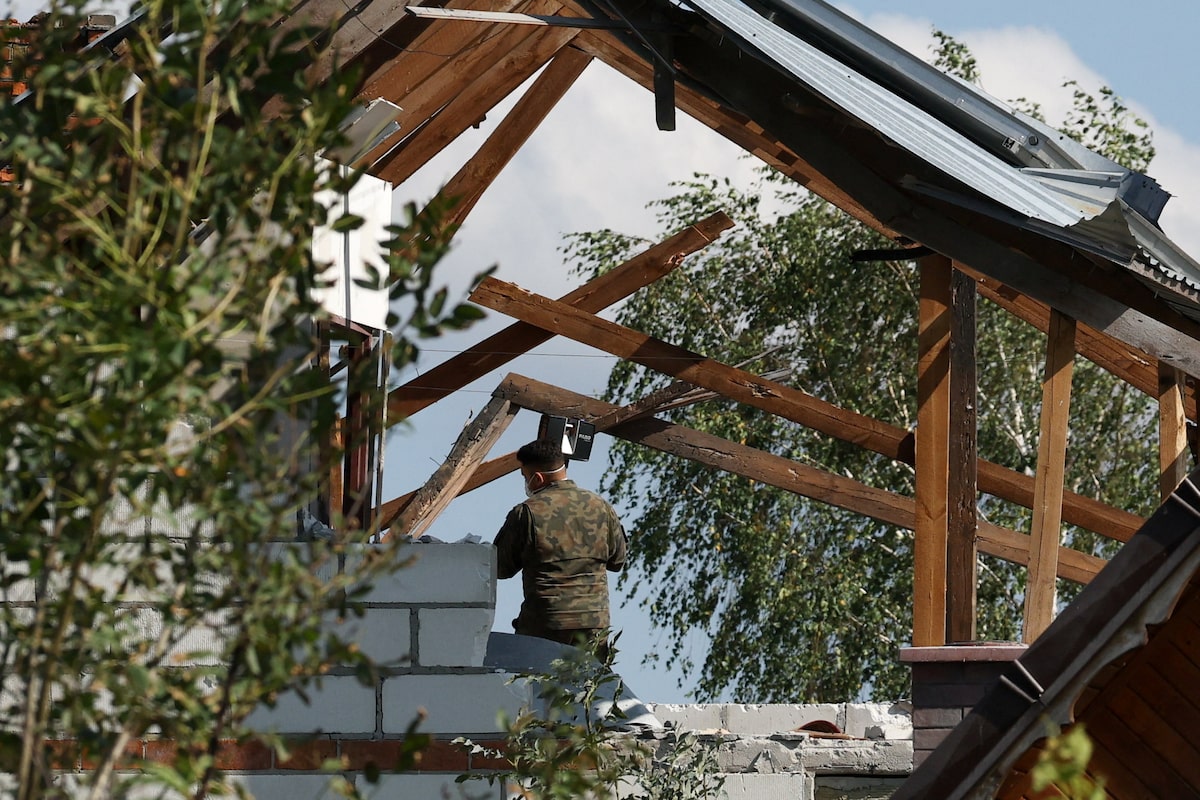
There are reports in Polish media that one drone struck the roof of a residential building in Wyryki, in eastern Poland, and that there were no injuries. The remains of another drone were found in two towns near the borders with Ukraine and Belarus.
“As a result of attack by the Russian Federation on Ukrainian territory, there was an unprecedented violation of Polish airspace by drone-type objects. This is an act of aggression that posed a real threat to the safety of our citizens,” Poland’s military said in a statement on X.
“Polish and allied assets radar-tracked several objects, and the Operational Commander of the Polish Armed Forces made decisions to neutralize those that could pose a threat. Some of the drones that entered our airspace were shot down.”
Four Polish airports, including Warsaw’s main Chopin Airport, were closed for several hours, and NATO jets were scrambled in response.
The airport in Rzeszow, a city just 100 kilometres from the border with Ukraine that has become a major hub for Western military aid to the country – and which is protected by several U.S. Patriot missile batteries – was also closed. Air-raid sirens did not sound in Rzeszow, though mobile phones buzzed with alerts that drones “have violated the borders of the Republic of Poland” and warning citizens not to approach the crash sites.
There were also calls for Poland and its allies to close their airspaces to all Russian air traffic, which would complicate civilian flights to Kaliningrad, the Russian exclave wedged between Poland, Lithuania and the Baltic Sea.
“We want a strong strategic signal sent to Russia, though this does not rule out responding bilaterally as well,” said Adam Eberhardt, deputy head of the Centre for East European Studies at the University of Warsaw. “I think we will request more allied air patrols along the eastern flank and reinforcement of missile and drone defences.”
“A Russian drone attack on Poland justifies a joint and united response from the alliance – for example, closing NATO airspace to all aircraft travelling to and from airports in Russia, as well as suspending navigational services for flights to Kaliningrad,” said Slawomir Debski, a visiting professor of strategy and international relations at the College of Europe in Natolin, Poland. “Such measures can be agreed upon by the alliance precisely on the basis of Article 4.”
The incursion has caused alarm in capitals across Europe, where there have long been fears of an escalation of Russia’s invasion of Ukraine.
“The Russian war of aggression against Ukraine poses a threat to the security of all of Europe,” said Swedish Prime Minister Ulf Kristersson. “Poland has every right to defend its airspace. We give our full support to Poland, as a NATO ally and EU member. Sweden and Poland stand united in our support for Ukraine.”
British Prime Minister Keir Starmer called the drone incursions an “egregious and unprecedented violation of Polish and NATO airspace.”
“This was an extremely reckless move by Russia and only serves to remind us of President Putin’s blatant disregard for peace, and the constant bombardment innocent Ukrainians face every day,” he said in a statement.
Lithuania’s Foreign Affairs Minister, Kęstutis Budrys, expressed his country’s solidarity with Poland and called for tougher sanctions against Russia. “The reality is clear: As long as Putin is allowed to continue waging his bloody war against Ukraine, no country – not even within NATO – is safe. Sanctions must strike at the heart of the Kremlin’s war economy. Putin will not stop unless we stop him,” Mr. Budrys said on X.
Ukrainian President Volodymyr Zelensky said that at least eight Russian drones had targeted Poland during Wednesday’s raid, which involved some 415 drones and more than 40 cruise and ballistic missiles. One person was killed in Ukraine and three others were reported injured so far, he added.
The attack was “an extremely dangerous precedent for Europe,” Mr. Zelensky added. “Increasing evidence indicates that this movement, this direction of strike, was no accident. There have been previous incidents of individual Russian drones crossing the border and travelling a short distance into neighbouring countries. But this time, we are recording a much larger scale and deliberate targeting.”
The European Union’s top diplomat, Kaja Kallas, also called for a tough response from Western allies. “Last night in Poland, we saw the most serious European airspace violation by Russia since the war began, and indications suggest it was intentional, not accidental,” she wrote on X. “Russia’s war is escalating, not ending. We must raise the cost on Moscow, strengthen support for Ukraine, and invest in Europe’s defence.”
NATO’s North Atlantic Council, the alliance’s main decision-making body, was holding a regular meeting Wednesday morning and would discuss how to respond to the drone incursion. “Numerous drones entered Polish airspace overnight and were met with Polish and NATO air defences,” NATO spokesperson Allison Hart said on X. Mr. Rutte was consulting closely with Polish officials, she added.
Pavel Muravyeika, the Deputy Defence Minister of Belarus, said Wednesday that the drones entered Polish airspace accidentally, after their navigation systems were jammed.
A Russian diplomat in Poland denied Russian forces deliberately targeted the country. “We consider the accusations groundless. No evidence has been presented that these drones are of Russian origin,” Andrei Ordash told Russian state media outlet RIA Novosti.