

Housing has been much in the headlines recently, with a few Auckland Councillors fighting tooth and nail to prevent more of it in their own neighbourhoods and instead push it out to other parts of the city. That approach failed yesterday, with a committee of council as a whole voting to accept a new Plan Change 120, to replace the existing Plan Change 78.
At an extraordinary policy and planning meeting on Wednesday, the councillors, mayor and two houkara (independent Māori statutory board) members, voted 18-5 in favour of significant intensification to parts of Auckland.
Those who voted against it were Christine Fletcher, Mike Lee, Ken Turner, Wayne Walker and John Watson. Had there been a majority against it, Plan Change 78 (PC78), which enabled three-story buildings in flood zone areas would have continued into law.
Fletcher’s amendment to delay a decision for three months to have more time for consultation was voted down.
Resource Management Act Reform Minister Chris Bishop will be formally notified and a submission period will run from November 3 to December 19. There will be hearings following that and it will be wrapped up in 18 months’ time.
The replacement plan, which will be known as Plan Change 120, continues to enable up to 2 million homes to be built in the city. There will be zoning for intensification in some suburbs, along rail corridors and by train and bus stations. It also reduces more building in flood plains.
So what was at stake?
In a nutshell, the new plan aims for the same capacity for housing, but focuses new homes around town centres, major train stations (maximising the CRL investment), and key rapid transit routes. In other words, it puts new dwellings where it makes most sense, because the infrastructure and amenities are already right there. It also allows for “down-zoning”, which is particularly important in areas of flood risk or coastal erosion.
This is in contrast to the pre-existing PC78, which allowed three 3-storey dwellings as of right across most of the isthmus, and didn’t allow for down-zoning in areas deemed unsuitable (or downright dangerous) for housing.
And yes, like PC78, the new plan works towards and within a projected capacity of a total two million homes for Auckland.
This doesn’t mean building two million brand new houses or apartments, because that would be silly.
It doesn’t even mean the city must (or can) have two million total dwellings.
It’s an enabling capacity – which is deliberately larger than the desired outcome to allow for choice and flexibility. It’s the same as how having 24 hours in a day (or two dozen items on a menu) gives you the ability to do (or eat) what and when works best for you.
Here’s a helpful diagram that has been shown to Councillors, which should help calm the farm.
Further to the 2 million figure – here’s a diagram that hopefully helps people understand why it is so high – this is from a presentation that councillors are receiving now, and have been shown this diagram in the past.
— Julie Fairey (she/her) (@juliefairey.bsky.social) 2025-09-17T00:13:30.295Z
And here’s another way of looking at it (although this is less technically accurate, as logically you can’t build anything that’s not enabled by the plan:
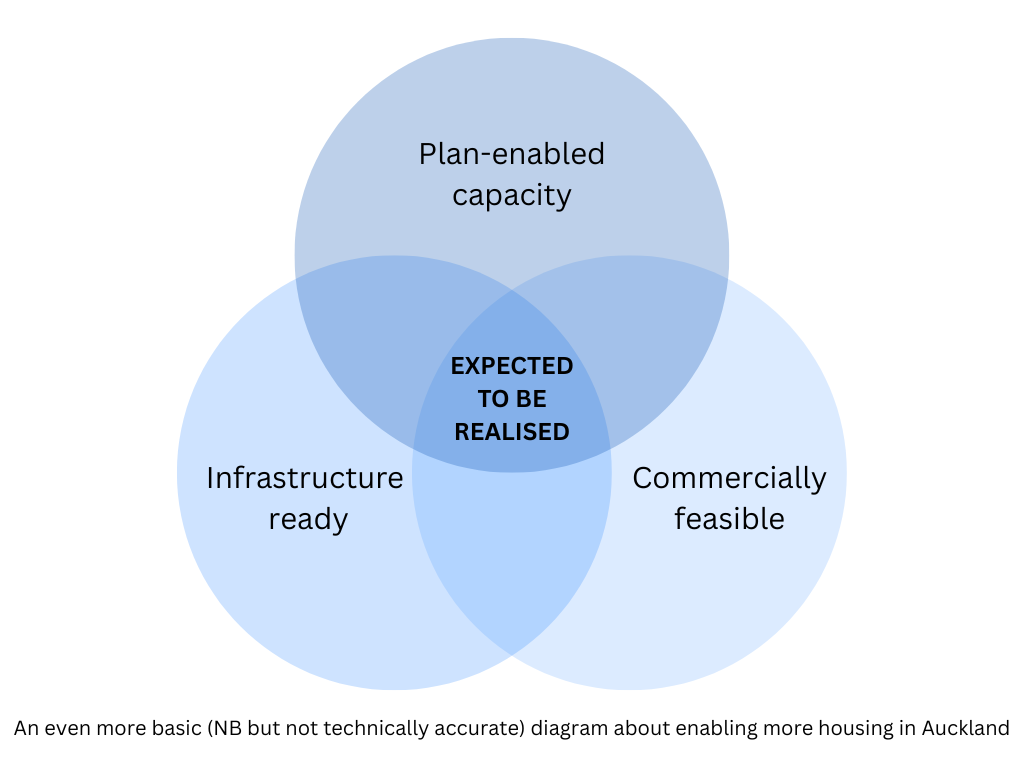 So it’s frankly shocking that some elected leaders – including old hands with track records of shaping Auckland more wisely, who’ve been around the Council table long enough to know better – have persisted in muddying this point and propagating misunderstandings, in a way that seems calculated to scare people.
We deserve much better than this kind of wilful obfuscation.
And yesterday we got better, in the hands of the chair of Policy and Planning Committee, Councillor Richard Hills, who – assisted by his deputy chair, outgoing Councillor Angela Dalton, and others who understood the assignment – did an excellent job of steering an important meeting towards a successful conclusion.
Live-blogs of the blow-by-blow
If you’re looking for a play by play of how it all went down, Simon Wilson live-blogged proceedings for the NZ Herald, as did Jonathan Killick for The Post and the inimicable Hayden Donnell for The Spinoff. And on the socials, Connor simultaneously live tweeted and bleeted throughout, as immortalised by Hayden at the end of his coverage:
And we are done here
The meeting is over. Councillors are filing out. Greater Auckland blogger and Waitematā local board candidate Connor Sharp is slowly unfurling his limbs after frantically live tweeting every exchange from his position in the public gallery.
The politics of more housing: how did we get to this point?
The now replaced PC78 was the council’s response to multiple pieces of bipartisan-supported central government policy aimed at allowing more density near major centres/transit stations, and permitting townhouses throughout the city’s suburbs.
Auckland Council fought and sought to undermine that central government direction at every turn – and the tragic and shocking 2023 floods gave them the best opportunity of a reset, given the natural desire to prevent new housing in flood and hazard-sensitive parts of the city.
(This was a point Cr. Hills emphasised in yesterday’s meeting, noting that it was now 971 days since the floods and the city still had no mechanism to prevent new builds in flood-prone areas. Cr Shane Henderson reiterated this, saying that resisting the new plan would cause insult to Aucklanders still impacted by the legacy of those floods, and injury to future Aucklanders.)
But that resistance couldn’t go on indefinitely. With agreements between the Mayor and Minister Bishop to allow even more housing near rail stations in order to make the most of the $6bn City Rail Link investment, the Minister allowed Auckland to update its plans – but only on the condition that the new Plan Change enabled the same overall capacity as the one it would replace.
Last month, Council revealed their replacement plan, and voted to initiate consultation with local boards and mana whenua before the decision on whether to proceed with the new version (which would itself be subject to full public consultation). At the time, Scott took a look at the good, bad and ugly of the proposed replacement plan in this great post.
Note that Councillors Mike Lee and John Watson were the only ones who voted against even that initial stage.
Perhaps the loudest opponent all along has been Councillor Christine Fletcher, who has numerous times over the last few years compared the prospect of more housing to various different kinds of violent assault. What is it with the hyperbole around housing?
The new plan does indeed allow more housing in parts of her ward – in large part because these are the areas with some of the best public transport connections in the city, especially once CRL opens.
It’s also crucial to point out that when drafting PC78, council had left changes to much of the central isthmus out – creating a giant black hole in the planning map – on the grounds that they were waiting to see what happened with light rail. This was always a weak justification, and it has likely contributed to making the change in this new plan change look more dramatic than it would have been.
Below is a map of PC120’s implications for Fletcher’s rohe, the Albert-Eden area. For those who don’t speak planning map, the darker orange blocks are where apartments will be allowed under the new PC120. Note there’s also down-zoning compared to PC78, e.g. across much of Point Chevalier.

Highlights and lowlights of the debate
Hayden Donnell’s coverage in the Spinoff of key moments from the meeting captured some of the peak absurdity from those opposed to the plan. Here we have Cr. Maurice Williamson, advancing some outrageous metaphors:
But then, a controversial moment. “We’ve been almost given the choice between the firing squad and a lethal injection,” says Williamson. There’s a hubbub around the council table. It’s not the first time councillors have used questionable metaphors when opposing dense housing, with Albert-Eden-Puketāpapa councillor Christine Fletcher comparing the townhouse law to “gang rape” in a meeting four years ago. “I’m asking for the violent language to stop when we talk about housing,” says committee chair Richard Hills. “It’s a metaphor,” grouses Williamson, though he agrees to amend to “two ghastly options”.
At one point Cr. Mike Lee suggested council corruption:
Waitematā’s Mike Lee has hinted darkly about developers putting pressure on council staff to allow more apartments. “We all know in this building that the council senior management comes under intense pressure from the property market and developers. Some people call it hammer sessions,” he says. He wants to know how much upzoning, particularly in the “Grammar zones”, is motivated by developer pressure.
“Are you saying staff are being pressured by developers? Is that what you’re saying? Because I think that’s really inappropriate,” says Hills.
“Don’t talk about the war. Don’t talk about special interests putting pressure on the council,” retorts Lee.
And a few hours later, he invoked the Byzantine empire for reasons best known to himself:
Waitematā councillor Mike Lee is speaking against today’s proposed plan change. Or at least I think he is. He’s talking about the Byzantine emperor Theophiles, who reigned from 829 to 842AD. “The emperor was processing from one end of Constantinople to another as he did every week and he was stopped by an elderly widow who complained to the emperor that a relation, I think it was his brother-in-law, was expanding the palace so much so to block all her light,” he says. “And the emperor responded by having his brother-in-law tear down the palace. And I think we should take an example from that.”
It’s somewhat ironic he would invoke the Byzantines, given it’s a term that famously describes a system or process that’s excessively complicated, convoluted, often secretive and typically involving a vast amount of administrative detail. Does Mike Lee want more of that? Although, if anything, it perfectly describes how the council have long tried to stop housing in the inner suburbs over many decades.
Speaking of Byzantine, as mentioned up top Cr. Christine Fletcher tried to pass an amendment to extend consultation for longer than planned, which Mike Lee said was needed “to drum up opposition to the plan change“. That amendment was voted down 15-8.
Another unusual metaphor (captured by Jonathan Killick for The Post) came from outgoing Councillor Chris Darby:
Councillor Chris Darby says he recalls the Unitary Plan being called “civil war”.
“Now we’ve got this served to us. We’ve got a choice of dog breeds and which one is going to bite us the hardest and the longest?
“Which one will give us rabies?”
There were some good defences of the plan too, including from Chair of the Policy and Planning Committee, Richard Hills who provided clear and strong guidance across the lengthy meeting. (This and the next two snippets are from Hayden Donnell’s Spinoff coverage):
Hills wants to counter some of the strongest objections to the plan. People say it will enable housing in places with inadequate infrastructure. Actually those places have been downzoned, and the places where apartments are enabled have some of the best infrastructure in the city, he argues. “This actually gives us the future where we accept that more people will live along our bus stations, live along our train stations, live along our metro centres,” he says. “We do not get the choice to not do anything. We do not get to thumb our nose at the government.”
Cr. Shane Henderson, who supported the plan, also critiqued it for the right reasons:
One of the strongest pro-housing voices on council, Waitākere councillor Shane Henderson, has rejected arguments against the plan. On it allegedly helping the already privileged, he says enabling more housing supply stablises, or sometimes reduces, housing prices. In response to infrastructure concerns, he says we know the central isthmus can take more development, and that its wastewater and stormwater systems are equipped to handle intensification. “When we allow more houses in the best places for them, everyone along the spectrum benefits.”
But he does have some problems with the new plan; its just that they’re pretty much the opposite to those of the people speaking against it. He doesn’t accept that we should be keeping 73% of the special character areas established under the 2016 Auckland unitary plan. “Special character areas don’t protect heritage. The category is a council invention that sets up wealthy areas of the central city to operate as gated communities,” he says.
And Cr. Julie Fairey summed up the positives thus, towards the end of the day:
It’s better for emissions reductions and affordability, she says. “More homes next to transport routes where people don’t have to have a car will significantly reduce the cost of transport for them.” Opponents of the plan paint themselves as being concerned about infrastructure and rising council debt. But they’re essentially advocating for sprawl, which is more expensive to service with infrastructure, Fairey says. “And infrastructure is funded with council debt, so join up the lines.”
Who voted which way
In the end, as noted earlier, only five councillors voted to oppose the new plan:
Christine FletcherMike LeeKen TurnerWayne WalkerJohn Watson
It’s also worth recording that the following councillors supported Cr. Fletcher’s attempted amendment to delay the plan, which would have likely caused significant legal issues with central government:
Daniel NewmanSharon StewartMaurice Williamson
And here’s who voted to proceed with the plan change:
Mayor Wayne BrownDeputy Mayor Desley SimpsonAndy BakerJosephine BartleyAngela DaltonChris DarbyJulie FaireyAlf FilipainaLotu FuliShane HendersonRichard HillsKerrin LeoniDaniel NewmanGreg SayersSharon StewartMaurice Williamsonand Edward Ashby and Tau Henare, Houkura members (formerly Independent Statutory Māori Board)What happens next?
This new plan will go out to public consultation later this year, and then start through an Independent Hearings Panel process, similar to those for PC78, and the Auckland Unitary Plan before that. So it will still be about 18 months before the plan is fully operational, and we’re bound to see a few more twists and turns before then.
Hopefully the Council will put the maps onto an interactive viewer soon. For now, there are PDF versions of the Local Board level here.
If housing’s your thing, come and hang out!
A special note for those who’ve read all the way to the end: Scott/ Scoot is hosting YIMBY drinks this evening, Thursday 25 September, from 5.15pm onwards at Glass Goose (near the Sky Tower).
The special guest is Jonathan O’Brien from YIMBY Melbourne. See you there?
This post, like all our work, is brought to you by the Greater Auckland crew and made possible by generous donations from our readers and fans. If you’d like to support our work, you can join our circle of supporters here, or support us on Substack.
Share this